• Skip to main content
  • Skip to primary sidebar

Kelly Casanova Weaving Lessons

  • Hi! I’m Kelly!
    • Affiliates Disclosure
  • Online Weaving School Class Index
    • Common account issues
    • Common technical issues
    • What do I get with a membership?
  • New to rigid heddle weaving? Start here!
    • Never heard of the rigid heddle loom?
    • How to weave neat edges on the rigid heddle loom
    • Rigid heddle weaving
    • Rigid Heddle Weaving Patterns
  • Patterns
  • Subscribe

rigid heddle weaving patterns

How to weave Snowmen on your rigid heddle loom

by Kelly 10 Comments

Snowmen are not something you might naturally think of when wondering what to weave next on your rigid heddle loom, but I love any excuse to make pictures on my loom, especially if they are as cute as these little snowmen guys are!
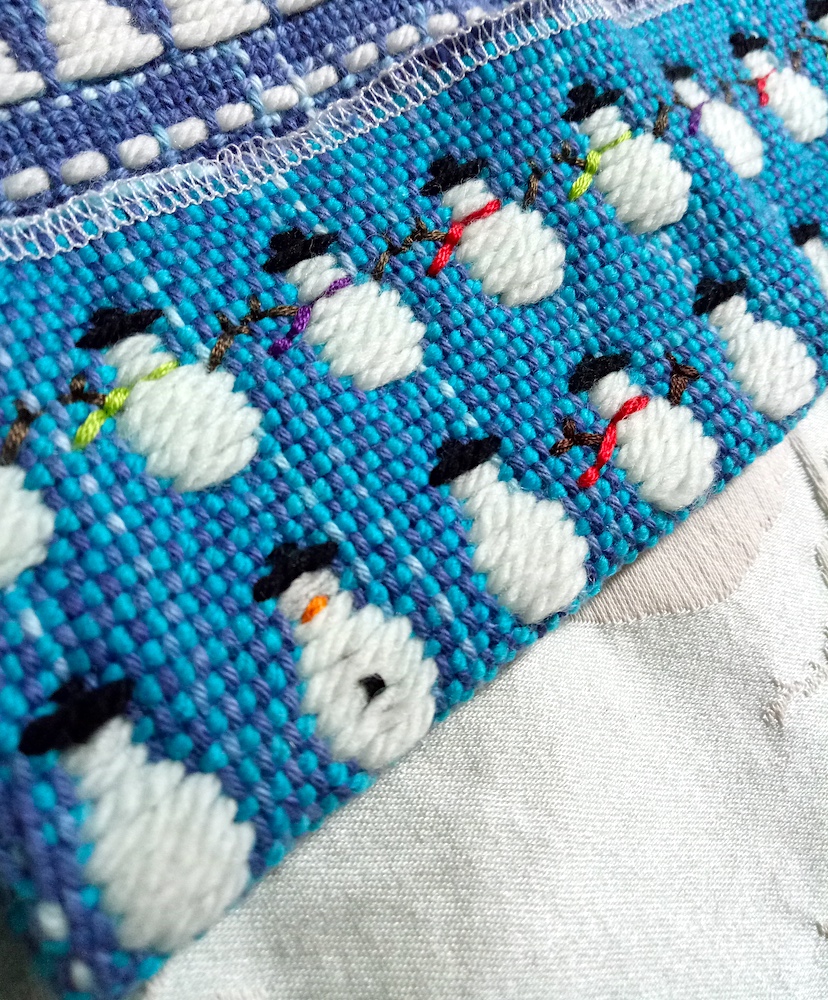
Weaving snowmen on your rigid heddle loom may not be as difficult as you think. We employ a type of overshot technique to create floats. Depending on the length of each float, we can then arrange them to make pictures. We warp the loom as we normally do for plain weave.

Overshot usually uses a thicker weft for the patterning (or floats) and a thinner, contrasting weft for the background (plain weave, commonly known as “tabby” when used in this way).

*This post contains affiliate links.

The weft floats do not become incorporated into the fabric, they literally float on top, which is why we use tabby in between pattern rows to tie the whole thing down and create a stable fabric. It also gives that lovely, slightly 3D effect of the pattern or picture being slightly raised.
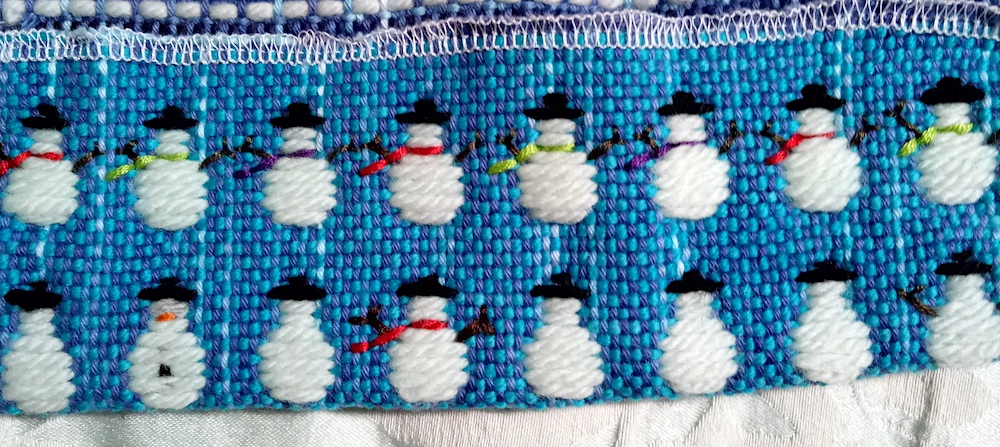
Because of the varying length in floats, there is something you need to keep in mind when doing this kind of weaving. Quite often, and particularly with a thicker yarn like I’ve used for this sample, the floats at the back of the work will be long. This might make the piece unsuitable for some uses. For example, a kitchen towel with long floats on the back is not ideal. The floats will catch on things and likely become a bit ratty and not neat looking over time. That is the other consideration – the back does not always look attractive and you may not want it on show. In my sample below, you can see the added untidiness of my having embroidered on details like the scarves.
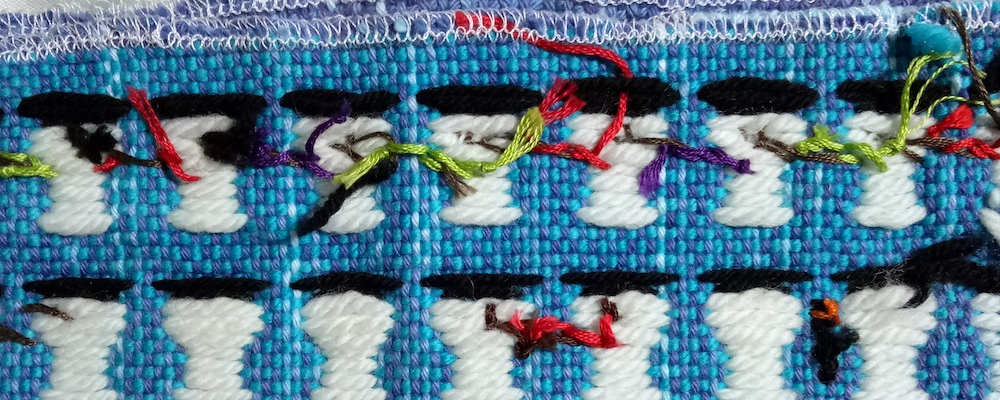
The back of the sample

A way around this issue is to plan to use this technique in a pattern where the back of the work will not show. Some ideas are notebook or journal covers, a table centrepiece or runner where you intend to sew a backing to the piece, a cute Christmas wall hanging and so on.

Here is what you will need to weave a sample like this one:

A rigid heddle loom (I used my 24″ but a Sampleit size is fine if you just want a small sample)

10 dent reed

A pick up stick

A knitting needle is handy but not essential

Yarns-

There are no set yarns for this project, but I will share what worked well for me and give suggestions for possible alternatives.

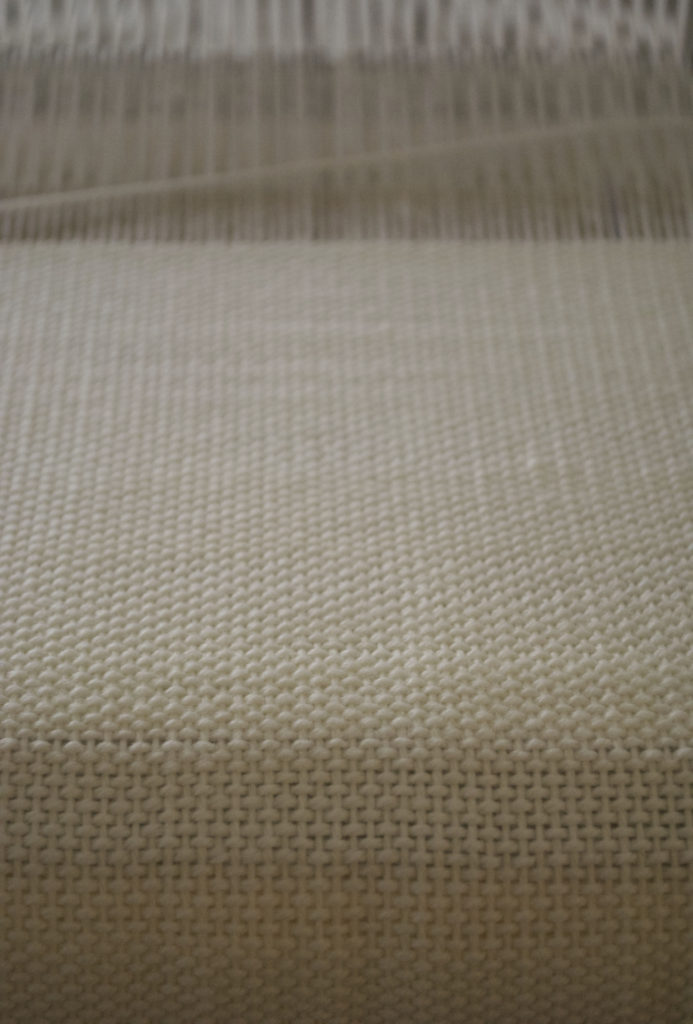
For the warp I used a fingering weight (Australian 4 ply) cotton in a hand dyed medium to dark blue. Rug warping cotton would work fine.

My tabby weft (background weft) was a lighter but strong coloured light worsted/dk weight (Australian 8 ply) in wool.

For the pattern weft, I used a cream coloured aran weight (Australian 10ply) in wool.

For the little hats, I used some black fingering weight wool – you don’t need very much of that.

I love to use wool, particularly for the patterning in this type of weaving because it works so well. Because it has that lovely fluff and bounciness, it fills in any gaps between pattern wefts and makes the design look full. You will notice that my pattern weft is only slightly thicker than my tabby weft, but the pattern weft still stands out due to it’s loftiness.
The embroidered details are what really bring these little snowmen to life. Stick arms, scarves, eyes, carrot noses, buttons down the front – the amount of detail is up to you. You don’t need to be a great embroiderer as the details are all just worked in simple straight stitches. For the scarves, to give them that really nice shiny look, I used Bambu 7. This yarn can be quite difficult to obtain, so here are some alternatives:

5/2 bamboo weaving yarn

Pure Bamboo yarn

DMC Embroidery floss (my favourite brand)

Anchor Embroidery floss

If you decide to use embroidery floss, don’t separate the strands, use all 6 of them for just the right snowman thickness.

If you would like to weave some snowmen of your own, here is a printable PDF that gives you the weaving sequences and details:

Snowmen-on-a-rhlDownload

You will also want to watch and follow along with the instructional video to see the weaving in action:

I hope you enjoyed this tutorial! Let me know if you weave some little snowmen of your own, and as always, leave any comments or questions underneath, I love to hear from you!

Until next time…

Happy Weaving!
Filed Under: Free Pattern, Free tutorial, Rigid heddle weaving, Tutorials, Weaving Tagged With: rigid heddle weaving, rigid heddle weaving patterns, rigid heddle weaving tutorial, snowmen

Rigid Heddle Weaving Patterns for Beginners: Simple Projects & Techniques

by Kelly 26 Comments

Are you a new weaver looking for rigid heddle weaving patterns for beginners — beyond just plain weave? You’re in the right place!

Rigid heddle looms are often thought of as “just for plain weave,” but that’s only the beginning. With a few simple tools and techniques, you can create stunning patterns—even as a beginner.

In this post, I’ll show you several easy weaving patterns and enhancements that go beyond plain weave, perfect for rigid heddle beginners who are ready to try something new.


Start with the Basics – Plain Weave

  • Plain weave is the foundation of rigid heddle weaving—and the best place to start if you’re new.
  • To weave plain weave:
    • Thread one slot and one hole, alternating across your warp
    • Use the heddle in the up and down positions while weaving
    • That’s it—you’re weaving!

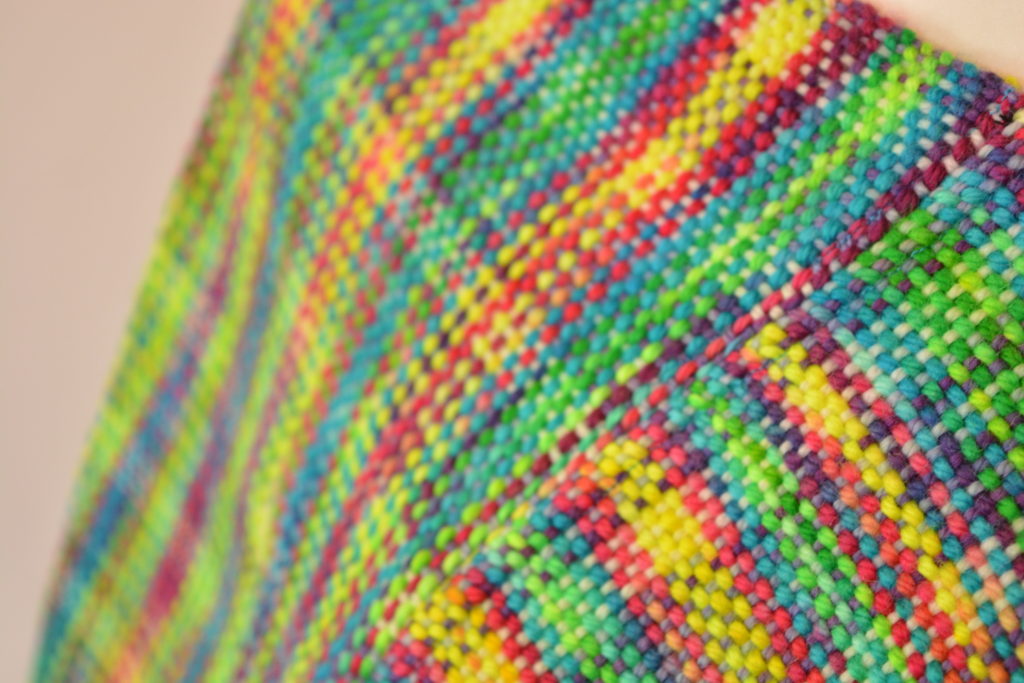
Make It Pop: Use Variegated Yarn

Want your plain weave to look more complex without changing the structure? Use a variegated yarn!

You can:

  • Warp with variegated yarn and weave with a solid color
  • Warp with a solid color and weave with variegated yarn

The results are always eye-catching and can resemble intricate patterns as colors shift and intermingle.

Here are some great beginner-friendly variegated yarns:

  • Sugar’n Cream Ombre Cotton
  • Lion Brand Landscapes
  • Red Heart Jellybeans

💡 Tip: Hand-dyed yarns also give beautiful, one-of-a-kind results!

Check out my free The Heart Scarf Project to see how variegated yarn can be used for a stand out piece!

Try Clasped Weft: Easy, Creative, Colorful

Clasped weft is a fun, beginner-friendly way to make bold, graphic designs—while still using plain weave!

It works beautifully with:

  • One solid yarn + one variegated yarn
  • Two (or more) contrasting colors

👉 Follow this clasped weft step by step tutorial

Once you get the hang of it, try:

  • 3-color clasped weft technique
  • 4-color clasped weft for dramatic effects
  • You can even use the clasped weft technique to create shapes!

🧵 Clasped weft is a great way to create scarves, wall hangings, and art pieces with personality.

Add Pattern with Pick-Up Sticks

Ready to go beyond plain weave? Pick-up sticks are the easiest way to start weaving actual patterns on your rigid heddle loom.

What are pick-up sticks?
They’re simple flat wooden tools that let you “pick up” warp threads and create new shed patterns—without needing a multi-shaft loom.

Why Beginners Love Pick-Up Sticks:

✅ They’re inexpensive
✅ Easy to use (no complex setup)
✅ Add texture, lace, and patterns to your projects

Learn more:

  • 👉 Watch this video tutorial on pick-up sticks
  • 👉 Read my detailed guide to using pick-up sticks

Explore Even More: Overshot-Style Patterns with Pick-Up Sticks

There’s just so much you can do with one, two, or even more pick-up sticks! Most weavers start by picking up warp threads behind the heddle, but did you know you can also pick up in front of the heddle to create a kind of overshot pattern?

This technique allows your pattern to float on top of the background weave—rather than becoming part of it—making for a dramatic, dimensional look.

If you play around with the spacing of floats and use colour changes creatively, you can design all sorts of exciting patterns!

🎄 Christmas patterns are always a favourite, so if you’re curious, here are a couple of the most-loved videos on this overshot style:

👉 Overshot-Style Snowmen

👉 Overshot-Style Reindeer

What Should You Try First?

Here’s a quick beginner weaving path to get you started:

  1. Plain weave scarf with a solid color warp + variegated weft
  2. Clasped weft sampler with two bold yarns
  3. Simple pick-up stick pattern on a placemat or table runner

And most importantly—have fun experimenting!

So Many Patterns, So Little Time!

This post is just a brief overview of the many pattern possibilities on your rigid heddle loom. There’s so much more you can explore!

I haven’t even touched on Colour and Weave—that deserves its own post entirely. You can read more about that here: 👉 Read my Colour and Weave article

Curious about plaid? I’ve also written about that and included free drafts for you to try: 👉 Get my plaid weaving post + drafts here

Want to dive into even more pattern ideas? I’ve got you covered in this deep-dive post where I share techniques like:

  • Doubled weft
  • Pick-up rows
  • Staggered pick-up
  • Dots and butterflies
    👉 Explore even more pattern techniques here

This post contains affiliate links. Please see my disclosure policy for more details.

Where to Go Next

If you’ve been weaving plain weave and wondering “what’s next?”, I hope this post has sparked some fresh ideas!

To take your weaving to the next level, I highly recommend my beginner’s class:
🎓 From Woe to Go — it’s a comprehensive, step-by-step course that helps you confidently get started on your rigid heddle loom.

If love to weave scarves, you will definitely want to check out my Rigid Heddle Beginner Scarf Bundle – this is 5 of my best selling digital download scarf patterns for one low price!

Perhaps you’re looking for some actual project ideas for your next rigid heddle weaving session? Check out this article for 5 Easy Beginner Rigid Heddle Projects!

Are you on my mailing list? I would love to have you! Sign up here and receive 10% off your next Online Weaving School purchase 👇

Sign up here!

Until next time…

Happy Weaving!

Filed Under: Rigid heddle weaving, Weaving Tagged With: rigid heddle weaving, rigid heddle weaving patterns

  • « Go to Previous Page
  • Page 1
  • Page 2

Primary Sidebar

About Kelly Casanova

Join Kindred Creatives!

Hand crafted boat shuttles

Categories

Archives

Meta

  • Log in
  • Entries feed
  • Comments feed
  • WordPress.org

Copyright © 2026 Kelly Casanova Weaving Lessons on the Foodie Pro Theme