• Skip to main content
  • Skip to primary sidebar

Kelly Casanova Weaving Lessons

  • Hi! I’m Kelly!
    • Disclosure
  • Online Weaving School Class Index
    • Common account issues
    • Common technical issues
    • What do I get with a membership?
  • New to rigid heddle weaving? Start here!
    • Never heard of the rigid heddle loom?
    • How to weave neat edges on the rigid heddle loom
    • Rigid heddle weaving
    • Rigid Heddle Weaving Patterns
  • Patterns
  • Subscribe

Selling

7 Profitable Weaving Projects to Sell (Make Money Weaving!)

by Kelly Leave a Comment

Weaving is a rewarding craft, but did you know you can also turn it into a profitable business? Whether you’re a beginner or an experienced weaver, there’s a strong market for handwoven textiles, from scarves to home décor.

In this guide, I’ll walk you through seven profitable weaving projects that sell well online, at craft fairs, and in local shops. Plus, I’ll share tips on pricing, marketing, and where to sell your handmade woven goods.

If you’re looking for weaving projects that make money, you’re in the right place!

1. Handwoven Scarves (A Timeless Bestseller!

Why It Sells:

Handwoven scarves are a staple in the handmade market. They are stylish, functional, and appeal to a wide audience, making them one of the best weaving projects to sell.

Best Materials:

  • Cotton or bamboo for lightweight, breathable scarves.
  • Merino wool or alpaca for cozy, winter-friendly options.
  • Hand-dyed or variegated yarns add a unique touch.
  • Tencel, bamboo, cashmere and silk for luxury scarves.

Pricing Tip:

Handwoven scarves can range anywhere from $50–$500 online, depending on fiber quality and weave complexity.

Marketing Idea:

Create seasonal collections—lightweight scarves for spring/summer and wool blends for fall/winter.

👉 Where to Sell: Shopify, Etsy, Instagram, local craft fairs, fiber festivals.

2. Woven Wall Hangings (Trendy & High-Value)

Why It Sells:

The demand for woven wall art has skyrocketed, especially with the popularity of boho home décor. These pieces allow weavers to express creativity while attracting home décor enthusiasts who are looking to invest in some textile art.

Best Styles to Sell:

  • Minimalist & neutral tones for a modern aesthetic.
  • Bold, textured pieces featuring fringe and mixed fibers.
  • Custom commissions for personalized home décor.

Pricing Tip:

Pricing varies based on size, but small pieces can start at $50, while larger custom wall hangings sell for $200+.

Marketing Idea:

Use Instagram Reels and Pinterest to show your weaving process—people love seeing handmade items in progress!

👉 Where to Sell: Shopify, Etsy, Instagram, interior design boutiques, online art markets.

3. Mug Rugs & Coasters (Small but Mighty!)

Why It Sells:

Mug rugs and woven coasters are perfect for customers looking for affordable, handmade gifts. They’re small, quick to make, and easy to ship, making them an excellent low-cost weaving project to sell.

Best Fibers:

  • Cotton for durability and easy washing.
  • Linen for a high-end, natural look.

Pricing Tip:

Sell single mug rugs for $10 – $15 or in sets of four for $40 – $50.

Marketing Idea:

Bundle your coasters with matching table runners or coffee gift sets for upselling.

👉 Where to Sell: Shopify, Etsy, gift shops, craft fairs, farmers’ markets.

4. Woven Tote Bags (Sustainable & Stylish)

Why It Sells:

Handwoven tote bags attract eco-conscious shoppers who love reusable, stylish bags. They are perfect for daily use, shopping, or even as beach bags.

Best Materials:

  • Thick cotton or hemp for durability.
  • Upcycled fabric strips for a unique, sustainable touch.
  • Wool (felted or unfelted)

Pricing Tip:

Handwoven totes sell for $40–$120, depending on size and materials.

Marketing Idea:

Offer custom colors or styles to make your totes stand out.

👉 Where to Sell: Shopify, Etsy, local boutiques, zero-waste stores, farmers’ markets.

5. Table Runners & Placemats (Handwoven Home Décor)

Why It Sells:

Handwoven table runners and placemats elevate any dining space, making them popular as wedding gifts or holiday décor.

Best Fibers:

  • Linen or cottolin for a classic, high-end look.
  • Cotton blends for durability.

Pricing Tip:

Placemats sell well in sets ($50–$100), while table runners range from $60–$200.

Marketing Idea:

Create seasonal collections (holiday, spring, rustic farmhouse) for repeat customers.

👉 Where to Sell: Shopify, Etsy, home décor stores, artisan markets.

6. Baby Blankets & Heirloom Textiles (Cherished Keepsakes)

Why It Sells:

Parents love one-of-a-kind, handwoven baby blankets as sentimental gifts. Family heirlooms are also popular. Many families have either full or fragments of hand woven coverlet and blankets from the past to pass down through the generations!

Best Fibers:

  • Organic cotton for breathability (very important for babies!)
  • Soft wool or bamboo for warmth.
  • A combination of cotton and wool, as you will often find in traditional overshot coverlets and blankets.

Pricing Tip:

Handwoven baby blankets range from $80 up to $300, depending on size and material.

Marketing Idea:

Offer personalized details for a higher price point.

👉 Where to Sell: Shopify, Etsy, baby boutiques, craft fairs.

7. Woven Keychains & Accessories (Perfect for Craft Fairs!)

Why It Sells:

Small, affordable, and easy to make in batches, woven keychains and mini accessories like small purses are great impulse buys.

Best Materials:

  • Cotton, cottolin, tencel, bamboo for durability.
  • Hand-dyed fibers for a unique touch.

Pricing Tip:

Handwoven keychains sell for $8–$20, making them great for bulk sales.

Marketing Idea:

Sell keychains as part of a bundle with other woven goods to increase order value.

👉 Where to Sell: Shopify, Craft fairs, Etsy, Instagram, gift shops.

How to Sell Your Woven Creations Successfully

  • Know Your Costs:
  • Factor in materials, time, and overhead. This is so important – you have to know that you’re actually able to make money to have a viable business.
  • Know What The People Want:
  • Sounds pretty common sense, right? Give potential customers what they’re looking for and you will make sales. We all love to make what we make, but is it going to sell?
  • Sell in the Right Places: Shopify, Etsy, craft fairs, social media shops, or local boutiques. Don’t forget word of mouth and starting out by selling to family and friends too, this teaches valuable lessons!
  • Use Social Media: Share your weaving process on Pinterest and Instagram to attract buyers.

Start Selling Your Weaving Projects Today!

If you’ve been wondering how to make money weaving, these seven projects are a great starting point! Experiment with styles, market your pieces well, and most importantly—enjoy the creative journey!

If now is the right time for you to get started selling your weaving, I have resources to help!

Selling Your Weaving

Selling Your Weaving (member’s only online class)

Which Platform is the Best for Online Selling?

Handmade Business Beginner Essentials

3 Ways to Start Selling Online for Free!

Have questions you need answered? I can help with that. Make your booking here to work with me in a one on one email consultation:

Book Your Consultation Here

Until next time…

Happy Weaving!

👇 Save this on Pinterest! 📌

Filed Under: Selling, Weaving Tagged With: handwoven business, make money weaving, selling

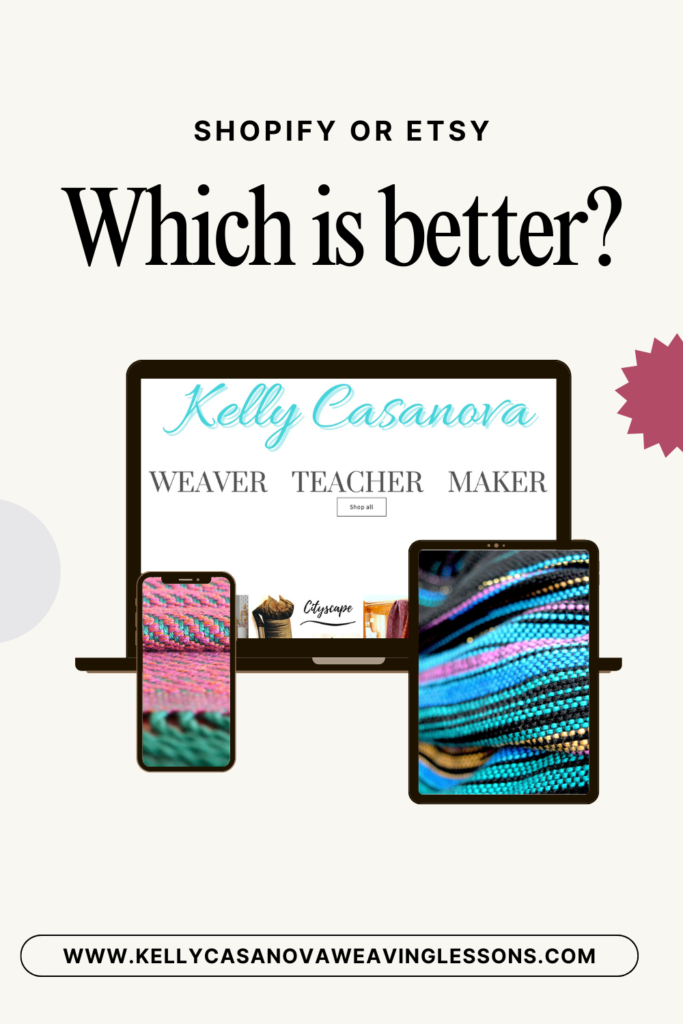
Should I start with Etsy or Shopify?

by Kelly 4 Comments

Opening your first online shop is such an exciting experience!

When I first started out as an Etsy seller in 2008 there were really only a couple of options for handmade sellers. Etsy is the one that has stood the test of time, but in 2024 you have a lot of choices when it comes to selling online and it may be difficult to choose one that best suits you, your products and your budget.

I sold my handmade goods on Etsy for many years and in the past 5 years I have moved almost exclusively into selling digital products. For me, digital products looks like hand weaving PDF patterns and ebooks.

This year, for a variety of reasons, I decided to open a Shopify store. This store contains the same patterns and ebooks as my Etsy store and the customer experience is quite similar. For now, I am keeping both stores open, and I will explain why as you read on.

Etsy has changed considerably since I opened my first shop there 16 years ago. Many of the changes (in my opinion) have not been for the better and that is why I have started my own store, on my own terms elsewhere.

I still do recommend Etsy for absolute beginners though, and we will have a look at the reasons why.

I’m going to take you through what I consider the pros and cons of Etsy and Shopify as well as how much my monthly fees cost.

Etsy Pros:

It is still a great option for absolute beginners. It’s easy to make an account and start listing products. All payments are processed for you and the templates are simple. Basically, you don’t need a lot of tech knowledge to get started.

One of the main attractions of Etsy for newbie sellers is the tiny financial outlay. The only initial cost you will pay is 20 cents to list an item. 

If you don’t make any sales for the month all you will be asked to pay is the 20 cent listing fee, so this is great for beginners as there is very little risk.

The other huge benefit to having a shop on Etsy is that it is a marketplace. This is great for those who are just starting out and may not have a customer base already.

Etsy Cons

Once you make a sale you must pay fees. Any you may be unpleasantly surprised by how much those fees add up to!

Yes, you start out with your very low 20 cent listing fee, but once a sale is made there is a transaction fee of 6.5% (this is even charged on your shipping amount) followed by payment processing fees. The payment processing fees will vary according to your physical location.

I mentioned in the “Pros” section that Etsy is a marketplace, and that can really help to build a customer base. Conversely, that marketplace can work against you because you have so very many competitors and it can be hard to be seen and found by new customers. There are many things you can do to optimise your listings but if you want to increase your reach Etsy will expect you to pay more for that in the form of offsite (which you can’t opt out of!) and onsite ads.

Now, another way in which a marketplace on Etsy can be a disadvantage is that when someone clicks on your listing to take a closer look, Etsy shows additional listings below your listing from other sellers. Effectively, they are using your page space to advertise other sellers!

Here is a screenshot example: I clicked on a knitted rabbit pattern listing from the wonderful Little Cotton Rabbits. When I scrolled down the listing page a little, Etsy had lists and pictures of similar items from other sellers and then underneath that there are more listings from other sellers under “You may also like”.

Underneath that, there are even more collections of other products to browse and related searches to explore.

OK, I get it, Etsy is a business, they exist to make money and they don’t care if they make a percentage of your sale or from another seller. But it certainly doesn’t help me, the seller, if my page advertises other sellers and I am not compensated for that.

On Etsy, you can’t collect emails in an automated fashion to be able to build and contact your customer base. This means that If anything happens to your Etsy shop you can’t get in touch with existing customers and you also can’t use Etsy to build a mailing list (an essential part of any business startup).

You also don’t own your shop and can be removed from Etsy at any time without warning. This has happened to many sellers who inadvertently or mistakenly breached copyright and had their shops removed. It can be a laborious and time consuming process to get a shop back and results in lost revenue while you’re trying to sort out the issues with Etsy customer service (which can be frustrating, to say the least).

I understand why Etsy does deactivate or remove shops, as copyright can be a huge issue in the selling field, but they seem to throw everyone into the same pool without carefully looking at individual circumstances. An example of this would be if a seller had made a short product video for one of their listings, and in the listing the seller is wearing a branded t-shirt. This can be seen as an instant copyright breach and the seller can be penalised, meanwhile the seller is wondering what on earth happened, as they were just wearing what they were wearing that day when they filmed the video!

A beef that I personally have with Etsy is that it is unrecognisable from back when I started, when it was a truly handmade marketplace. It felt niche and special in those days. Now they allow “vintage”, “supplies” and even print on demand. It feels more like a commercial shopping centre.

Shopify Pros

Shopify has a professional, clean and customisable look. Even if you don’t customise anything it still looks great and is easy to navigate.

It’s easy to setup and use and payments and ordering are simple processes

One of the best and most important part is that your own shop on the internet, you own it and can collect emails of your customers. You set your own parameters and no one can take the shop from you.

You can have a domain name of your own choosing for your shop, so it’s easy for customers to find.

Shopify Cons

You need to have a way to get eyes on your shop, Shopify is not a marketplace. If you already have an audience (especially in the form of a mailing list) it won’t be hard to share your shop link. But if you’re starting from scratch it’s going to be much harder for potential customers to find your shop.

The monthly fee that Shopify charges as hosting fees is charged whether you make sales or not. This can be a big disadvantage to a newer seller unless you get a lot of sales right away.

In addition to the monthly hosting fees, there are other fees that you will likely have to pay for customisation. This is not something that I realised when I first signed up for Shopify – I assumed that everything would be covered by the monthly fee. I use some apps for things like displaying customer feedback and social media icons.

Speaking of fees, I’m going to share some of my financials for both Etsy and Shopify to give you an idea of what to expect. Please note that my sales for both can vary immensely from month to month, this is particularly relevant to the Etsy figures considering they take a percentage of earnings.

FEES – Please bear in mind that these are my figures. Yours may look quite different.

Etsy per month -For me, the monthly fees range from $50 – $1600 (yes, really!!)

Shopify per month – $42 per month plus apps of around $20 = total of $60 a month

When you compare these figures you can probably see why I started the Shopify store. Overall, for me as an established seller with a very healthy customer base (over 12,000 sales on Etsy at the time of this article) Shopify fees work out at a much more affordable rate and are not dependent on my total sales for the month.

FINAL THOUGHTS ON SHOPIFY-

I wanted to share my thoughts as a newer user of Shopify. My sales in my Shopify store have been slower than I had hoped, but that is business in general in the present climate. I’m seeing slow sales in the Online Weaving School, my Etsy store and my affiliate links. There is a lot of economic uncertainty and inflation remains high, this is all having an impact on my business.

Also, having been on Etsy for 16 years, customers are comfortable with seeing and buying from me there. They are familiar with the process and they know where to find me. Not everyone likes change and I completely understand that.

Hopefully people will start to use my Shopify store more as time goes on as I would prefer to continue moving away from Etsy.

If you are interested in starting your own Shopify store, be sure to use my link to sign up! You can get your first month for just $1 when you sign up for a free trial, which is a great way to try out Shopify and see what you think.

Or if you are wondering about different avenues you can take for getting started selling your handmade products, check out there articles:

3 ways to start selling online for free!…

Do you want to start selling your weaving?…

3 Etsy essentials…

My 11 income streams…

What I would do differently if I started selling now…

I hope you found this article helpful in making a decision for yourself and your own needs as a seller or potential seller.

This post may contain affiliate links. For more information, please see my disclosure policy.

Filed Under: Handmade business, Selling, Weaving Tagged With: selling, selling handmade, selling on etsy, selling on shopify

3 ways to level up your rigid heddle weaving

by Kelly 8 Comments

The humble rigid heddle loom is capable of so much more than first meets the eye.

That’s exactly why it’s such a wonderful loom for beginners. You can start with its most basic function — plain weave — and then gradually build skills and confidence from there. No rush or overwhelm, just steady progress.

And yet, many newer rigid heddle weavers reach a point where they feel a bit stuck.

Or perhaps the opposite happens. Suddenly there seem to be too many possibilities, and choosing feels overwhelming.

That’s usually when doubt creeps in:

  • What if my skill level isn’t ready for the next step?
  • What if I mess it up and lose confidence altogether?

These are incredibly common (and completely valid) concerns. That’s why I always encourage rigid heddle weavers to build skills in steps, not leaps.

Some weavers love to leap, and that’s great.
Many others need a gentler take-off.

So how does the fledgling weaver get their wings?

By starting slowly.
Building momentum.
And stretching just a little further each time.

If you’re feeling in a rut with your weaving, or unsure what to explore next, here are three practical, confidence-building ways to level up your rigid heddle weaving — without overwhelm.

1. Explore Pick Up Stick Weaving

If you haven’t used a pick up stick yet, this is one of the easiest and most effective ways to expand what your rigid heddle loom can do.

Pick up sticks are simple tools, but they can completely transform your woven cloth.

For your first exploration, I recommend:

  • A warp that’s not too long
  • Not too wide
  • And no pressure to make a “finished” project – a sampler is great!

Just explore, get curious and have fun 🤩

How to Start with a Pick Up Stick

At its most basic level, pick up stick weaving begins like this:

  1. Place your heddle in the down position
  2. Behind the heddle, pick up warp threads using your pick up stick

Start simply:

  • 1 up, 1 down (one thread on top of the stick, one underneath and repeat)
  • Then try 2 up, 1 down
  • Then 2 up, 2 down

Once the stick is inserted and you’re ready to weave:

  • Move the heddle to neutral
  • Slide the pick up stick forward
  • Turn it on edge
  • Weave that pick

Then return to plain weave.

A simple repeating sequence might look like this:

  • Heddle up
  • Heddle neutral, pick up stick on edge
  • Heddle down
  • Heddle neutral, pick up stick on edge

Repeat from the top.

Even this basic sequence offers huge variation. You can:

  • Use pick up stick rows sparingly as accents
  • Alternate them regularly for pattern
  • Or combine them with colour for even more interest

Try This Next

With the pick up stick still installed:

  • Place the heddle in the up position
  • Slide the stick forward behind the heddle
  • Weave a row and notice how different the result is

You can even revisit the same 4-step sequence, but substitute the heddle-up/stick-forward combination.

Once you start experimenting, the possibilities really open up.

2. Use Colour and Weave Techniques

Colour is one of the simplest and most effective ways to level up your weaving.

And no, you don’t need to be a “colour expert” to use it well. Check out this free and basic resource that will introduce you to colour theory.

Most people can easily choose two colours they like together. That’s all you need to begin.

Simple Colour Ideas for Rigid Heddle Looms

  • One colour in the warp, one in the weft
  • Solid warp, changing weft colours for stripes
  • Blocks of colour in the weft for bold results

If changing warp colours feels intimidating, don’t — just start with the weft.

For example:

  • Warp with a neutral grey
  • Weave with grey for a while
  • Then introduce a bold colour like red
  • Alternate blocks of grey and red weft

Instant stripes. Simple. Effective.

Variegated Yarn: Colour Made Easy

Variegated yarns do the colour work for you — which is why I love them for rigid heddle weaving.

One of my favourite approaches:

  • Variegated yarn in the warp
  • Solid colour in the weft

More open structures (like those created with pick up sticks) are especially beautiful with variegated yarns, as they allow the full colour range to shine.

The scarf pictured above was woven with fingering-weight wool.
The warp was hand-dyed as a rainbow gradient, while the weft was a solid commercially dyed grey of the same yarn.

You’ll find a similar approach in my free Heart Scarf project.

3. Try Luxury or Special Yarns

Not all yarns are ideal for weaving — especially when you’re new — but today’s weavers have access to an incredible range of fibres.

Many knitting yarns work beautifully on a rigid heddle loom.

And introducing a luxury or special yarn can completely transform your finished cloth.

Yarns to Experiment With

Consider:

  • Silk or silk blends
  • Tencel
  • Bamboo
  • Cashmere or luxury blends

The scarf shown below was woven with a DK-weight hand-dyed silk. The result had a beautiful, flowing quality — almost like a waterfall.

What Luxury Yarns Add to Your Weaving

  • Iridescence: Silks, tencels, and bamboos add glow and light
  • Texture: Soft, fluid, and often slightly slippery
  • Perceived value: Perfect for special gifts or higher-end pieces to sell

Even a very simple weave structure can look extraordinary when paired with the right yarn.

Build Confidence, One Step at a Time

You don’t need to leap into complex techniques to grow as a rigid heddle weaver.

Small, intentional steps – like adding a pick up stick, introducing colour thoughtfully, or trying a special yarn, can take your weaving to an entirely new level.

Confidence comes from doing, not from being perfect.

I hope these ideas have sparked some inspiration and helped you see just how much potential your rigid heddle loom really has.

Until next time…

Happy Weaving!

*This post contains affiliate links. For further information, please see my disclosure policy.

Grab the "How To Use Pick Up Sticks" Printable Here!

Filed Under: Rigid heddle weaving, Selling, Weaving Tagged With: level up your weaving, rigid heddle weaving, selling your weaving

3 Etsy Essentials

by Kelly Leave a Comment

There can be a lot to learn when you make the decision to open an Etsy shop to sell your handmade products. However, rather than trying to learn “all the things” I always recommend to new sellers that they narrow it down to the most important things.

There are the obvious must haves like ensuring you are selling a quality product at a price that is fair to both you and the buyer, having policies in place and shipping on time.

In my experience as a handmade Etsy seller over the past 15 years and after almost 10,000 sales, I think there are 3 essentials that will best set you up for success on Etsy.

Before I talk about my recommended essentials, I’d like to point out why I think Etsy is a great place for beginner (and veteran) sellers.

Etsy has been around for a long time now and unlike some online platforms, you won’t have to jump through hoops to set up an account, list some items and start getting sales. The process is very simple and doesn’t require special technical knowledge.

Etsy takes care of all the payment processing for you and although they do take a percentage of each sale as commission, it takes that additional stress off you when you’re starting out.

Etsy is a marketplace, meaning shoppers can search for what they are wanting to buy. It’s a great way to get found and start building a customer base.

According to Capital One’s Research Report, there are over 100 million people worldwide using Etsy to buy and sell. They say that there are 277 million visits by shoppers every month to the platform. That is a lot of potential eyeballs on your products!

Now let’s have a look at my 3 Etsy essentials!

  1. Photos

This is an absolute non negotiable for Etsy success. The only real downside to selling online is that the buyer does not have the ability to see and touch your handmade item in person. Your goal should be to bring that in person experience to them as much as possible. Excellent photos are a must.

You can present your handmade items best by ensuring your photographs are well lit (natural light is best when possible), clear (nothing will turn off a buyer like a blurry photo will!) and appropriate composition.

If you don’t have any experience with photography, don’t worry! Almost any smartphone these days will take very nice photos and they are basically point and shoot.

If you are brand new to photography or feel that you can make some improvements, I have an excellent free resource for you:

Photography for Weavers…

2. Customer Service

When selling online, customer service begins when you list your item, ensuring you have great photos and descriptions so that the buyer can make a well informed decision. For some transactions, that is as far as the customer service needs to go.

But quite often you will need to have some form of contact with the buyer. On Etsy, this happens through direct messaging. It’s a great opportunity to answer buyer questions and to assure them of their purchase.

This is your time to shine as a seller. Your job is to make the sale as easy and positive for the buyer as you possibly can. A happy sale means a happy buyer and this is crucial to a successful business. Why?

Well, firstly, a happy customer will tell others about you. Never underestimate the value of word of mouth advertising (and it’s free for you as the seller!) Secondly, a happy customer will leave you a positive review which will tell other potential buyers that your business can be trusted. And thirdly, a happy buyer will likely become a repeat and loyal customer. Win, win, win!

One simple move that you can make towards providing great customer service on Etsy is to check your messages regularly and respond to them promptly. A 24 hour time frame is good, but if you can reply sooner than that, even better. Buyers love a fast response – remember, they are waiting to make a decision on whether to buy or not, so that is time sensitive.

When you do respond to messages, make sure your reply is friendly and polite. Check your grammar and spelling. If the buyer has a problem, offer a resolution. It’s not always easy to convey meaning within the confines of text, so read over any of your messages before sending to make sure they are coherent and professional.

3. Description

Your description section can be so much more than simply describing the item you are selling. I think of it as one of the little pieces of real estate available in my Etsy shop. I use it to let shoppers know more about the item they are interested in, but I also use it to let shoppers get to know me a little more by the tone I use. It’s also the perfect space to tell a story about the item – the way it was made, what it means to you, how it will enrich the life of the buyer.

Here is an example of one of my actual listings for a PDF download pattern in my shop. The listing text is in italics and my commentary is in bold.

Description

Please note – this is a PDF pattern, not a finished item. (Telling the buyer exactly what they’re purchasing).

This project is designed for those who are familiar with the basics of rigid heddle weaving.  (Is this skill level appropriate to the buyer?)

This wrap is inspired by and dedicated to Cheryl. Cheryl was a student of the Online Weaving School and a valued member of the private member’s group.

Sadly, Cheryl lost her battle with cancer in October 2021. 

Weaving brought great joy to her life during her illness and I know she would have loved this wrap. (Telling the story of how the pattern came about and why).

When you complete this project, you can choose from either a long version (pictured) for luxurious multiple wrapping, or a shorter, more scarf like version. (Giving the buyer choices or variations).

You will need:

Rigid heddle loom with a width 16 inches or wider

1x 10 dent heddle

A stick shuttle longer than the width of the project or a boat shuttle

A warping board or frame for hybrid warping (if you are weaving the longer version).

A reed and threading hook

Tapestry needle

A fringe twister is very handy

Full yarn and materials list is given when you purchase the pattern. (Telling the buyer what they need for the project, so there are no surprises).

The printable PDF file is 30 pages long and includes instructions, lots of colour photos and video tutorial links to ensure your success. (Instilling confidence in the buyer that they can complete the project).

This PDF is not just a pattern, it’s a lesson!

In the additional resource pages, you will learn all about colcolastic yarn and the hybrid warping method. 

Any questions? Simply message me and I’ll get back to you ASAP. (Ensuring support to the buyer).

What happens when you purchase a digital file? (Further information for a smooth transaction).

Following checkout you will receive an email from Etsy with a download link. If you don’t see the email in a timely matter, please check your spam/junk email folder.

If for any reason you are not able to access your file in this way, you can find it by logging into your Etsy account, clicking on your profile picture in the top right hand corner of your page, then choosing “Purchases and Reviews” from the drop down menu.

If you need further help, please feel free to message me 😊

I finish this listing my linking to my other available scarf patterns in my shop, using that available real estate to advertise my other products that could be of interest to the buyer.

If you are interested in selling your handmade pieces, I have a number of resources that you will find most helpful:

3 ways to start selling online for free…

Do you want to start selling your weaving?..

10 things I’ve learned about Etsy in 10 years…

I hope you found this post interesting and useful, feel free to leave a comment or ask any questions down below!

Until next time…

Happy Weaving!

*This post may contain affiliate links. For further information, please see my disclosure policy.

Filed Under: Business, Etsy, Selling, Weaving Tagged With: Etsy, handmade business, selling, selling on etsy

3 ways to start selling online for free!

by Kelly 4 Comments

When you have a desire to start selling your handmade items, it can feel like an overwhelming leap to take. But it doesn’t have to be. Today I will share 3 ways to start selling online for free.

There is no rule that says to start selling you need to launch a full on business with all the bells and whistles. That is certainly not the way I started out.

  • This post may contain affiliate links, please see my disclosure policy for further information.

If your budget is tight or you are wanting to just dip your toe in the selling game to find out if it’s something you want to continue to do, I have 3 ways that you can start selling online for free!

3 Ways to Start Selling Online for Free!

Now, just as a little disclaimer, a couple of these methods are not necessarily 100% free, due to payment processing fees. But, as far as actually making an item available for sale, these methods do not cost you anything until you’ve actually made a sale (and even then, I’m going to talk about other ways to take payments without fees).

Firstly I’m going to talk about the pros, or positives of these methods. I’ll cover the cons (negatives) at the end.

Now that we have that out of the way, here are my 3 recommendations for starting out selling for free online:

  1. Social Media or blog

2. Mailing List

3. Family and friends

Let’s look at each one in more detail.

Selling on Social Media

This can include Facebook, Instagram, Twitter, TikTok and others. Today I’m going to be talking about Facebook and Instagram, as these are the platforms where I have specific experience selling handmade.

A misconception is that you need to have a large social media audience in order to sell anything. Let me tell you, the quality of your audience is way more important than the quantity.

A small audience of people who are genuinely interested in what you do is so much more valuable than a huge pool of people who couldn’t really care less.

Selling on Facebook

On Facebook, groups have been a good way to sell in the past and could still be relevant, depending on the group. Make sure the group is very relevant to what you sell and educate yourself as to the rules. You don’t want to get booted out of groups for infringing on the rules!

Another way to sell on Facebook is to simply make posts. I will be going into more detail with this when I talk about Instagram, but basically you can make a selling post either on your personal Facebook profile or you can make a business/fan page.

I recommend the business page route, as your Facebook friends may not appreciate feeling like they are being spammed with sales posts. A business page is a more appropriate place for these styles of posts.

Selling on Instagram

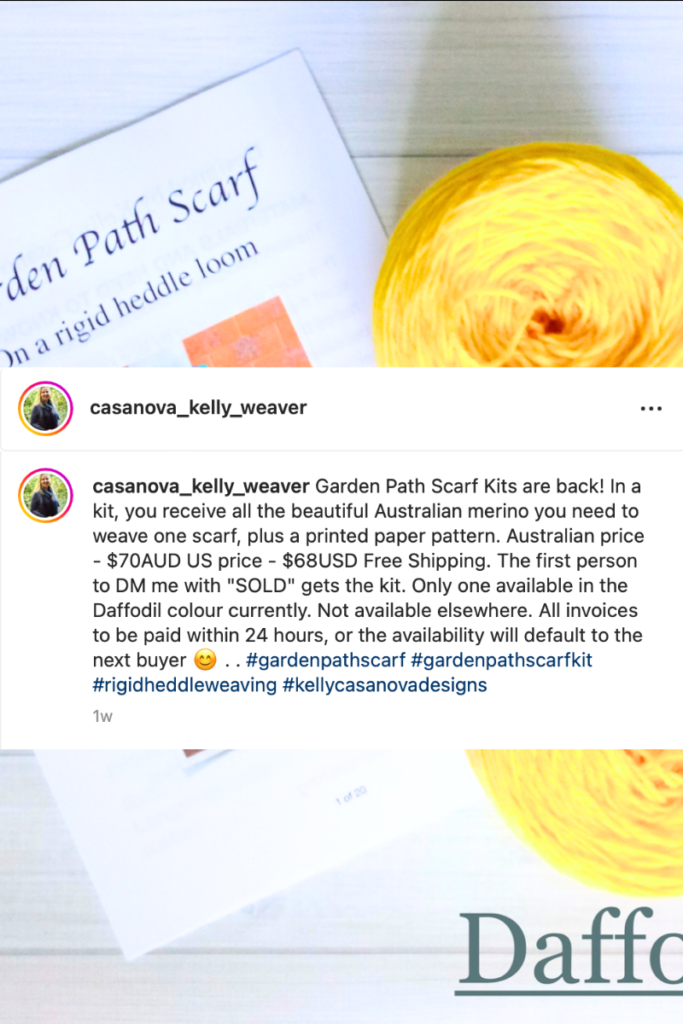
Now we will look at Instagram. I have recently been testing selling on Instagram, (not following me yet? You can find my account here.) with successful results. I’m going to show you my exact post from last week that I used to successfully sell a weaving kit.

Again, check the rules of any platform you’re using first to ensure no violation of rules is occurring.

If you look at my wording for this sales post, you will notice that it’s very clear and provides all the detail the buyer needs to make a well informed purchase, without being too wordy or overdone.

Importantly, I’ve clearly stated my terms for payment, the exact items that the buyer will receive, the price, and a good quality photo of the item. The invitation to be the first buyer to DM (direct message) me with “SOLD” creates a sense of urgency and competition.

This particular kit sold within 8 seconds of posting and the invoice was sent a paid for well within the 24 hour time frame.

What About PayPal?

I use PayPal to create and send invoices, but this is where this method is not completely free. There are payment processing fees through PayPal – usually a few dollars but it does depend on the value of the item sold. I factor these fees into the total cost of the item before I sell it. The “free shipping” is also calculated beforehand so that I’m not paying for that out of my own pocket.

Going through PayPal means that once the sale is made, I get the buyer’s email, make up their invoice (which takes less than 30 seconds) and send. As soon as the buyer has paid the invoice, PayPal emails me with the buyer’s shipping details and notification of payment.

You could still get around these fees by doing something like a direct bank transfer, but that is not such a popular way to make online payments these days. I recommend researching and experimenting to find a happy medium that suits you.

Selling on a Blog

I go into the idea of blogging in more depth in this post if you think that might be an interesting way for you to get started. There are completely free ways to blog but I do recommend that you use low cost hosting with a WordPress blog for best results.

Starting a Mailing List

Now we will talk about selling through EMAIL. If you have watched any of my business videos or read any of my posts, you will have already heard me talk about how essential it is to have a mailing list to build an audience.

Want to start selling your handmade items but don’t have a mailing list yet? Start one today! You can get started with Convertkit (my email provider) for free.

Contrary to popular belief, you do not need a huge amount of subscribers on your email list in order to make money. The quality of subscriber is so much more important than the quantity. A quality subscriber is already interested in your work (that’s why they joined your list!) and they may be interested in purchasing from you.

Keep Your Emails Simple

Selling through email is very similar to making a social media post. The key is to not make every email a sales post. That can make your audience feel like they are constantly being inundated and they may unsubscribe.

I like to provide my mailing list with valuable and good quality news and information and include a small section on the item I’m selling. Very recently I sold another Garden Path Scarf kit this way, by sending out my weekly email, The Weekend Edition.

In this weekly newsletter, I provide links to blog articles and videos, update my audience on what I’ve been working on. I basically share whatever I feel will be interesting to them. For the kit, I did the same as I would for a social media post – the clear photo, all the details, my terms and conditions. Again, this kit sold rapidly and I had multiple buyers who missed out.

If you want to take a look at how it might look to have a mailing list, I recommend that you sign up to mine for inspiration.

Selling Through Family and Friends

The third and final way that you can start selling online for free is through FAMILY AND FRIENDS.

This is such an easy and organic way to get started, without the pressure of selling to people you don’t know. It can be so natural that you don’t even realise a sale is happening until it’s done!

It could be as simple as someone in a social situation asking you what you do, or what you’ve been doing and you tell them about your craft. They may ask more questions and become interested. This can lead to them asking either whether you have a specific item for sale that they want or whether you would be interested in making them something (custom order).

To sell in a relaxed situation, perhaps in your home or someone else’s requires no technical knowledge of online processes or payments. Often you will be paid in cash in this type of scenario. You don’t need to take photos or make online posts.

Friends and family will also likely advertise for free on your behalf, by telling others about what you do and what you sell. Perfect!

Pros and Cons

OK, I’ve talked about how great these three methods are, but are there any downsides?

Yes, but they are very minimal, I think the positives outweigh the negatives here.

  • If posting to sell online, make sure you’re aware of regulations to ensure you don’t violate rules and possibly lose your account.
  • These methods are not automated. If you’re selling on Etsy for example, the work is all done beforehand. The listing is published and then Etsy takes care of the rest once there is a sale (apart from you sending out the physical product). If using any of these 3 methods, all the steps of the process are up to you (including sometimes having to chase buyers for payment and sometimes hearing crickets in return 🙄).
  • If you’re selling a larger number of items, you will definitely want to be able to automate your process more. These free methods are better for the seller just dipping a toe in, or selling items occasionally rather than frequently and at a higher volume.

Learn with Additional Resources

I have some additional resources for you if this is a really interesting topic for you:

Do You Want To Start Selling Your Weaving?…

Selling for Weavers Online Class (members only)…

Starting a Weaving Business in 2023…

10 Things I’ve Learned about Etsy in 10 Years…

I hope these ideas have been super helpful to you. If you want to see this post in video format, you can view that here:

Until next time…

Happy Weaving!

Filed Under: Business, Selling, Weaving Tagged With: handmade business, selling for free, selling handmade, selling weaving, weaving business

Do you want to start selling your weaving?

by Kelly 16 Comments

There are numerous reasons why as a weaver you may decide it is the right time to begin selling your weaving.

Why To Start Selling

  • You have an ambition to make a living doing what you love

  • You have more woven items than you know what to do with (I think we can all relate to this one!)

  • You would like some spare money to buy more yarn or weaving supplies
  • Although there is a lot to learn when it comes to beginning to sell your work and it can feel intimidating, you can start out very small and learn as you go along. Don’t feel as though you need to know “all the things” before you start selling.

I’m going to talk about a few key points to think about when you start selling. It’s not an exhaustive list, but more of a guide to get you thinking in the right direction.

Key Points to Begin Selling:

The Why?

Have a serious think about your personal reasons for wanting to sell your hand wovens. This will help to determine the kind of approach you might want to take when starting up.

For example, if you are a hobby weaver and wish to make a little money on the side to fund your hobby, your approach will be quite different to a weaver who wants to work towards making a full time income from selling.

Deciding on what level of selling you want to get into will help to determine all of the next steps.

Available Space

Many weavers will begin by weaving items in their own homes and then selling them. Consider whether you have the right space and enough space to house your woven pieces ready to sell. Do you have a good work flow, or is your space a total mess? Do you need to rejig your space to make it more viable, or find a different space within your home that is more conducive to weaving for a business?

The weaver who is more serious about selling may have to consider other avenues for making a space just for weaving. When I was selling physical handmade items, I did have a space within our home, but it was a shared family space. This became increasingly difficult over time, as my tools and items made their way into other parts of the home, and other items of the home made their way into my space. It was a great way to start out, but not all that viable over time.

If you don’t have a dedicated space for your weaving, you may also find the constant set up and storing away of tools and materials difficult.

Available Time

Are you in a position to devote the time to selling? Being realistic about the time you need to put into selling is important. It’s not just the weaving of items to sell, but possible liasing with customers, wrapping and packing, set up and pack up for markets, business recording requirements.

Is It Sustainable?

Is a weaving business going to be a positive thing for you? Are you prepared for the bookkeeping, packing and shipping, photography, travel and all the possible necessities revolving around being a business owner? I don’t detail any of these points in order to put you off, but I think it’s fair to say that many people have no idea what goes into a business behind the scenes – this has certainly been an eye opener for me over the years!

As I pointed out earlier, all of these things can be learned, but some weavers, after consideration, may well decide that they would be more content keeping their weaving as a hobby.

Will it pay?

This is very relevant to sustainability, but also deserves it’s own section because it’s a major consideration when selling your work.

I have experienced first hand how difficult it can to have to let go of a business idea because it is not financially viable. Many years ago, when my children were small, I handcrafted Waldorf style dolls for sale. I started out making dolls for my children, but really loved the creative process and so began selling them also.

These dolls were a really big time investment, you can’t hurry the process of first making the doll, embroidering the face, sewing on (and sometimes knitting the wig first to sew on!) the hair, then completing further details like sewing a full outfit. I chose to use beautiful, natural materials like the best quality cotton tricot for the skin, mohair for the wigs, gorgeously carded wool for the stuffing and European fabrics for the clothes.

It was after a my first negative experience with a customer who felt the customer doll I made for her did not look enough like her daughter (!!!) that I started to ponder how much time I was spending making a doll and what I was actually getting paid for all that work.

I used a calculation formula and was absolutely dumbfounded with results. I was making negative $1AUD per hour! That is correct, it was actually costing me $1 per hour to run that business.

I was a little bit heartbroken, but I stopped offering my dolls for sale.

The point is, I never did my research in the first place to determine if it was a viable business venture, and so I learned the hard way.

Here is a basic formula to get you started:

Supplies cost + labour (your time) + 10% (other costs eg. fees, packaging, insurance)

Here is a practical example for how you might use this formula for a weaving business (these calculations make the assumption that you already have a loom and all the tools you need to actually weave the project, and also that the customer is paying for shipping, if applicable –

The item – A bamboo scarf

Materials cost –

  • Warp – 2 cones Bambu 7 @ $18AUD each = $36
  • Weft – 1.5 cones Bambu 7 @ $18AUD each = $27

Total materials cost = $63 AUD

Labour cost-

This is how much you wished to be paid per hour. This is a very personal decision, but for the sake of this exercise, I will put my desired hourly rate at $20AUD.

Now is the tricky part – how much time does it take to weave a scarf? In this example, I’m using a floor loom, which takes a good while to set up! I also have to allow for weaving time, things like hemstitching, wet finishing, packing time and even liasing with the customer if that applies. I’m going to estimate 5 hours for this, though that is probably too low. I never time a project, so it’s just an estimation.

5 hours of labour at $20 per hour = $100AUD.

So far we have total materials cost of $63 + labour of $100 = $163

Now we take that figure and add an extra 10% to allow for other, often hidden or forgotten costs.

So, $163 + $16.30 = $179.30

If you would like a quick and easy way to know your costs, check out my free interactive Weaving Cost Estimator.

Here I’m going to insert my personal opinion again 😊 You can take it or leave it, I’m just sharing thoughts. Pricing is a delicate and sensitive issue, it’s essential that you do what works for YOU. I’ll make a couple of points to ponder over:

  • It’s very important to not “cheapen the weaving industry” by charging too little. People complain that non weavers don’t understand the time and skill that goes into a woven item. Well, the best way to change that perception is by charging appropriately for your work.
  • When you are starting out selling, it is likely your work will not be as good as someone who has been weaving professionally for some time. That is OK, there is absolutely nothing wrong with selling pieces that are “not perfect” but be realistic in your pricing. I’m not talking about being cheap. But you may expect to price your work lower than someone who is known as a professional weaver, has an excellent reputation and consistently delivers high quality. You can adjust your pricing over time, as your work improves and there is nothing wrong with that. Everyone has to start somewhere!
  • Your time is valuable. If you are weaving as a business, make sure your hourly rate (labour) is an amount that is sustainable for you and that you feel good about. Again, this can always be adjusted over time, but trust me, you are not going to feel motivated to weave beautiful things for customers if your hourly rate is below minimum wage or worse.

There are many more points to discuss when it comes to selling, some of which include:

  • Avenues for selling and finding the right avenue for you.
  • Legal and tax requirements.
  • Getting the word out.
  • Copyright issues.

If you would like to dive deeper into this subject, have a member’s only class – Selling Your Weaving class, which is a 40 minute discussion workshop to get you thinking about whether selling is right for you.

I also have a video that discusses many of the points listed here, plus more:

And if you are interested specifically in selling on Etsy, I have this Youtube video from the perspective of 10 years of selling there:

In addition to my Etsy shop I now have my own store Kelly Casanova Designs. I use Shopify to host this store and I think it’s a great option for weavers who want to sell and have an interested audience already.

You can get your first month for just $1 when you sign up to Shopify for a free trial.

If you are ready to start your own email list, I recommend using Convertkit. This is the company that I use for my mailing list and I think it’s awesome. Perhaps you want to see what my emails to my list actually look like? You can do that by signing up to my mailing list.

Have questions you need answered? I can help with that. Make your booking here to work with me in a one on one email consultation:

Book Your Consulation Here

I hope this post was helpful to you! I would love to continue the discussion, so if you have any comments or questions, please leave them in the comments section down below.

Until next time…

Happy Weaving!

Filed Under: Selling, Weaving Tagged With: business, selling

Primary Sidebar

About Kelly Casanova

Hand crafted boat shuttles

Categories

Archives

Meta

  • Log in
  • Entries feed
  • Comments feed
  • WordPress.org

Copyright © 2026 Kelly Casanova Weaving Lessons on the Foodie Pro Theme