• Skip to main content
  • Skip to primary sidebar

Kelly Casanova Weaving Lessons

  • Hi! I’m Kelly!
    • Disclosure
  • Online Weaving School Class Index
    • Common account issues
    • Common technical issues
    • What do I get with a membership?
  • New to rigid heddle weaving? Start here!
    • Never heard of the rigid heddle loom?
    • How to weave neat edges on the rigid heddle loom
    • Rigid heddle weaving
    • Rigid Heddle Weaving Patterns
  • Patterns
  • Subscribe

weaving business

3 Fears Stopping You From Starting Your Creative Business (And How to Start Anyway)

by Kelly 2 Comments

You dream of turning your weaving or handmade craft into a business—but something keeps holding you back. I have noticed over time that there tends to be 3 fears stopping you from starting your creative business.

When I asked my YouTube audience if they wanted to start their own business, over half said yes. So why don’t more people get started? Why are they stuck and can’t get their business idea from their head into reality?

I have been running my own six figure weaving business for 10 years now and you could say that I’ve learned a thing or two about how to start and run a successful business.

The 3 Biggest Fears

Today, I want to walk you through what I perceive to be the 3 biggest fears that stop most creative people from starting. I want to also give you some simple baby steps you can take to begin— no need to quit your job, spend a fortune, or announce anything big to the world.
Fear 1: Fear of What You Don’t Know

“I don’t know how to start a business.”
“I don’t understand websites, email, marketing…”

This fear is totally normal. You’ve never done this before—and guess what? Neither had I when I started. Have you ever started a new job and known exactly what to do, right away? Starting a business is no different – of course you don’t know what you don’t know!

My business started as a micro movement. Just me, myself and I, one step at a time. No money, literally none. I worked around my young family, investing time in the business around existing commitments and utilising free and very low cost online tools.

When I think back, I knew nothing about starting and running a business. The benefit of starting super small is that you can baby step your way in, learning what you need to know, when you need to know it.

Baby Step 1 : Start a blog.

Setting up a blog is one of the easiest, safest ways to build an online presence without needing social media or pressure to sell anything yet. I have been blogging since 2008 (yes, really!!) and it started as a free and satisfying hobby. It gave me a way to share my creative life with an online audience.

✅ WordPress is a free way to get started quickly. You do need some sort of blog hosting though, I have used Bluehost for many years and am happy with their service. They are very low cost to get started with.
✅ You can begin by just writing about your craft, what you’re working on, or what you’re learning. No pressure to “sell” anything. This helps you to gather an interested audience. You can even begin selling directly from your blog if you want to.

Why it works:
Blogging helps you build confidence, get comfortable sharing online (including familiarity with writing good copy, taking clear and quality photos and fielding queries), and slowly grow an audience that trusts you.

A blog can be monetised in a variety of ways, but the most simple beginner way is to sign up with a media company. They will place ads on your blog and pay for the privilege. I started out using Google Adsense and now I use Journey by Mediavine.
Fear 2: Fear of Failure

“What if I try and nobody buys?”
“What if I waste time or money?”
“What if I fail in public?”

Starting small is your antidote. You don’t need to launch a full business. You just need to test the waters. When my business was starting to grow bigger and at times I felt overwhelmed with the work, someone recommended Company of One by Paul Jarvis. This book resonated so much with me that I spent some time re-evaluating the kind of business I wanted to have. Paul encourages you to stay small as a business rather than growing to the point of needing a team, if that speaks to your heart. It surely does to mine!

Baby Step 2 : Start collecting emails.
Your email list is the single most important tool you’ll ever use to grow your business. I can not overstate this enough!

Once you have built a mailing list, it belongs to you. That means you will always have a way to contact your audience directly.

And it makes sense, right? You want to be in contact with the people who are genuinely interested in what you do.

✅ I use Kit (formerly known as Convertkit) — it’s free for your first 10,000 subscribers (that’s an amazing deal!) and built for creators.
✅ You can put a simple opt-in form on your blog: “Want to see behind the scenes of my weaving life?” Or use your blog to mention your newsletter/mailing list and get sign ups that way.

Why it works:
You’re not “selling” yet. You’re just building a list of people who are interested in what you do. No pressure. You can figure out what to offer later.
Fear 3: Fear of the Work

“This sounds like a lot. I don’t have time.”
“I already have a job/kids/health issues…”

Totally fair. That was me when I started, a busy Mum, homeschooling her kids and running a household. You don’t need to do it all. The beauty of being your own boss is that you decide how much or how little you put in to the business.

Admittedly, the work will increase as the business grows, this is inevitable and is actually a good thing because it means you’re succeeding. Again, keeping the business small initially and taking baby steps is the way to go to prevent work overwhelm.

Baby Step 3: Start sharing casually.
If you’re already on Instagram, YouTube (this topic needs it’s own post, it has been so instrumental in building my business!), or Pinterest, just start saying things like:

  • “I’ve been thinking about turning my weaving into a business…”
  • “Testing out email marketing to share more of my weaving journey…”
  • “Just started a blog to document my process—excited and nervous!”

✅ This arouses curiosity. People will start following along naturally.
✅ You’re not launching anything—you’re just documenting and sharing.

*This post contains affiliate links. For further information please see my disclosure policy.

Wrap-Up: You Don’t Need to Jump—Just Take the Next Step

You don’t need a “launch plan”, business plan, products, or a perfect website. You just need to start showing up in a consistent, gentle way that feels right to you.

Here’s your 3-step starter kit:

  1. Start a blog with Bluehost
  2. Collect emails with ConvertKit
  3. Talk about your journey naturally on social media

More Resources

3 Ways to Start Selling Online For Free

Do You Want To Start Selling Your Weaving?

Etsy V’s Shopify

Selling For Weavers (online class)

And if you want to see what tools I use to run my own creative business, grab my free PDF (scroll to the download button underneath 😉):

Tools I use to grow my weaving business!Download

Would you like to continue the discussion? Check out my Youtube video and leave a comment to share your thoughts 👇

Have questions you need answered? I can help with that. Make your booking here to work with me in a one on one email consultation:

Book Your Consultation Here

Until next time…

Happy Weaving!

Filed Under: Business, Handmade business, Online business, Weaving Tagged With: entrepreneur, handmade business, online business, weaving business

3 ways to start selling online for free!

by Kelly 4 Comments

When you have a desire to start selling your handmade items, it can feel like an overwhelming leap to take. But it doesn’t have to be. Today I will share 3 ways to start selling online for free.

There is no rule that says to start selling you need to launch a full on business with all the bells and whistles. That is certainly not the way I started out.

  • This post may contain affiliate links, please see my disclosure policy for further information.

If your budget is tight or you are wanting to just dip your toe in the selling game to find out if it’s something you want to continue to do, I have 3 ways that you can start selling online for free!

3 Ways to Start Selling Online for Free!

Now, just as a little disclaimer, a couple of these methods are not necessarily 100% free, due to payment processing fees. But, as far as actually making an item available for sale, these methods do not cost you anything until you’ve actually made a sale (and even then, I’m going to talk about other ways to take payments without fees).

Firstly I’m going to talk about the pros, or positives of these methods. I’ll cover the cons (negatives) at the end.

Now that we have that out of the way, here are my 3 recommendations for starting out selling for free online:

  1. Social Media or blog

2. Mailing List

3. Family and friends

Let’s look at each one in more detail.

Selling on Social Media

This can include Facebook, Instagram, Twitter, TikTok and others. Today I’m going to be talking about Facebook and Instagram, as these are the platforms where I have specific experience selling handmade.

A misconception is that you need to have a large social media audience in order to sell anything. Let me tell you, the quality of your audience is way more important than the quantity.

A small audience of people who are genuinely interested in what you do is so much more valuable than a huge pool of people who couldn’t really care less.

Selling on Facebook

On Facebook, groups have been a good way to sell in the past and could still be relevant, depending on the group. Make sure the group is very relevant to what you sell and educate yourself as to the rules. You don’t want to get booted out of groups for infringing on the rules!

Another way to sell on Facebook is to simply make posts. I will be going into more detail with this when I talk about Instagram, but basically you can make a selling post either on your personal Facebook profile or you can make a business/fan page.

I recommend the business page route, as your Facebook friends may not appreciate feeling like they are being spammed with sales posts. A business page is a more appropriate place for these styles of posts.

Selling on Instagram

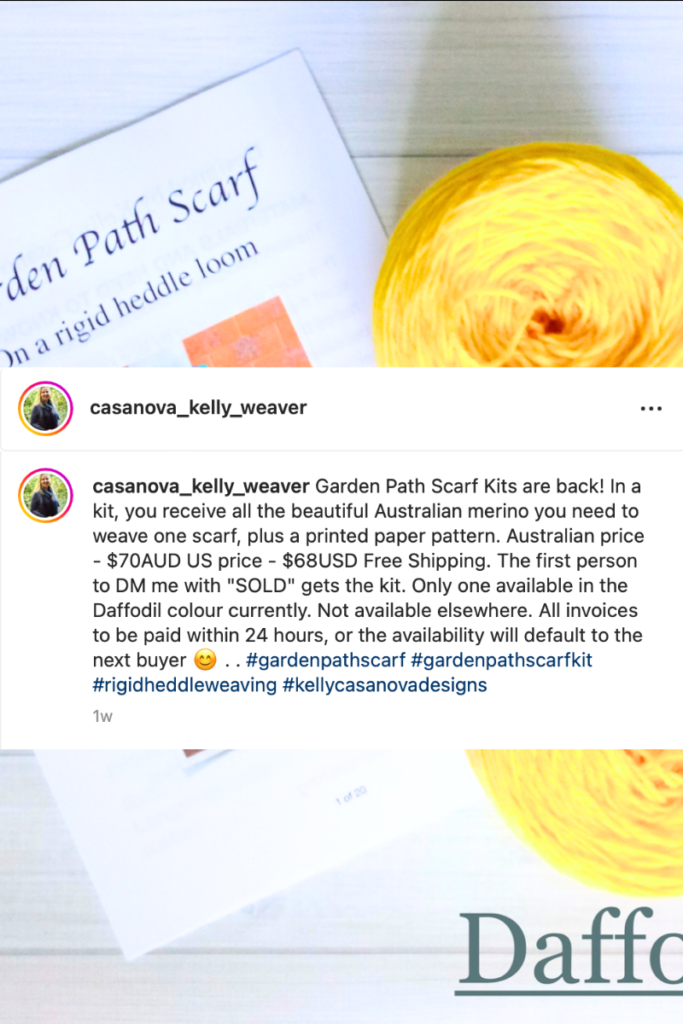
Now we will look at Instagram. I have recently been testing selling on Instagram, (not following me yet? You can find my account here.) with successful results. I’m going to show you my exact post from last week that I used to successfully sell a weaving kit.

Again, check the rules of any platform you’re using first to ensure no violation of rules is occurring.

If you look at my wording for this sales post, you will notice that it’s very clear and provides all the detail the buyer needs to make a well informed purchase, without being too wordy or overdone.

Importantly, I’ve clearly stated my terms for payment, the exact items that the buyer will receive, the price, and a good quality photo of the item. The invitation to be the first buyer to DM (direct message) me with “SOLD” creates a sense of urgency and competition.

This particular kit sold within 8 seconds of posting and the invoice was sent a paid for well within the 24 hour time frame.

What About PayPal?

I use PayPal to create and send invoices, but this is where this method is not completely free. There are payment processing fees through PayPal – usually a few dollars but it does depend on the value of the item sold. I factor these fees into the total cost of the item before I sell it. The “free shipping” is also calculated beforehand so that I’m not paying for that out of my own pocket.

Going through PayPal means that once the sale is made, I get the buyer’s email, make up their invoice (which takes less than 30 seconds) and send. As soon as the buyer has paid the invoice, PayPal emails me with the buyer’s shipping details and notification of payment.

You could still get around these fees by doing something like a direct bank transfer, but that is not such a popular way to make online payments these days. I recommend researching and experimenting to find a happy medium that suits you.

Selling on a Blog

I go into the idea of blogging in more depth in this post if you think that might be an interesting way for you to get started. There are completely free ways to blog but I do recommend that you use low cost hosting with a WordPress blog for best results.

Starting a Mailing List

Now we will talk about selling through EMAIL. If you have watched any of my business videos or read any of my posts, you will have already heard me talk about how essential it is to have a mailing list to build an audience.

Want to start selling your handmade items but don’t have a mailing list yet? Start one today! You can get started with Convertkit (my email provider) for free.

Contrary to popular belief, you do not need a huge amount of subscribers on your email list in order to make money. The quality of subscriber is so much more important than the quantity. A quality subscriber is already interested in your work (that’s why they joined your list!) and they may be interested in purchasing from you.

Keep Your Emails Simple

Selling through email is very similar to making a social media post. The key is to not make every email a sales post. That can make your audience feel like they are constantly being inundated and they may unsubscribe.

I like to provide my mailing list with valuable and good quality news and information and include a small section on the item I’m selling. Very recently I sold another Garden Path Scarf kit this way, by sending out my weekly email, The Weekend Edition.

In this weekly newsletter, I provide links to blog articles and videos, update my audience on what I’ve been working on. I basically share whatever I feel will be interesting to them. For the kit, I did the same as I would for a social media post – the clear photo, all the details, my terms and conditions. Again, this kit sold rapidly and I had multiple buyers who missed out.

If you want to take a look at how it might look to have a mailing list, I recommend that you sign up to mine for inspiration.

Selling Through Family and Friends

The third and final way that you can start selling online for free is through FAMILY AND FRIENDS.

This is such an easy and organic way to get started, without the pressure of selling to people you don’t know. It can be so natural that you don’t even realise a sale is happening until it’s done!

It could be as simple as someone in a social situation asking you what you do, or what you’ve been doing and you tell them about your craft. They may ask more questions and become interested. This can lead to them asking either whether you have a specific item for sale that they want or whether you would be interested in making them something (custom order).

To sell in a relaxed situation, perhaps in your home or someone else’s requires no technical knowledge of online processes or payments. Often you will be paid in cash in this type of scenario. You don’t need to take photos or make online posts.

Friends and family will also likely advertise for free on your behalf, by telling others about what you do and what you sell. Perfect!

Pros and Cons

OK, I’ve talked about how great these three methods are, but are there any downsides?

Yes, but they are very minimal, I think the positives outweigh the negatives here.

  • If posting to sell online, make sure you’re aware of regulations to ensure you don’t violate rules and possibly lose your account.
  • These methods are not automated. If you’re selling on Etsy for example, the work is all done beforehand. The listing is published and then Etsy takes care of the rest once there is a sale (apart from you sending out the physical product). If using any of these 3 methods, all the steps of the process are up to you (including sometimes having to chase buyers for payment and sometimes hearing crickets in return 🙄).
  • If you’re selling a larger number of items, you will definitely want to be able to automate your process more. These free methods are better for the seller just dipping a toe in, or selling items occasionally rather than frequently and at a higher volume.

Learn with Additional Resources

I have some additional resources for you if this is a really interesting topic for you:

Do You Want To Start Selling Your Weaving?…

Selling for Weavers Online Class (members only)…

Starting a Weaving Business in 2023…

10 Things I’ve Learned about Etsy in 10 Years…

I hope these ideas have been super helpful to you. If you want to see this post in video format, you can view that here:

Until next time…

Happy Weaving!

Filed Under: Business, Selling, Weaving Tagged With: handmade business, selling for free, selling handmade, selling weaving, weaving business

Primary Sidebar

About Kelly Casanova

Hand crafted boat shuttles

Categories

Archives

Meta

  • Log in
  • Entries feed
  • Comments feed
  • WordPress.org

Copyright © 2026 Kelly Casanova Weaving Lessons on the Foodie Pro Theme