• Skip to main content
  • Skip to primary sidebar

Kelly Casanova Weaving Lessons

  • Hi! I’m Kelly!
    • Affiliates Disclosure
  • Online Weaving School Class Index
    • Common account issues
    • Common technical issues
    • What do I get with a membership?
  • New to rigid heddle weaving? Start here!
    • Never heard of the rigid heddle loom?
    • How to weave neat edges on the rigid heddle loom
    • Rigid heddle weaving
    • Rigid Heddle Weaving Patterns
  • Patterns
  • Subscribe

Kelly

I deleted my last post and wrote about krokbragd instead!

by Kelly 13 Comments

I had a long post, all ready to go. It was a little bit of weaving and a LOT of life. I’m glad I didn’t hit “publish” on that post right away. I’ll explain…


The post was written at the end of a really busy week. I had launched a new class for my Online Weaving School, I had made a Youtube video, I had promoted the new class everywhere I could think of to promote it, I had homeschooled the kids and cared for my family, we had been on educational outings, appointments and activities. Yeh, I was pretty tired at the end of that week. And then I sat down to write a blog post.


A little bit of advice to you all – don’t write blog posts when you’re over tired. And if you do write them, don’t publish them! That’s all I’ll say on the subject for now, except to add that I have now caught up on some much needed sleep and rest and am thankful that, not only did I get over my little self pity party, but also that I decided not to inflict my Whingefest upon your eyes and minds!


Now, let’s get to the fun stuff.


I had been wanting to warp up my inkle loom for quite some time, as it has been sadly neglected and I do so enjoy weaving on it, just for something a bit different. My loom is the Ashford Inkle, which is the larger version, they also make the Inklette, which is more petite for smaller and narrower bands.


I didn’t know what to warp up, so I took a flick through my go – to Inkle book, The Weaver’s Pattern Directory by Anne Dixon. I often recommend Anne’s Handweaver’s Pattern Directory  for 4 shafts, as it is so packed with drafts and quality information and her inkle book is no exception. 


I started by picking out some colours from my stash that I love (always a good way to start a project, even if you’re not that confident with colour choices). I ended up with a mixture of mercerised and unmercerised 8/2 cottons. If you’re unfamiliar with 8/2 cottons I often use Maurice Brassard as they are great quality and come in heaps of colours. Here is an example of MB 8/2 unmercerised. A comment from Gai has just reminded me of something I wanted to add about mercerised cotton. In general, I don’t like to use it on a larger loom, it twists up on itself and is a general pain in the neck. However, on the Inkle loom it’s different. Because you warp directly on to the pegs without having to do extra threading or moving of the warp, it behaves itself very well. It is constantly under high tension, so is easy to use and does add a lovely “gleam” to the project.

Being the lover of the weave structure Krokbragd that I am, it was a natural choice. Did you know you can weave krokbragd on an inkle loom? Yes, you totally can!


And, did you know that a krokbragd band is as equally gorgeous as a larger loom project? Yes, it totally is!  

So now I’m really excited about the design possibilities for this, though I admit that the design aspect is different to what I’m accustomed to –  it’s proving quite a challenge for me and is a bit to get my head around. I’ll keep plugging away at it though, and I’m sure I’ll get there.

I love that the reverse side is just as striking as the front.

As soon as I posted these on social media, people were asking me for a class, which I would love to do once I have some of my own designs up and running. In the meantime, if you have Anne’s book or are interested in purchasing (perhaps your library might have it?) this krokbragd design is from page 107.

And, if krokbragd band weaving is of interest to you, there will definitely be more to come!

Thanks for reading, until next time…

Happy Weaving!

*Please note – this post contains affiliate links, meaning that if you click and purchase, I will receive a small percentage of the sale. I only recommend products that I own and love.


Filed Under: Weaving Tagged With: inkle loom, krokbragd, weaving, weaving books

Interview with Mirrix Looms

by Kelly 7 Comments

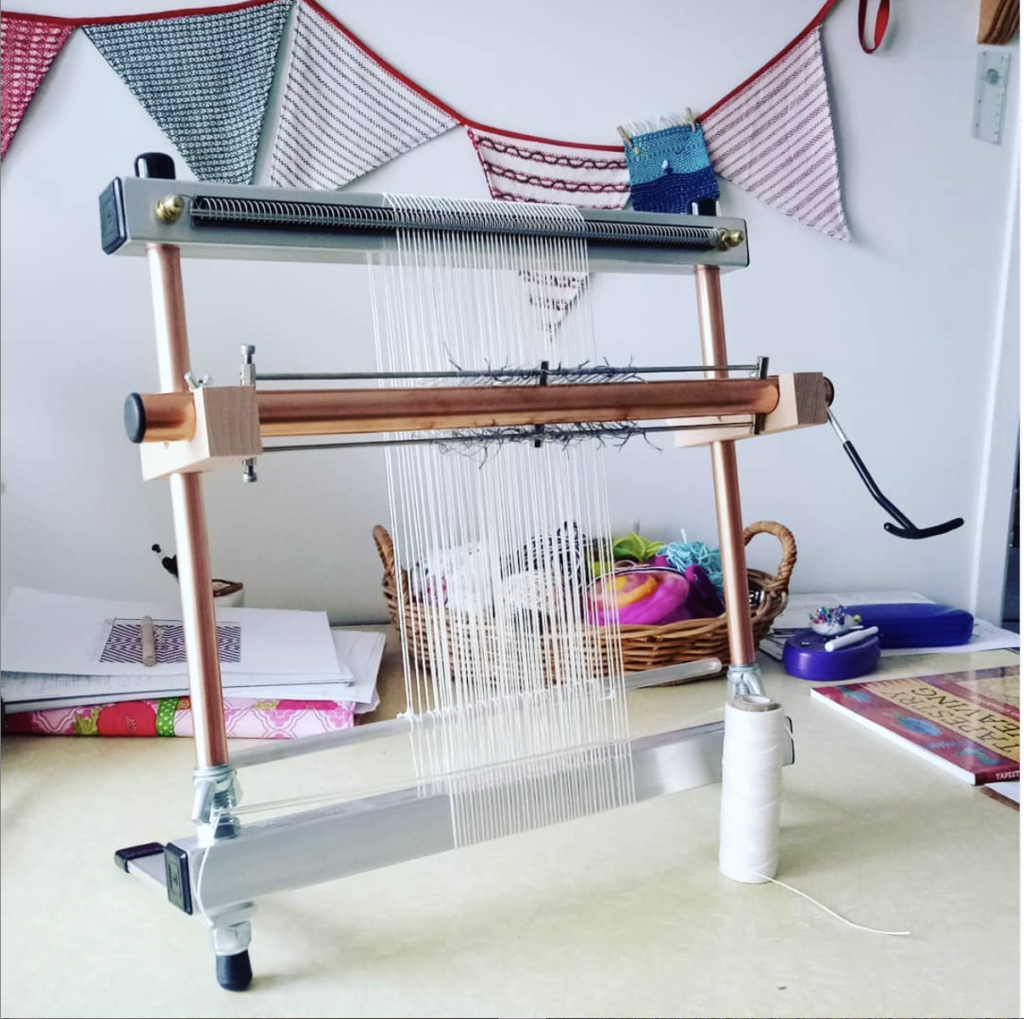
I was thrilled to have the opportunity to interview Claudia Chase, President of Mirrix Looms. You may be aware that I am quite taken by the tapestry looms available from Mirrix and have one on my Wishlist, as I discussed in this post.


                                              Photo credit Williams-Prior Art + Design


When did you first become interested in weaving? How did you learn? What attracted you to it?

I became interested in weaving when I was nine or ten. I saw a rigid heddle loom in the home goods department of Macy’s! My parents bought it for me for Christmas. I was hooked. But that was cloth weaving and it would take me many years to realize my passion was actually tapestry weaving. That happened when I was pregnant with my daughter Elena. There was a tapestry course being offered in San Francisco, CA (United States) where I was living at the time. The class seemed more like a gathering of women who wanted to weave together and not a lot of instruction seemed to be happening. They were also doing some natural dyeing and it struck me that although the onion skins were cool maybe the heavy metal they were using to fix it was not the best thing for my pregnant self. I attended two classes. I learned only one thing: I loved tapestry and I was going to master it on my own. 


When did you decide to start a business and how did you settle on a name?

I designed the loom with a friend because I wanted a high-end very portable metal tapestry loom. A metal loom existed called the Hagen but the smallest size was 24 inches and I wanted something really small that I could throw in a bag and haul wherever I might go. I didn’t want to miss any opportunity to get in a few weft passes. I also wanted a loom with a more sophisticated shedding device along with excellent tension. Our prototype was ten inches wide. Sometimes life just happens and the next thing I knew I  was in business manufacturing portable metal looms. The name came from the joining of a Greek and Italian verb to mirror or to wonder. I just added “ix” at the end and Mirrix was born!


                                            Photo credit Williams-Prior Art + Design

Mirrix looms are quite unique in design and aesthetics. What influenced your decisions on materials and style for your looms?

I wanted to use metal because it is much stronger than wood and one of the biggest failures for small wooden tapestry looms is they cannot withstand the stress of tension and in any case most of them don’t even have a tensioning device. There were a couple of other metal tapestry looms out there and folks were making their own out of copper pipes. I wanted a loom with an easy to use shedding device, perfect tension and portability. We took some old ideas and some new ideas and came up with what we think is the perfect portable tapestry and bead loom.
How many looms do you personally own and which is your favourite?

There are fourteen looms in my studio at this very moment with various stages of tapestries on them. I am always experimenting for new kits, new products and new ways to weave so I need a lot of looms. My favorite size changes over time. For a while I was weaving tiny tapestries on the 5 inch loom. I guess I was looking for intimacy. Currently I am working with all the smaller looms. But I have a lovely piece temporarily in repose on a twenty-two inch loom, which at times has been my favorite size for tapestry. It’s small enough to easily move from space to space and it’s large enough to make a rather substantial tapestry. In the past I have stated that if I could have only one Mirrix Loom it would most likely be the 22 inch loom. But then again, I really do love those smaller looms that peopled my original vision. I would also want one of the smaller looms. Gosh, deciding which one would be quite the dilemma. There is a reason why folks collect multiple Mirrix Looms!

What are your favourite fibre/threads to use and why?

I use wool and silk almost exclusively. I am fascinated with weaving with our hand-painted silk yarn and ribbon. Combining it with wool is magical. For warp I use wool, linen and cotton depending on the project. For about ten years I dyed fleece and the spun it in to yarn. I do hope to get back to that someday because it made my tapestries totally mine.

What items do you love to weave the most?

Lately, I’ve been obsessed with working on smaller pieces. They are little, tiny comments on life and happen quickly so I can move through one a day. In the past I have woven large pieces which take weeks or months to complete. That requires an entirely different mind set. I find lately that I find myself more attracted to the smaller pieces because I can move through a design or color problem much more quickly with small format. I know I will be ready to go back and do a large piece very soon. 

What did you do before your weaving business?

                                         Photo credit Williams-Prior Art + Design

I wove tapestry before I began the loom business. Before that I wrote and published poetry and worked as an editor. I had founded a poetry magazine back in the day. My interests range from verbal to visual. I believe I have a healthy dose of ability in each.

I love that your looms are manufactured local to you and at Sunshine House. Can you tell us a little about Sunshine House and how this wonderful collaboration came to be?

Sunshine House provides supported employment for people with physical and mental disabilities. Making a loom is a complex process and the managers there do a fantastic job matching tasks to people’s abilities and setting up work stations to help people with different abilities be successful. It’s a wonderful place and allows people who may not be able to get employment elsewhere to work and to be a part of something truly good. 

What are your plans for the future of your business?

We want to continue doing what we’ve been doing all along. We have created a rhythm for doing business whether it’s finding a new audience to developing new looms, accessories and projects. It’s careful and determined. We don’t rush into anything because we want to make sure we are always taking Mirrix in the right direction. Thus far, we have been so lucky with our choices. We do have a new product on the horizon which will allow lightening quick warping of the Mirrix which will both accommodate new weavers but also assist seasoned weavers who want to instantly throw on a warp for sampling or otherwise. We have been working on this new accessory for a year now. It has just survived market testing with flying colors so we are ready to launch!

What advice would you give to someone who is interested in learning weaving?

Start slowly. Sometimes people get into their heads that they want to weave something very complex or very specific and they get frustrated when their skill level doesn’t match their expectations. Weaving is a skill that can take many years to develop. Don’t put too much pressure on yourself and start with the basics and you’ll be way more successful. Giving yourself a strong foundation of weaving skills is very important! 

Thanks to the Mirrix team for a marvellous insight into your looms and business!

I wanted to add that another thing that really appeals to me about the company is all of the excellent instructions and tutorials you can access on their blog and Youtube. These are people who really want you to succeed in your weaving and I just love that.

To find out more about Mirrix, you can visit them at the following places:

Mirrix website
Instagram
Youtube channel

Filed Under: Interviews Tagged With: interviews, looms, mirrixlooms, tapestry weaving, weaving

Online Weaving School FAQ’s

by Kelly 88 Comments

Have you been wondering about my Online Weaving School? Maybe you have visited already but feel unsure about where to get started? Today I am going to address some of my most frequently asked questions!


What is your Online Weaving School?

It’s a place I’ve created online for weavers of all different levels and abilities to learn. Because the lessons are all online, the student can learn at their own pace, in their own time, and in the comfort of their own home.


How do I take a class?
You need to be registered and have an account to purchase classes. This is a simple process using your email and a password. Making an account does not cost you anything.
You can look through the classes available, read a little about them and view the curriculum. Many of my classes are available as single purchase classes and there are quite a few free classes you can take as well. 


What is a membership?
You can also purchase a membership. This gives you access to a library of classes and projects. Some of these classes are only available to members. Members are invited to join a private member’s group where we share photos, discussions and ideas. There are also occasional giveaways and live videos just for members.
Member’s also have access to Member’s Only Classes. There are currently 16 of these classes available that are not available to the public.
You have access to the library of classes while your membership is active. If your membership payments lapse or you cancel, you will no longer have access to the classes.


What is the difference between a monthly and yearly membership?

If you want to purchase a membership, you have several choices. Currently available are the Premium Membership, the 6 month membership and the monthly membership.


What classes are included in a membership?
Currently, all classes are included. 
Premium members also enjoy early access to all new classes as I make and upload them. This means that Premium members can access this new content weeks and sometimes months before it’s actual release.


Are memberships always open?
Yes, you can purchase a membership at anytime. 


What is Weaving Boot Camp?
This is a great opportunity for newer rigid heddle weavers, or those who have not yet gained the confidence they desire. The course runs over 4 weeks and is designed to get you going with your loom with step by step instructions and demonstrations. I have had many students tell me that this was the class that solidified weaving for them.


Is Weaving Boot Camp always open?
No. It opens once a year, for a limited time. The best way to keep updated on opening times is through joining my email list.


Are all of your classes for the rigid heddle loom?
Most are, as they are the most in demand.  I also have an introductory class for floor loom weaving plus a follow up to this class. There is the Weaving on a Table Loom course. I also have classes for inkle weaving, and plans for more floor/table loom classes and classes that incorporate other fibre art techniques.


Is there a time limit to watching a class?
No. Once you have purchased a class, you have lifetime access and can view at your leisure. You can go back and rewatch as many times as you wish.
Are your classes downloadable?
Unfortunately not. Due to the prevalence of online course theft, I do not allow downloads of classes. Instead, when you access your classes they are streamed.
How is your Online Weaving School different to your Youtube channel?
Good question! Youtube is where the idea for my weaving school began. Youtube is mostly a short tutorial format and is fairly basic. My Online Weaving School is not just a learning platform, it is also a community. Classes are usually lengthy, with lots of video content as well as printable PDF’s. The general rule is, if you like my Youtube channel, you will love my weaving school!
 
Any more questions I need to add to this list? Let me know if I’ve missed any and I’ll either answer in the comments or update to include them in this list.
 
Happy Weaving!


Filed Under: Online Weaving School Tagged With: FAQs, Kelly casanova weaving lessons, online weaving class, online weaving school, weaving

Interview with Goose Nest Weavers

by Kelly 8 Comments

Today I have the honour of interviewing Jessie from Goose Nest Weavers. I first came across Jessie and her husband Lemuel on Instagram. I was instantly smitten with their beautiful images of old looms, stunning weaving and the fact that this husband and wife team are sharing the joy of weaving, faith and life together. 

They have inspired me in many ways and I’m sure you will find them equally fascinating.


I love that you and your husband work and weave together. Which of you started your weaving journey first, and how did it all begin?

I began weaving after I was encouraged by a dear friend to give it a try. I bought a small loom and struggled to learn pretty much on my own. After I retired from my job, my husband and I found a really super school where we could spend a week at a time and have personal instruction.  We began at the beginning and not only was I in love with the entire process my husband turned out to be a natural at it too. As a small child my Mom had a friend that was an older lady that made rugs for the community on a loom that went back in her family for several generations.  I watched her and itched to be allowed to try.  I was 10 at the time, so thank goodness she knew not to allow me any where near the loom.  Nearly 30 years later after the lady’s death I now have been able to acquire that loom and that was  our first antique loom. 


Goose Nest Weavers is a wonderful name for a business. How did your business start and what was your inspiration for the name?

Naming the business was easy.  We live in a rural area and over the years there have been small villages that have come and gone.  We have a small farm and on the property there was once a small settlement that was called Goose Nest.  It has become sort of part of our identity now too. Hence, the only proper name it seemed to us, was Goose Nest Weavers.

To be totally honest we are probably the worst business people in the world.  We do some custom work on order but as you well know the time required to begin and follow to completion a hand weaving project is time consuming to say the least.  So once you have made people aware that an overshot coverlet is not an on demand kind of thing, that there is probably a month or more involved in producing it , the folks that want to go ahead are the fuel for the creative fire. I really get a buzz from folks that see and understand and appreciate the product as well as, the process.

You and Lem weave specifically on beautiful antique looms. Was this a conscious decision for you?

 As I explained I had  acquired our first barn loom and after very carefully taking it down and numbering and labelling all her parts I quickly realized that there was very little that I could transfer from my knowledge of the modern loom I had been working on. So I set to looking for a place where I could gain the expertise that was going to be required. I guess you could say that we chose the old looms. 

We went to study at the Marshfield School of Weaving. The prime reason being that there you work on 18th century looms. It was the best thing we could have done.  The folks there walked us through a project and at the end of the week we were feeling very confident.  Kate Smith the director of the school has been a great resource for the looms. We have acquired several from her.  Most of them came from someone’s barn or attic.. They look like a pile of sticks when we first see them.  We bring them back to Lem’s workshop for some TLC and before long they are up and functioning again.  Currently we have four old looms that we are weaving with plus one new loom.  There are about 4 or 5 more that are waiting to be given a good cleaning and be put to work.


Have there been any challenges or difficulties in working with old looms?

Oh you know, these “old ladies” are quite the characters.  Sure there are tricks and tweaks that you have to acquaint yourself with each.  Because they are generally pretty old, we have several that are now more than 200 years old, they have been built with a combination of woods, each species reacts differently to temperature and humidity, the “Girls” can be temperamental.  

We do our best to keep everything environmentally on an even keel.  But, that being said there is nothing more satisfying than sitting down to spend time with  a piece of equipment that has become like an old friend and allowing her to glide through a job just as she has for the past two hundred years. You can very nearly feel all the hands that have asked her to work for them over the centuries guiding your hands. We were told early on that looms have a feminine nature.  As you move your hands and feet to get her to do your work it is very like dancing with a lovely lady. So it is imperative that you treat her as you would a “lady”. I must admit it seems to work the charm. 

Do you have any favourite fibres or threads?

We both prefer natural fibers, we use a great deal of cotton and linen in conjunction with wool in several weights.


What items do you love to weave the most? Do you have a favourite weave structure?

Lemuel enjoys weaving heavier projects. He especially enjoys making rugs, either the traditional rag rug or we have become acquainted with a Venetian pattern that dates back to a weaver in the 1700’s. 
I prefer making household linens. Towelling and blankets. However, my all time favourite is Overshot and Summer & Winter coverlets.

           What did you and Lem do before your weaving business?

My goodness we have been jacks of several trades.  Lemuel worked with his family on the family farm and when his health dictated a change he had his own business as an Equine Dentist.

As the wife of a farmer I worked on the farm too, while working as a medical office receptionist and later as a letter carrier for the Postal Service on the side.


What plans do you have for the future of your business?

Go slowly.  Enjoy what we are producing.  Make sure that what we are asking the looms to produce is something that we will proud to put our names on and be associated with for many years maybe generations to come. 
We have become aware of several 18th and 19th century weavers that worked in our community. Once folks found out what we doing they have brought us their family treasures to share with us the skills of the generations of their families. We want to be producing coverlets and rugs of a quality that will allow the folks that own them to pass them down their families with pride.


Do you have some advice for those who are interested in learning to weave?

I would say don’t worry about starting a business. Allow yourself to fall in love with the craft. It requires a steady hand, the time to do a thing properly. If you will do those things you will find that there is so much that artistically you can explore.  Color, texture, fibers, more and more.
  
Find someone who you can depend on to mentor you. I’m old school and a real person is good for me but you younger minds can probably make the internet work for you. The craft of weaving has been around since before the pyramids and the process is essentially the same,  the only difference is that the creative spark that you have is yours alone and it can make a very big impression if you set it free. 


You can visit Goose Nest Weavers on Instagram 
                                  and
                check out their Etsy shop.


Filed Under: Interviews Tagged With: antique looms, floor loom weaving, goose nest weavers, interviews

How to Fix Wonky Edges in Weaving (Without Floating Selvedges)

by Kelly 5 Comments

When you move beyond plain weave into more complex patterns, you’ll eventually run into a common frustration – the weft yarn simply refuses to catch the outer warp thread.
You enter the shed with the shuttle, beat the pick, and then realise your yarn hasn’t wrapped around the outer edge warp thread.
If you ignore this, your selvedges will become wonky, unstable, and downright messy!
Fortunately, achieving neat edges in this situation is easy once you know the trick.
Regardless of whether you are using a multi shaft loom or a rigid heddle loom, there is a quick and simple fix to keep your weaving tidy!
If you continue to weave, your edges will be wonky and they will be unstable.
 
Fortunately, there is a quick and easy fix to this problem!
 
You could add floating selvedges and ensure that you go around them between each woven pick.
 
OR
 
You can go around the edge thread manually, which is really, really simple.
Usually, if you’re weaving a repeating pattern, the problem will occur on the same side, in the same shed. For me, on this particular pattern, it was the down shed.
 
By simply entering the shed by first going over the edge thread, you fix the problem. The weft yarn wraps around the edge warp thread, and all is right with the world again.
 
In these photos I am weaving my downloadable pattern, the Rainbow Lap Blanket. I designed this pattern for little loom weavers who crave to weave something large and also for those who are in a cold part of the world and wish to snuggle up with something bright and warm. I hope you love it as much as I do! 
 
 
Oh, before I forget, there is a companion video to this post, just in case you need to see how it all works!
 
Until next time… 
 
Happy Weaving!

Filed Under: Tutorials Tagged With: edges, selvedges

How to make a warping stand

by Kelly 22 Comments

DIY Warping Stand: How We Made an Affordable and Sturdy One at Home

I had been wanting a warping stand for a long time, but the store-bought versions were just too expensive. Thankfully, my husband stepped in! After I showed him a few pictures and explained how it works, he offered to make one—and he did an amazing job.

When I shared the finished stand on social media, the response was overwhelming. So many of you asked how to make one yourselves. I’m happy to share that my husband not only created a set of free plans and measurements, but we also filmed a full YouTube tutorial to walk you through the process.

🧰 Good news: You don’t need fancy tools or woodworking experience to make this warping stand. With a little effort and some basic supplies, you’ll have a strong, functional tool that will last for years.


How to use a warping stand

Using a warping stand is super simple and will make your warping experience so much easier!

Simply place your yarn cone over one of the dowel pieces:

Pull up the yarn end to thread through the eye hook directly above the dowel:

Place the warping stand on the floor, ready to use 😊

🛠 Tools and Materials Needed

Here’s a list of the tools and materials we used to make the DIY warping stand:

  • Electric drill – (these ones are great!)

  • Drill measuring rod (usually included with your drill)

  • Wood boring bits – 13mm and 10mm sizes

  • Rubber or non-slip matting – A small piece to stabilize the base

  • 6 x eye screws – 23mm long, 2mm diameter

  • 8 x 10-gauge screws – 45mm long (we used square head screws)

  • Square drive drill bit No. 2 – (came with our screws)

  • Pre-drill bit – Same size as your screw body

  • Handsaw

  • PVA wood glue – Just a small amount

  • Ruler or measuring tape

  • Sandpaper – Medium and fine grit

  • HB pencil – For marking your cuts

  • ——————————————————————————————-

Why I Love My DIY Warping Stand

  • Affordable – Costs a fraction of store-bought versions

  • Customizable – Make it the perfect size for your space

  • Sturdy & Reliable – Built to last, even with regular use

  • Beginner-Friendly – No fancy tools or woodworking skills needed

  • No More Rolling Cones of Yarn! – I used to get really annoyed when my yarn cone would not stay put. I rigged up a cardboard box with a chopstick as a temporary holder, which worked ok but was bulky, dust gathering and the chopstick hole would get bigger with use.

✨ Bonus Tips

  • If you don’t have a handsaw, many hardware stores will cut the wood to size for you, you just have to ask and give them the specifications.

  • Use clamps while gluing for extra strength.

  • Sand well to avoid yarn snags during warping.

  • You can use a wood finish if you prefer. This will protect the wood, making your stand last even longer. Beeswax, wood oil or varnish are all suitable.


🪵 Wood Measurements & Materials (Premium Pine)

We used premium pine for this project because it’s lightweight, affordable, and easy to work with. Here’s a breakdown of the wood pieces:

Part Quantity Dimensions (cm) Dimensions (inches)
Base piece 1 30 L x 19 W x 3 D 11.8″ x 7.3″ x 1.2″
Side pieces 2 34 L x 4.3 W x 1.9 D 13.3″ x 1.6″ x 0.75″
Top piece 1 Same as side pieces —
Thick dowels 3 17.7 L x 1.27 Ø 7″ x 0.5″
Thin dowels 3 17.7 L x 0.95 Ø 7″ x 0.37″

📏 Note: The measurements don’t have to be exact. As my husband says, small variations are totally fine—just aim for consistency and functionality.


📐 Reference Diagrams

We’ve included hand-drawn diagrams to help guide you alongside the video tutorial. These are meant to support your build visually in case anything gets confusing while following the video.

🎥 Don’t skip the video! This blog post is intended to complement the full video tutorial, not replace it. Be sure to use both for the best results.


💰 How Much Does It Cost?

One of the best things about this DIY warping stand project is how inexpensive it is compared to a store-bought warping stand. Please note that prices change over time due to inflation so these original figures may differ to current figures:

  • If you already have some tools (like we did), the total cost for materials was between $25–$40 AUD

  • If you already have the wood, screws, and bits, it could be a completely free project!

That’s a huge saving when commercial stands often cost over $100!

Don’t forget to check out the video tutorial:

❤️ We Hope This Helps!

We truly hope this project helps you get a functional, custom-made DIY warping stand at a fraction of the cost. If you have any questions, feel free to reach out in the comments below 👇

🙏 Was this post helpful? We gratefully accept donations if you’d like to support more free tutorials like this.

Leave a tip 😀
Until next time…
Happy Weaving!
 
*This post contains affiliate links. For further information please see my disclosure policy.

Filed Under: Tutorials Tagged With: cone stand, tutorial, warping stand, weaving, woodworking, youtube tutorial

Which looms do you have and what is on your Wishlist?

by Kelly 24 Comments

This post contains affiliate links. I only recommend products that I own, use and love.
Ashford 60cm (24″) rigid heddle loom 

This is my most used loom at this point and most of the classes I teach are on this loom. Initially, I chose it because the price point fitted my budget at the time, and I had the right amount of space for it. I’ve never regretted the purchase. I think of it as my little workhorse! You can check out the same loom by following this link.


Ashford Sampleit


I bought this one for my girls, who often complained that they never got to weave because my loom was always full. I think I have used it more than they have though! It is so good for sampling new ideas and designs, enabling me to have a couple of rigid heddle projects going at once. It also takes up hardly any space at all.


Ashford Inkle

I love inkle weaving, but unfortunately have not had the time to indulge and explore as much as I would like. Once again, it’s not space hungry and allows me to weave a different kind of project while other larger projects are going on. This loom is for bands, but that doesn’t mean that only band projects are possible, you can sew bands together to make all kinds of cool things. I have a beginner series on Youtube for using an inkle.
 David 2 Louet
 

Aka the love of my life! Alright, that’s taking it a bit far but I do really love this loom. 8 shafts, 10 treadles, made in the Netherlands. Compact, easy to operate, beautiful to look at, and so much more. I review it here if you’re interested. I have the second instalment of my Floor Loom Series coming up soon, so watch out for that one!

Previously owned – Ashford 8 shaft 80cm (30″) table loom  (the loom available in this listing is a 24″)

I ran out of space when I bought my floor loom, so had to sell my table loom. You can see a demonstration of me using it here and an overview of the loom here. To be honest, I really do miss this loom and often recommend them to others. I can envision myself once again investing in a table loom “one day” but in a smaller format so that it is portable for teaching. The Katie, with it’s light weight and 8 shaft capability would be just the ticket.

Wishlist


Mirrix Little Guy or Big Sister

I have been doing a lot of tapestry work on my rigid heddle loom recently, which has highlighted a couple of things for me.
1. The rigid heddle loom is a good loom for playing around with tapestry, but not the best.
2. I love tapestry!
3. As tapestries are a time investment, it would be ideal for me to have a separate loom for this.
 
So, why would I choose a Mirrix?
Well, their looms are simple and compact but still a complete tapestry loom. It wouldn’t take up a lot of space that I no longer have the luxury of! I love their sturdy and attractive design, and the shedding devices that many of the loom have is a huge bonus. I have done quite a bit of research and I feel that these are really quality looms, made by weavers for weavers. 


There is a video version of this blog post on my Youtube channel if you’re a visual kinda person.


Until next time…


Happy Weaving!
Filed Under: Weaving Tagged With: floor loom, inkle loom, rigid heddle loom, table loom, weaving

What can I DO on a rigid heddle loom?

by Kelly 12 Comments

Perhaps a better question might be “What can’t I do on a rigid heddle loom?”. Yes, it’s that versatile!


I already mentioned in the previous post that you can create more complex patterns by using multiple heddles/reeds. For example, if I want to weave a 4 shaft pattern, I can use 3 heddles/reeds to achieve that, as demonstrated in my Three Heddle Adventures class. Or, if I want to use 2 heddles I can also weave some really awesome patterns, as demonstrated in my Weaving with Two Heddles class. However, many rigid heddle weavers also achieve more complex patterns by using pick up sticks to manipulate threads that are threaded in the slots of the heddle/reed. You could think of these threads as “uncommitted”, (not threaded in a hole) so free to play around with. One of the more impressive examples of complex patterns with pick up sticks is Jeen’s Pinwheels, which is actually an 8 shaft pattern! You can see another great example of that on FarmNana. I also have a simplified 4 shaft pinwheels class if that interests you!


My Midnight Shawl pattern uses 2 heddles/reeds to achieve a diamond pattern.


Another great boon to rigid heddle weavers is the use of Colour and Weave techniques. To break it down to a simple form, you arrange your warp and weft colours in such a way that, even though you’re usually working plain weave, it can look like an impressive and complicated pattern.

My Log Cabin Table Runner is a good example of the use of Colour and Weave.
 
My newest Youtube video shows you what you can do by thinking outside the box. I show you how to make a wavy and a zigzag shuttle from cardboard, so fun!
 
 
Did you know that you can use your rigid heddle loom for tapestry too? You can read more about that in this post. I also share my tapestry thoughts in this video.
There are many possibilities with tapestry on the rigid heddle loom! This video series outlines the use of freestyle tapestry.
 
Krokbragd is one of my favourite weave structures, and is easily achievable on a rigid heddle loom. I have written about it, and have many videos on Youtube, as well as a few online classes. I just love it!
I could really go on and on because there is so much more you can do with this humble loom. Hopefully what I’ve written here has convinced you of the capabilities of rigid heddle weaving and given you some more material to look into.
 
Until next time…
 
Happy Weaving!
Filed Under: Rigid heddle weaving Tagged With: Kelly casanova weaving lessons, rigid heddle loom, rigid heddle weaving

What tools do I need for rigid heddle weaving?

by Kelly 13 Comments

When you buy a rigid heddle loom, it should come with a few standard tools, which usually include:
 
*This post contains some affiliate links, which means if you click and buy, I receive a small commission at no extra cost to you.

*A heddle/reed (usually 7.5 or 8 dent)
* A warping peg and clamp for direct warping
* A clamp for holding the loom to a table while warping
* A stick shuttle
* It may include a threading and reed hook
* Cardboard warp separators (may not come with all looms)
** Some looms now come with a double heddle block built in


Apart from the standard tools, there are extra things that are either essential or come in handy.
 
Other essentials:
 
*Scissors – sharp scissors will save you a lot of frustration
*Tape measure
*Warp separators (if not received with your loom)
*Yarn
*Inch ruler (for figuring out the sett of your yarn)
*Project journal for recording all your project information
*A big mug of tea (or is that just me?!)


                                    Handy optional extras:


*Tapestry needle
*Extra heddles
*Fringe twister
*Sewing machine 
*Serger
*Loom stand
*Tapestry beater, comb or household fork
* “S” hooks or other weights
*Calculator
*Instructional books (the  Book Depository (affiliate link) has a huge range of great weaving books and this post will help you to determine which book/s might be right for you).
*Online lessons are an awesome tool to get started. You can check out my Youtube channel and my Online Weaving School for further help. 


This post is a companion post to this Youtube video, so pop over and watch if you want to see the tools and hear my explanations.


Something to remember when you’re just starting out with rigid heddle weaving is that you don’t need All.The.Things right away! The tools that come with a newly purchased loom are sufficient to get you started, and you can gradually build from there.

If you have any questions, don’t be shy, leave me a comment below.

Until next time…

Happy Weaving!
Filed Under: Rigid heddle weaving Tagged With: learn to weave, rigid heddle loom, rigid heddle weaving, weaving tools

What IS a rigid heddle loom?

by Kelly 10 Comments

The rigid heddle loom has gained considerable popularity in recent years due to it’s affordability, portability and versatility as a weaving loom.


*This post contains some affiliate links.

The rigid heddle loom is essentially a rectangular, wooden frame loom. However, it differs from the simple frame looms that are now readily available and often used for simple tapestry, as it has a space for a heddle/reed, making it capable of producing sheds (gaps or spaces) to weave through. It is a 2 shaft loom, but has further reaching capabilities, which I will explain further in a future post. I guess you could say that it is a crossover between a simple frame loom and a table/floor loom once you start looking at the specifics.


The “rigid heddle” that the loom gets it’s name from is an ingenious device made from wood and often plastic nowadays. A single heddle/reed gives your loom holes and slots (these are what allow you to create the sheds) plus it doubles as a beater. The more of these heddles/reeds you use, the greater the possibility and range of sheds, and therefore patterns, become available. Another benefit of using 2 heddle/reeds at a time is the ability to weave double width cloth, which is ultra cool and can be seen in my Double Weave Baby Blanket class. Some rigid heddle looms now come with a built in double heddle block, which means it is easy to have 2 heddle/reeds positioned on your loom.
In it’s most basic, 2 shaft form, you place the heddle/reed in either an up or down position, creating a different shed each time. Using these 2 sheds will give you plain weave.


This same heddle/reed will have a predetermined size or sett, which means that once you have established the sett for your project, you choose a heddle/reed that matches. As you thread the heddle/reed, the rigid plastic slots keep the threads at a certain spacing, and that is what makes your sett.


The RHL, similar to table/floor looms, has a front and back roller, meaning that you can put on a long warp and you advance the warp as you go so that the cloth will roll around the front beam as you weave. Some looms will have the option of buying an additional warp beam that attaches to the loom and allows you to put on extra long warps. It also has a tensioning system, which varies from loom to loom, but usually involves winding a pawl or a crank at the side of the loom to achieve good tension. 

In addition to your loom, you can purchase a stand, which, in my opinion is a really good option. Buying a loom and stand combo can work out more economically. I talk more about that in this video.

If you purchase a RHL new, it will come with everything you need to get started (except the yarn!)

I hope this has helped you to begin to wrap your head around what a rigid heddle loom is.

Be sure to leave me a comment if you have any questions.

Next time I’ll be discussing what tools you need and how they work, so stayed tuned for that one!

Until next time…

Happy Weaving!
Filed Under: Rigid heddle weaving Tagged With: rigid heddle loom, rigid heddle weaving

  • « Go to Previous Page
  • Page 1
  • Interim pages omitted …
  • Page 28
  • Page 29
  • Page 30
  • Page 31
  • Page 32
  • Interim pages omitted …
  • Page 118
  • Go to Next Page »

Primary Sidebar

About Kelly Casanova

Hand crafted boat shuttles

Categories

Archives

Meta

  • Log in
  • Entries feed
  • Comments feed
  • WordPress.org

Copyright © 2026 Kelly Casanova Weaving Lessons on the Foodie Pro Theme