• Skip to main content
  • Skip to primary sidebar

Kelly Casanova Weaving Lessons

  • Hi! I’m Kelly!
    • Disclosure
  • Online Weaving School Class Index
    • Common account issues
    • Common technical issues
    • What do I get with a membership?
  • New to rigid heddle weaving? Start here!
    • Never heard of the rigid heddle loom?
    • How to weave neat edges on the rigid heddle loom
    • Rigid heddle weaving
    • Rigid Heddle Weaving Patterns
  • Patterns
  • Subscribe

Online Weaving School

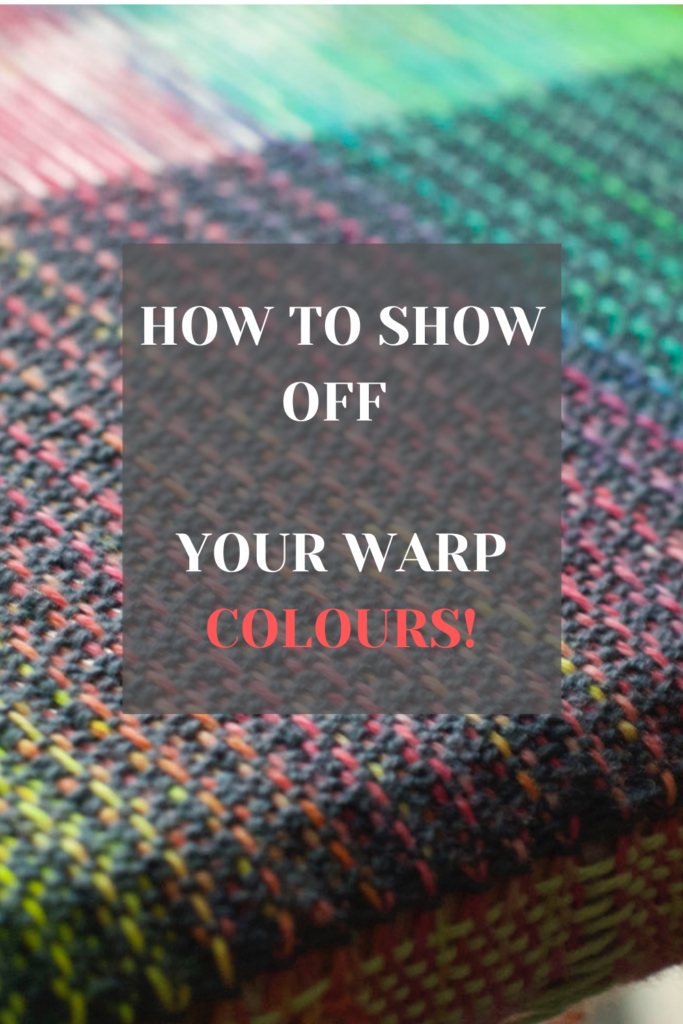
How to show off a multi coloured warp

by Kelly 10 Comments

A frequently asked question is “how do I best show off my warp?” and it’s usually asked in relation to having bright colours, lots of colours or a gradient in the warp.
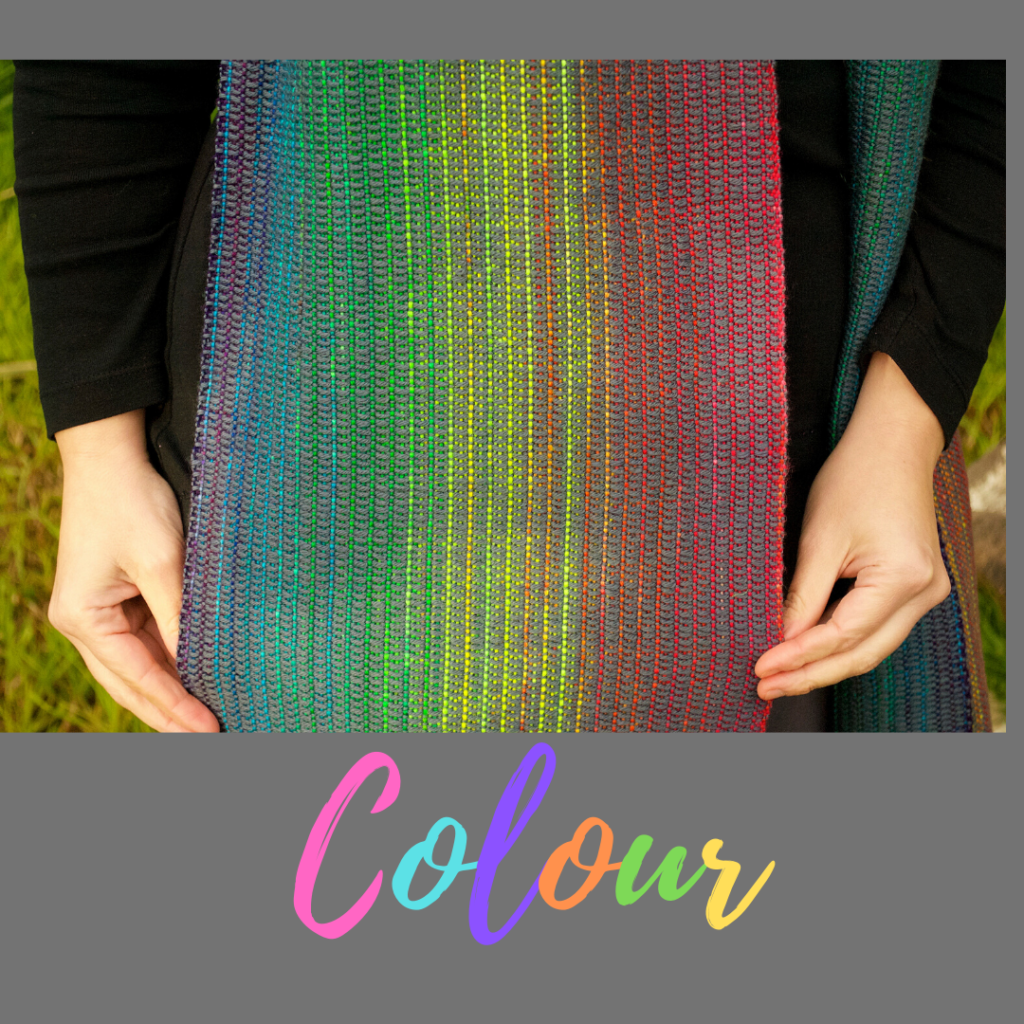
If you have spent a lot of time on your warp to arrange the colours just the way you want to, you certainly don’t want to obscure all that beauty by weaving with an inappropriate weft.

If you’re one of those people who feels a bit bewildered when it comes to choosing colours for a project, check out this article on Basic Colour Theory first 😉

Plan Warp Colours Before You Start

In the planning stages of your warp, you will want to think a lot about how your warp colours will look side by side. There are several ways to visualise this. You can use colouring pencils to just draw and colour in bands of colour next to each other on a blank piece of paper to see if they look pleasing to you.

You can also grab some short lengths of the intended colours in the yarn you are using and twist them together a couple of times. They will twirl around each other and give you an idea of how they will behave side by side.
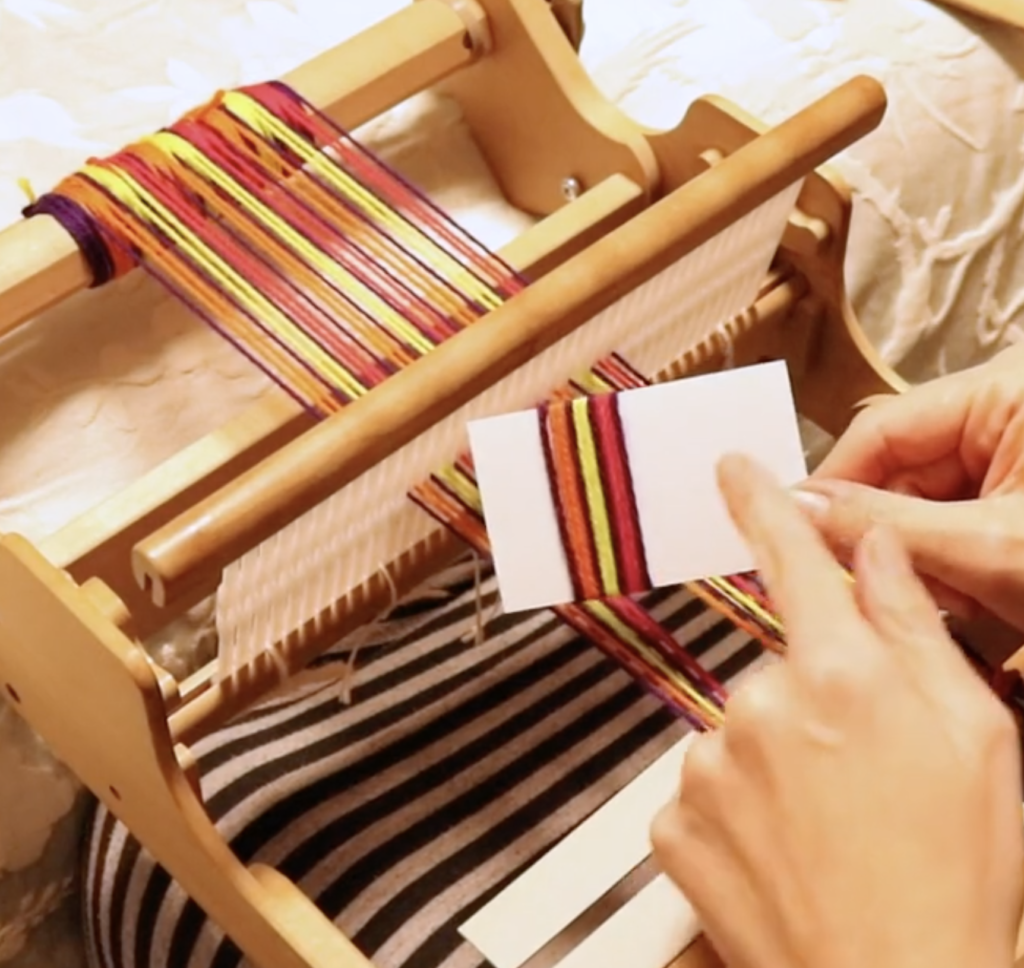
You can also do a wrapping as I have here, which gives a great visual representation of colours and thicknesses of stripes. I teach you how to do this in my members only Gaining Confidence with Colour class.

Don’t Forget The Weft!

It is best that you also plan which weft you will use, but it can be hard to know how different colours and yarns will look on the loom. I highly recommend that you take the time and a little extra yarn to warp up a sampler, which will take all of the guess work out of the project.

In this article, I am sharing some of my samples from my new members only Options for Showing Warp Colours class. The class goes into plenty of detail with yarns used, weaving structures and demonstrations that will give you lots of ideas for your next colourful warp.

Let’s Look At Some Samples

All my samples, excepting one, were woven with woollen yarn but not all in the same thickness. My first sample was a white wool. I particularly wanted to show you how a white weft has the effect of toning bright colours right down. That can be desirable in some circumstances, and not in others. It’s best to know these things before you begin your project to avoid disappointment!

Sample 1
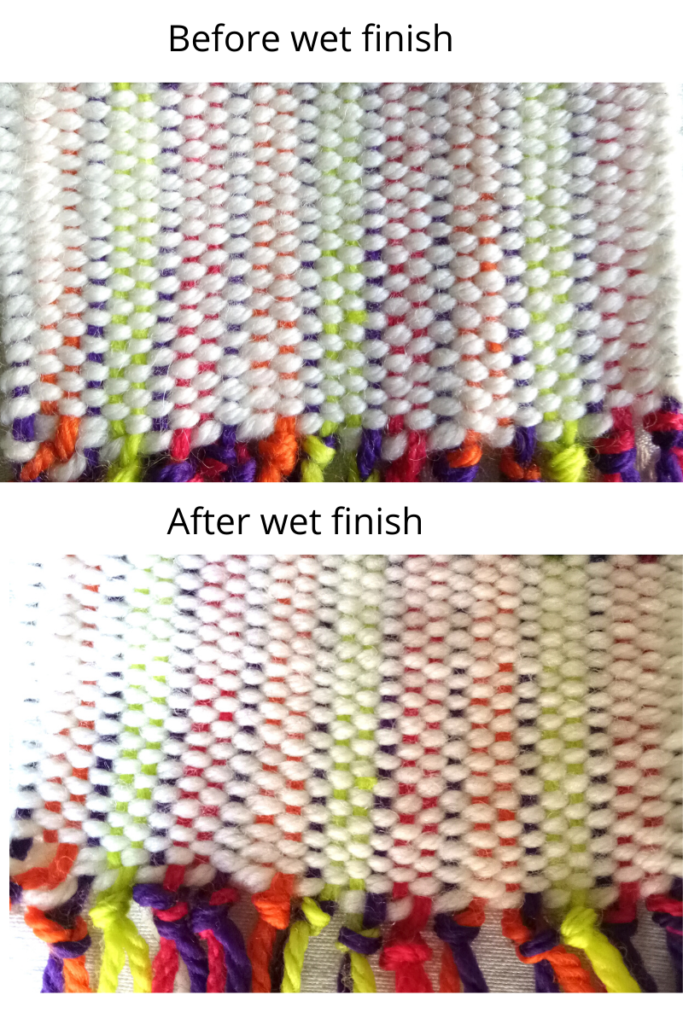
I’ll readily admit that this sample makes me cringe, but perhaps for another weaver it might be just to their taste. Once again, sampling is invaluable in helping to reveal your own personal likes and dislikes. So, while this balanced plain weave sample doesn’t appeal to me in the slightest, that doesn’t mean that I’m against all white wefts!
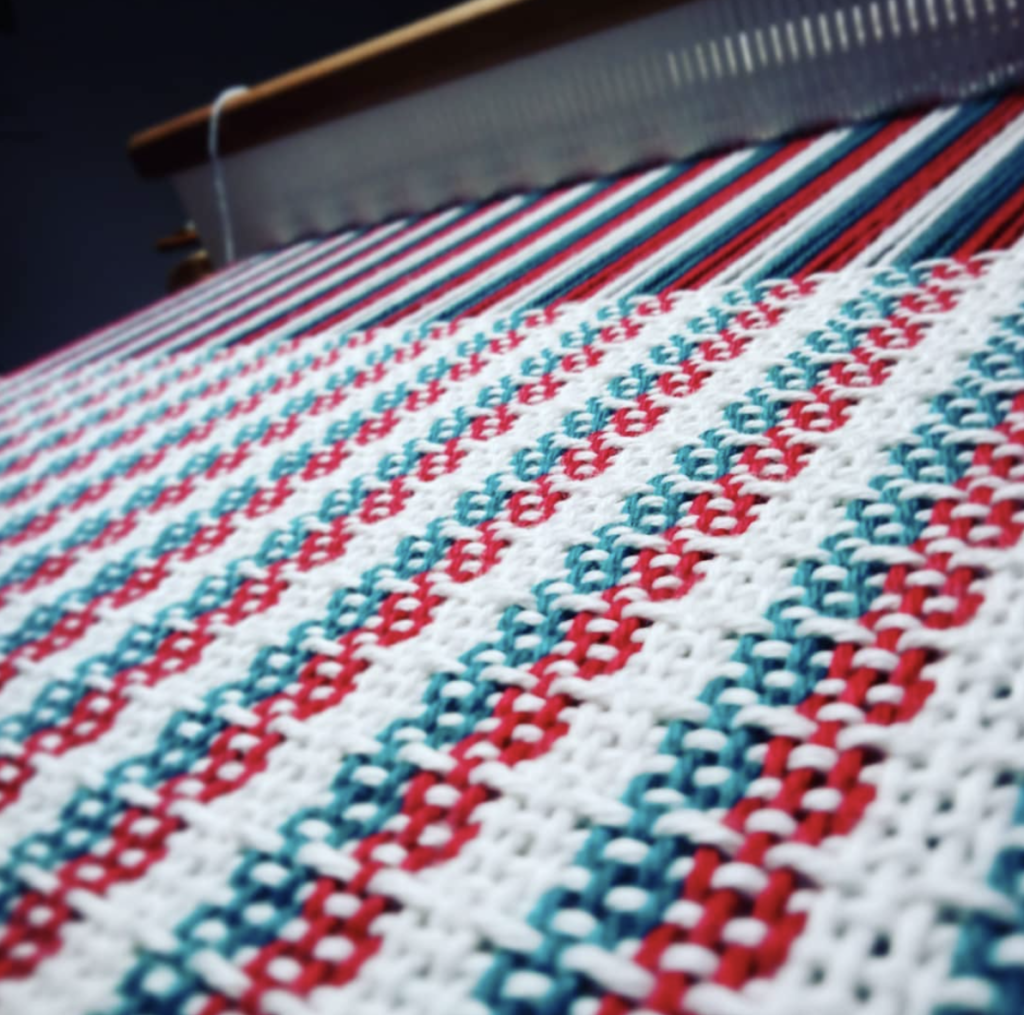
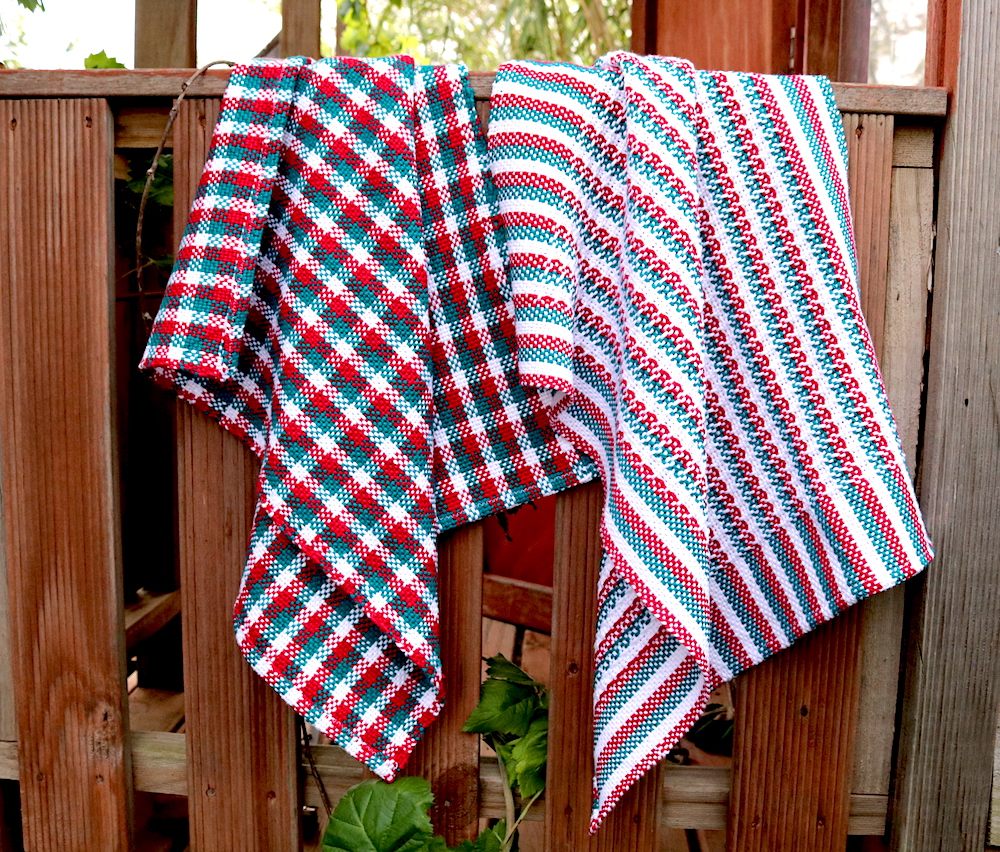
For my second Wash Your Hands Towel I also used a white weft, but look at the difference! In this case, due to the arrangement of colours in the weft and a lovely pick up pattern, white really makes this towel pop in a way that I love.

Sample 2

The second sample is the opposite of the first in that it uses black as the weft. I didn’t have any black in the same weight as the warp, so I used a lighter weight. I had to be careful to beat gently to avoid obscuring the warp altogether. I don’t often use much black in my weaving, as it tends to be so dominant. It can be perfect when pairing with another solid, contrasting colour and an interesting pattern, but for plain weave, once again, I’m not a fan.
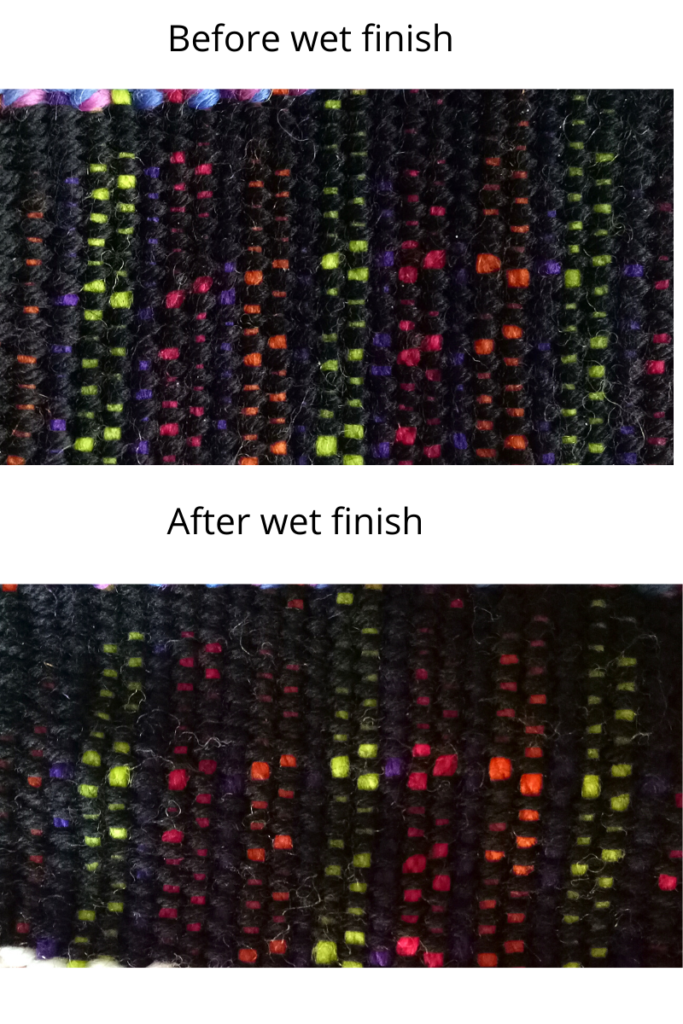
I don’t mind the way the black has little pops of the warp colour, but I do feel that it just wants to take over all those colours I spent time carefully warping!

Sample 3

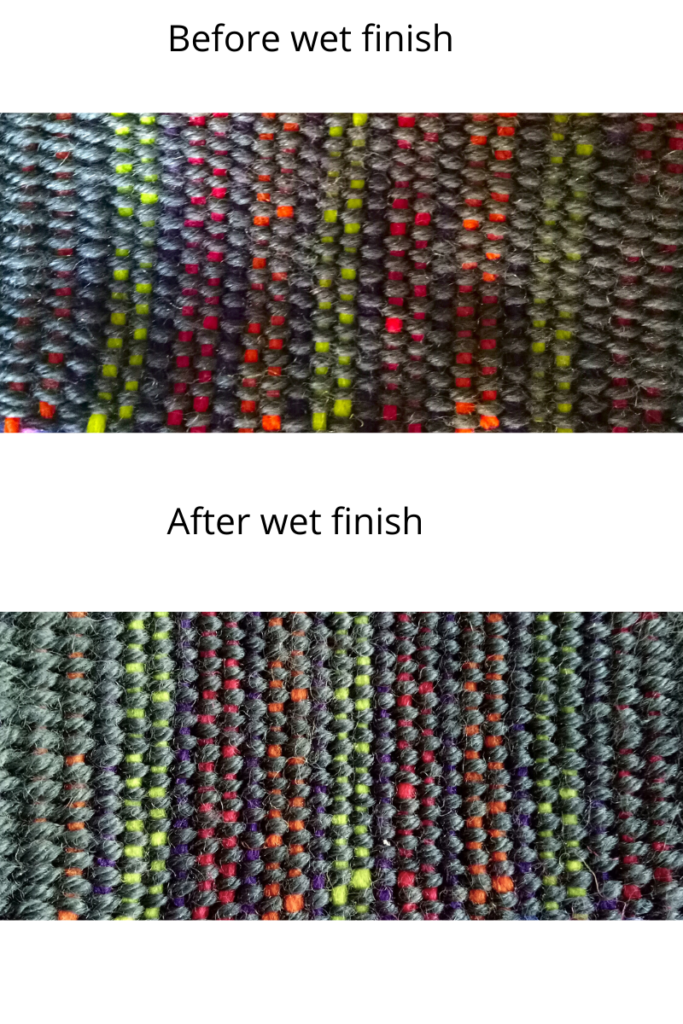
The third sample was a plain weave in dark grey. Dark grey is my preferred option for when I want my warp colours to shine. It seems to harmonise and compliment rather than dominate.
Sample 4

Now on to my favourite option – grey with pick up. This is a total win win situation in my opinion. You have the non obtrusive grey and the openness of the pick up to allow that warp to shine. I find this the most complimentary combination of weft and warp.
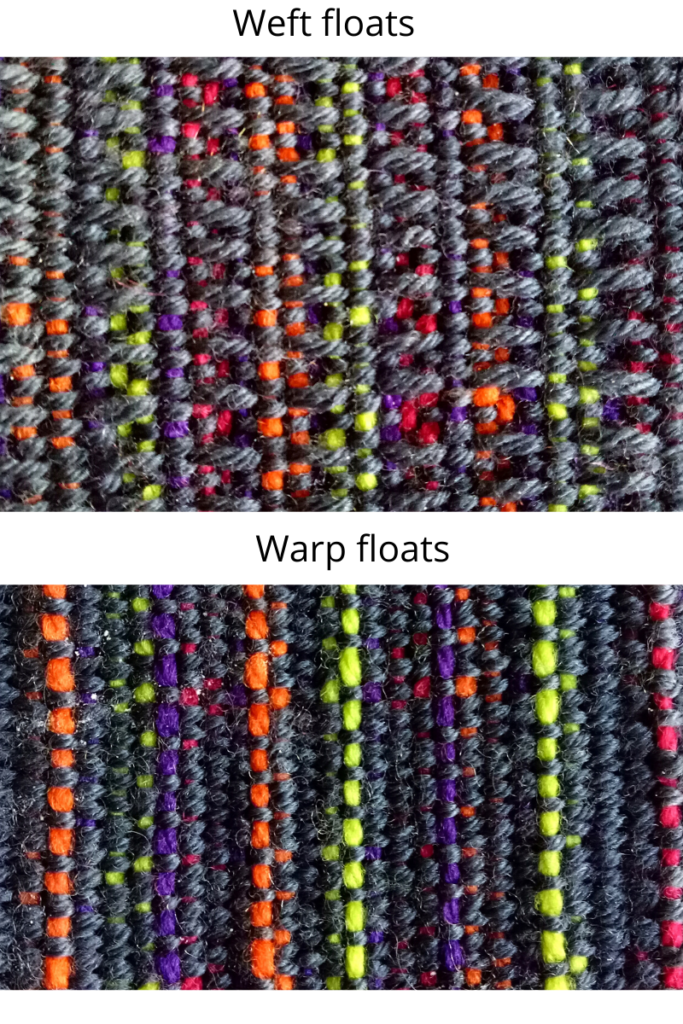
These have both been wet finished.

My Personal Favourites

Before I go, I want to show you some of my favourite projects woven with colourful, gradient warps and grey weft in pick up patterns, just to inspire you!
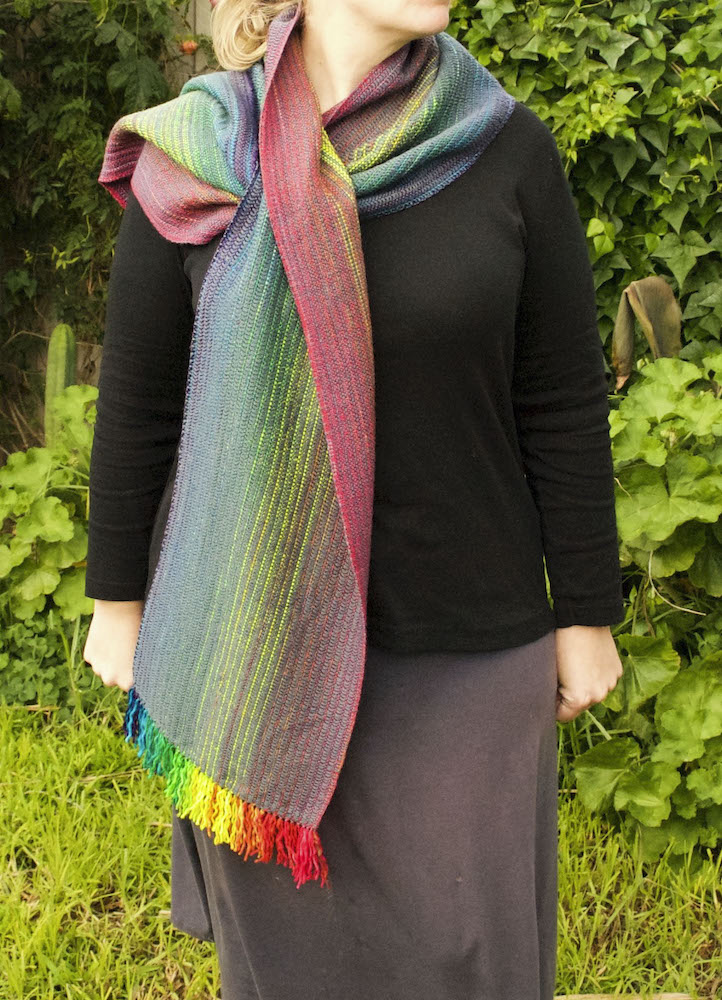
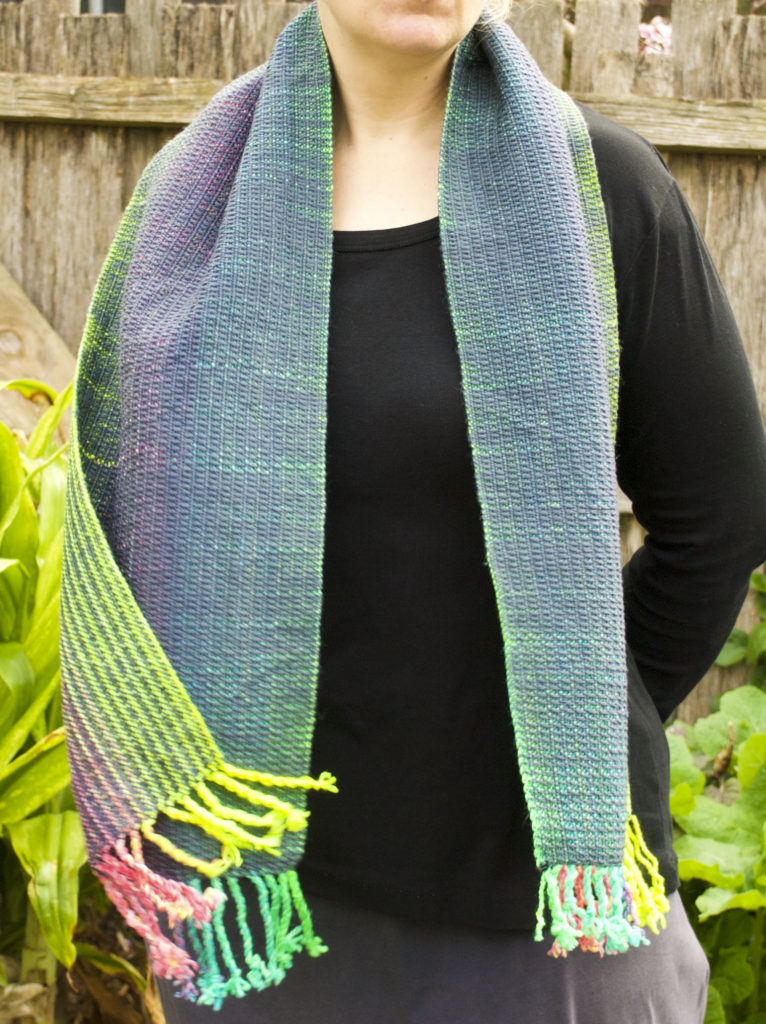
This one is my favourite. It took me a long time to dye that rainbow gradient warp!
Note the reversibility of the design – one side shows weft floats while the other shows warp floats. Pretty cool huh?

I hope this post has helped you to think about ways that you might use wefts to make your warp a stand out. If topics like this are interesting and useful to you, I’m sure you will love my Online Weaving School. There are single classes or memberships available for purchase.

If you are interested to know more about pick up sticks, you will find this article very useful.

I also have available an 11 page printable guide which includes 5 additional pick up stick patterns for you to try out plus a tips and tricks page. You can grab that here 👇

How To Use Pick Up Sticks Printable PDF

As always, if you have any questions or if you enjoyed reading this, please leave me a comment, I love to read them!

Until next time…

Happy Weaving!
Filed Under: Inspiration, Online Weaving School, Rigid heddle weaving, Tutorials, Weaving Tagged With: colour, warping options, weaving advice, weaving with color

Online Weaving School 3 year anniversary giveaway!

by Kelly

It’s hard to believe that 3 years have passed since I began my Online Weaving School. Many of you have been with me for all of that time and longer, but if you’re new here, I’d like to tell you a little about my teaching journey.

*This post contains affiliate links

I’ve always been a creative person but making things with my hands became more important to me when I found myself an at home Mum with 4 children. The urge to relax and create became very strong and somewhat vital. I needed that quiet, meditative time away from my regular daily duties.

I started with embroidery after my mother in law gifted me with some vintage supplies. Then I got a sewing machine and started sewing clothes for my kids. From there I started making dolls. This began my relationship with Etsy, where I sold my dolls. Then bear making, quilting, knitting, spinning, dyeing and weaving. Many of these were learned books, some from just teaching myself and some (especially knitting) from Youtube. Youtube was just becoming a thing at that time. When I came to weaving, I found it the perfect culmination of so many of the arts and skills I had already been practicing for years. When I found weaving, I felt like I had come home.

After I had been weaving for some time and felt very confident at my rigid heddle loom, I felt that I really wanted to share some of the wonderful things I had learned. I was almost bursting with excitement and passion but I didn’t know any other weavers at all.

So I made a video and uploaded it to Youtube. I didn’t know anything about how to teach or how to use Youtube. My son helped me to film and edit to make the video passable. I expected nothing, I didn’t even think about whether anyone would be interested. I just thought it might help someone and I wanted to share.

As it turns out, that video is still helping weavers, 5 years later! People loved the video and asked for more. I made more. And I loved it. It was so rewarding to know that I could help others and share this passion for weaving.

After a while, my Youtube hobby was starting to cost a lot of money in materials and the meagre income from Youtube ads didn’t even begin to cover the expense. I was a stay at home Mum, homeschooling her children and relying on my husband to earn enough income to keep us fed and clothed.

So, using a Youtube paid channel, I started to (gasp! how could I even dare to!) charge for classes. This was a big mind shift for me. People wanted to pay me in exchange for classes!! I still ran my free channel, but the paid channel was a huge blessing. Now at least I could cover my expenses, even if I still wasn’t really earning anything extra. When the Youtube paid channels ceased to exist, I had a fairly sizeable following of enthusiastic weavers. And they still wanted more! So, I found Teachable and set up my tiny Online Weaving School and community.

3 years later, that “tiny” weaving school has grown to over 4000 registered users and 750 paid memberships and is still growing! I am still pinching myself. Thanks to the constant support from my wonderful and loyal students, I now provide the income for my family of 6. This is something I never would have dreamed could happen and I have learned so much. I would go so far as to say that having my weaving school has transformed me as a person – or perhaps better to say, it has formed me into the person I was meant to be.

Aside from all of the obvious benefits the success of the school has brought me are the less obvious blessings. The beautiful friendships and relationships I’ve encountered with weavers all over the world. The ability to help others not just to learn to weave, but to share other difficult life burdens. It is amazing to be in a position where you feel you can truly make a difference to the lives of others!

If you already know or follow me, then you will be aware of my recent free project, The Wash Your Hands Towels. I designed these towels in the time of uncertainty while the world was suffering from the effects (and still is) of the coronavirus pandemic. This has been a hugely popular project and seemed to come at just the right time for many weavers at home under lockdown. I’ve seen lots of different versions completed in a big variety of colours, it’s been wonderful to see.

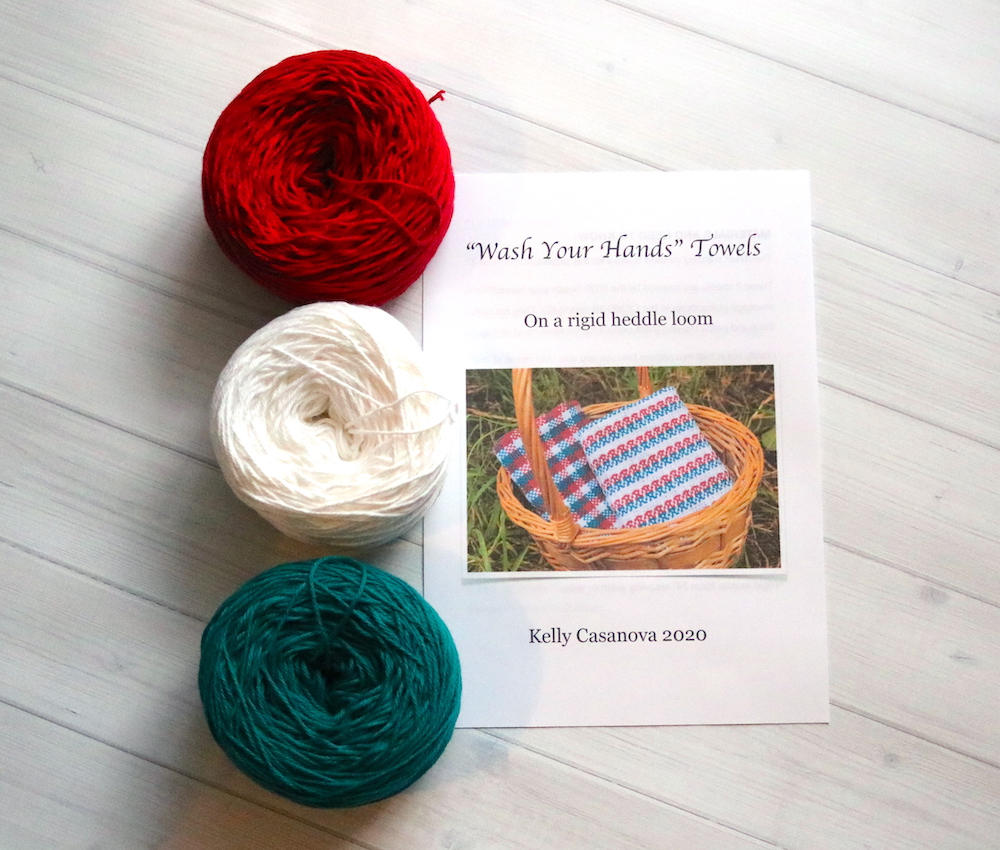
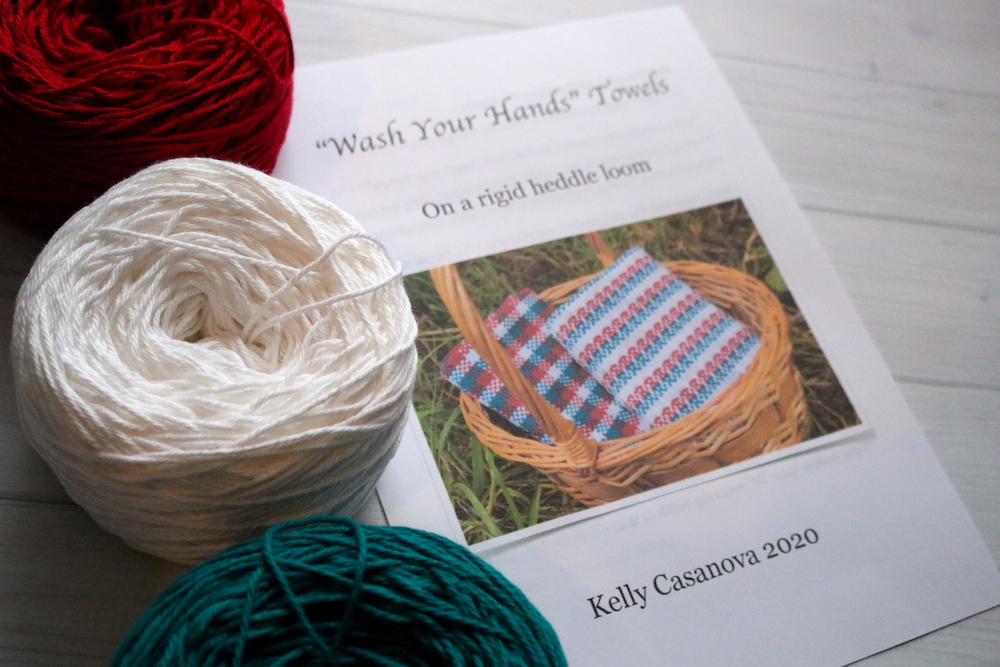
So, I thought a very appropriate way to celebrate this 3 year milestone would be to give away a Wash Your Hands Towels Kit. This kit will be a one off, as I don’t have plans to make kits available for sale.

Included in the kit is all the beautiful Australian cotton yarn you need to make two towels plus a paper printed PDF. You use the PDF in conjunction with the video tutorial. If you wish to know what you need to complete this rigid heddle project, read this post that has all the details.

This giveaway is open to all, wherever you happen to be in the world. Entries are open until the end of this month of May 2020.

To enter the giveaway, please leave me a comment here (only comments on this blog post will be considered entries) and tell me why you would like to win.

Make sure you are on my email list to keep up to date with the giveaway and for the winner announcement.

I look forward to reading all your comments and drawing a winner!

THIS GIVEAWAY IS NOW CLOSED. CONGRATULATIONS TO THE WINNER – VEENA RAGHAVEN!

Until next time…

Happy Weaving!
Filed Under: Free Pattern, Free tutorial, Giveaways, Inspiration, Online Weaving School, Rigid heddle weaving, Weaving Tagged With: anniversary, celebration, giveaway, kit, online weaving school, rigid heddle weaving tutorial, wash your hands towels

High Hopes

by Kelly 14 Comments

I read a quote recently that really impressed me. I don’t make New year’s resolutions, but the end of the year is a perfect time for a bit of reflection. Homeschooling has finished for the year and I try to take a break from making classes and just be peaceful and restful. With this gear change comes thoughts of what I did well during the year and what I could have done better.

The quote was “Have high hopes and low expectations“.

At first glance, it may seem a little defeatist. But something that 43 years on this earth has taught me is that life is a roller coaster. Many wonderful things happen and there are many, often bitter disappointments.

I don’t think it’s life that needs to change though. I think it’s the way we look at it that needs altering. If we expect that everything will be always rosy, we are kind of like spoiled little brats who never experienced a hardship.

Have you ever visited an impoverished country or area? Do the people go about with gloomy faces? Are they angry at life… or at God? No, they have something that many of us in our wealthier society have lost and forgotten.

They have little.

When you have so little, you appreciate what you do have. And you are grateful for anything extra that comes your way. Your life is simple. You have clothing, shelter and food for today – then you have everything you need and you are thankful. You have hopes that life may improve, but you are content to live simply.

So, I’m making this quote my motto for 2020.

My hopes are high. I hope this year that all of my family are happy and have good health. I hope that my business grows and that I can make my Online Weaving School even better. I hope I get lots of time to weave and learn. I hope that my husband’s back injury may improve. I hope that we can meet all of our financial responsibilities. I hope that we can finally make our move to the country. I hope that we have a great homeschooling year. I hope that my understanding of my faith will increase. I hope that I can love and serve God better than ever before.

And I will try to expect nothing.

There is a big difference between hoping for the best and expecting the best. One makes us joyful – the other miserable. One is a freedom, the other a slavery to our own thoughts and desires.

So tell me friends, is this something that you struggle with too? (oh yes, this is a huge struggle for me!) Share your hopes in the comments below!

Until next time…

Happy Weaving!
Filed Under: Health and home, Inspiration, Online Weaving School Tagged With: inspiration, inspiring quotes

What running a creative, online business is really like.

by Kelly 156 Comments

I’m well aware that as an online weaving teacher, designer and encourager, I have a lot of people’s dream job.

I design my own classes and projects, I make my own hours around my family commitments and I work from my own home.

It could be easy for those on the outside looking in to think “she is so lucky” or “I wish I could do that”. And honestly, I consider myself so blessed to be able to do this. But there is definitely more than one downside to being an online entrepreneur.

Tracy from Knit, Spin Weave wrote a blog post recently that was quite candid about the reality of owning a creative business. It struck a chord with me.

Being a part of the online world can have it’s ups and downs. People will type things that they would not dare to say to your face (depending on their level of rudeness I guess!) It has been suggested that I am somehow a greedy person lacking charity because I choose to earn money from my business rather than doing it just as a hobby. I guess that person (and yes, unfortunately it was someone well known in online weaving circles) never too the time to browse through my completely free blog and Youtube channel. Or signed up for my email list for extra free information, patterns and inspiration. I think I have published more free content to the internet than paid content. I guess that person has no idea how much time I spend every single day at my computer responding to questions and helping weavers with advice. That is not paid either, but I feel it’s an essential part of what I do.

Is there something wrong with wanting to earn money doing what you love? I certainly didn’t make any money for a long time and now earn a modest income. Out of that modest income, I of course pay taxes, materials for projects, online selling fees, I could go on and on. I pay well over $1000USD a year for online course hosting, the same for this website, $79USD per month for email hosting. The costs of actually running a business can be huge, thousands of dollars every year, even without a bricks and mortar shop.

There are times, many times where you simply do not make any money. But still, the bills must be met. And the work must continue. Yes, unlike a wage job, you have to continue to put in the work, whether or not you are being paid for it.

As a business owner, I do everything. I don’t have help with the business, apart from my wonderful sounding board husband and my son who occasionally does closed captions for me when he has time. I’m in that very tricky position of the business growing but still not earning enough to hire out help occasionally – every penny goes back into the business and into raising my family.

I did not start out intending to make money from weaving. It was, and is my passion and above all I wanted (and still do want to) share my passion with others and ignite the same passion for them. My Online Weaving School only grew out of a demand from weavers who had seen my Youtube videos – I had no idea about online courses. Over the past 3 years I’ve seen the potential grow from a hobby to a business. This has allowed me to continue to stay home with my family, homeschool our kids and contribute to our income, which has been an amazing blessing and as a stay at home Mum, was something I prayed about for years and years.

A hobby that is all of a sudden taking over every waking hour can not continue to be a free hobby. It would not be fair to my family if I spent so much time on a hobby that did not otherwise contribute to all of us.

Anyone who has seen my online classes or has purchased a pattern could not claim that I overcharge. I purposefully keep my prices as reasonable as I can. I want weaving to be accessible to anyone who wants to learn, that is why I continue to upload to Youtube even though I don’t need to anymore and the revenue that I earn from ads on Youtube is a very, very small portion of my income.

Perhaps it’s the wrong time of year to be writing this kind of post, but I do feel very reflective as the new year approaches. Perhaps it’s wrong of me to share this kind of information with those who follow me for my lessons and tutorials. It’s certainly something I don’t normally talk about, but I want people to know that this is not all easy and fun. Not just for my sake, but for the sake of other business owners in similar situations.

The internet can be so deceptive. I do love Instagram and social media but there are times I just want it all to go away. Social media can be a monster that never rests, there is always someone doing better than you, looking better than you, having more than you. Increasing the anxiety of those who use it. But don’t be fooled. Things are not always as they seem.

If there is only one point that you take away from this lengthy and disjointed post, I hope that it will be this:

Be kind. Don’t judge. Be patient with others. You can’t see behind the scenes and you can’t assume to take everything at face value. People are complicated, life is complicated! We all have to do our best to love one another, even though it’s possibly the hardest thing we are asked to do.

You know what? I think I need to go and weave something wonderful. I’ve been thinking about Krokbragd again…

Until next time…

Happy Weaving!
Filed Under: Inspiration, Online Weaving School, Weaving Tagged With: entrepreneur, online business, weaving

Clasped Warp Quechquemitl Wrap – New Class!

by Kelly 6 Comments

What on earth is a quechquemitl anyway?!

Well, it’s a traditional Mexican upper body garment for women and it’s the inspiration behind my new class.

From what I understand, it is pronounced something like “kech- ka – mil” (please do correct me if I’m mistaken!)

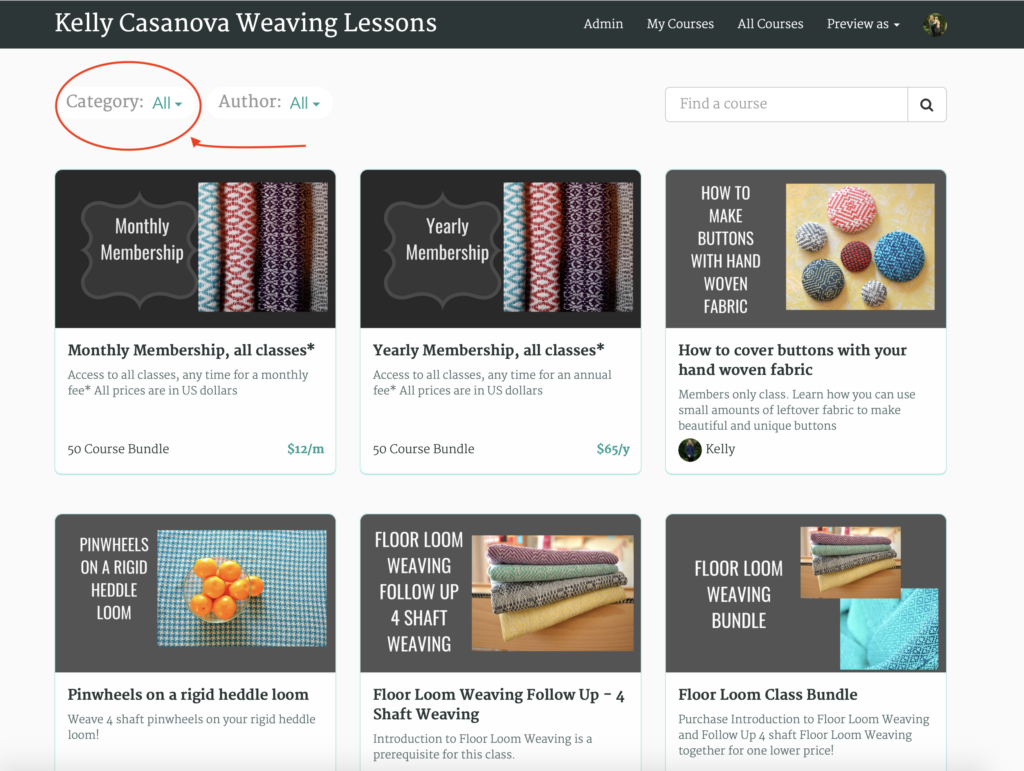
I started researching the quechquemitl because I wanted to find a flattering and easy garment to make with my clasped warp fabric. The clasped warp technique gives a striking appearance to the fabric, and I wanted to utilise that and put it on show.

I started (as all projects should!) with some gorgeous yarn. Tencel and bamboo are both soft and light with an amazing sheen. Perfect for this project!

These fibres made a supple and drapey fabric, and the simple yet contrasting colours make the piece really special.

There are two ways to wear this wrap – in a poncho fashion as pictured above or you can swivel it around so that horizontal lines run across the body. Either way is totally beautiful!

This is a low sew project, so great for those who are dipping their toes in the world of sewing.

This class is available now at my Online Weaving School. You can make a single purchase, or, if you’re already a member you can simply login and enjoy.

Happy Weaving!

Filed Under: Online Weaving School, Rigid heddle weaving, Sewing, Weaving Tagged With: new class, online weaving class, online weaving school, quechquemitl wrap, rigid heddle weaving

How do I find the right class for me?

by Kelly 20 Comments

Currently there are over 60 classes available on my Online Weaving School. That is a lot of classes!

With all of that information, it can be a little tricky for new visitors to navigate the space according to their weaving level.

This little tutorial will show you how easy it is to find a class to suit you!

I have categorised each class into one of three categories:

  • Suitable for beginners
  • Suitable for weavers with some experience
  • Suitable for advanced

*One disclaimer. These categories are general terms that I put together to help you find your way around my classes. They are not set in stone. And please, don’t be put off trying a class just because it’s marked as advanced. Different weavers learn in a variety of ways and at differing rates. If you’re interested in a class, have a look at it before you determine that it’s not for you.

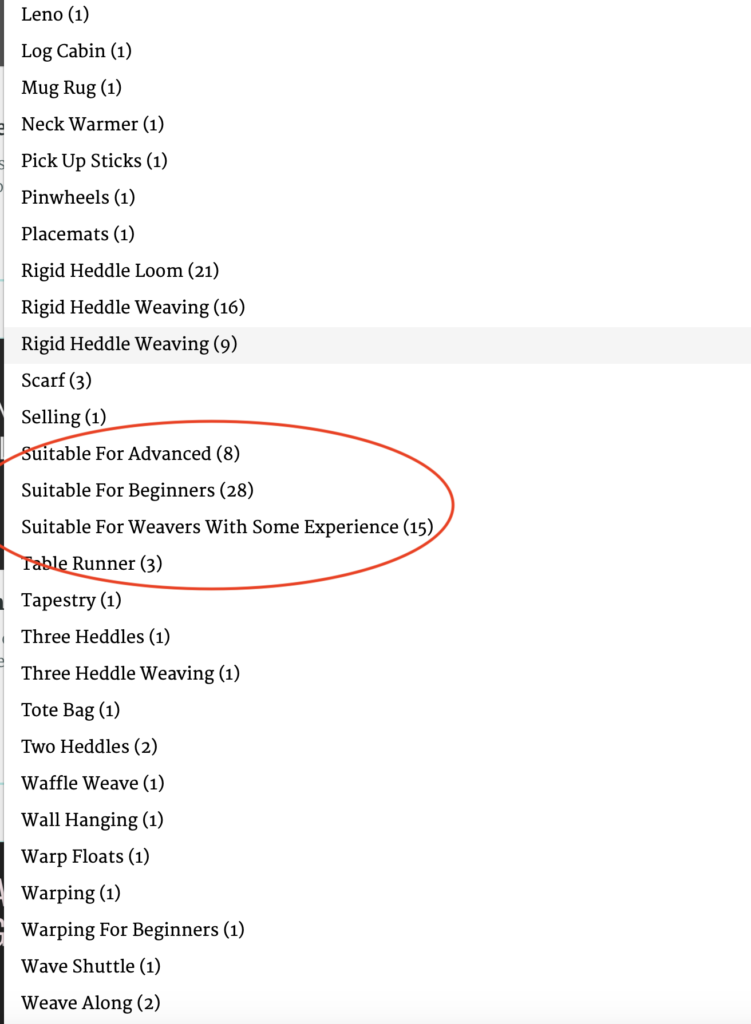
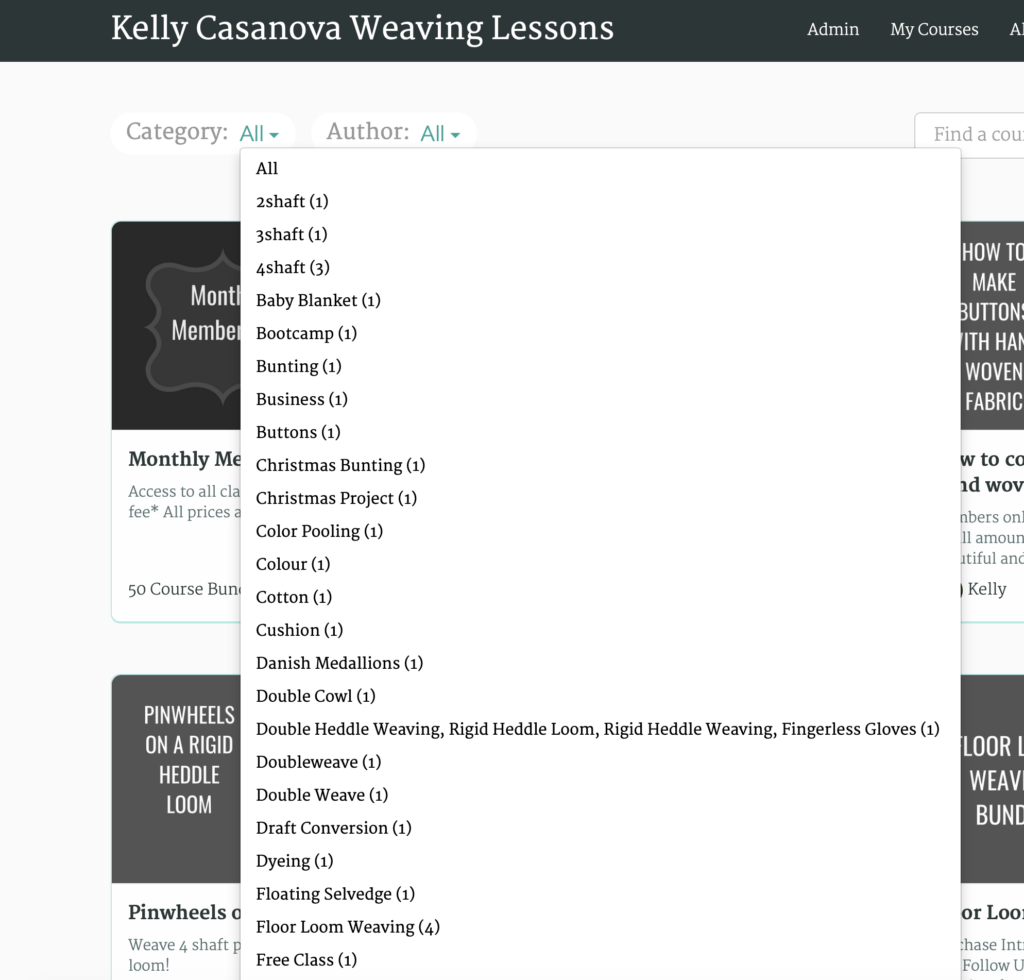
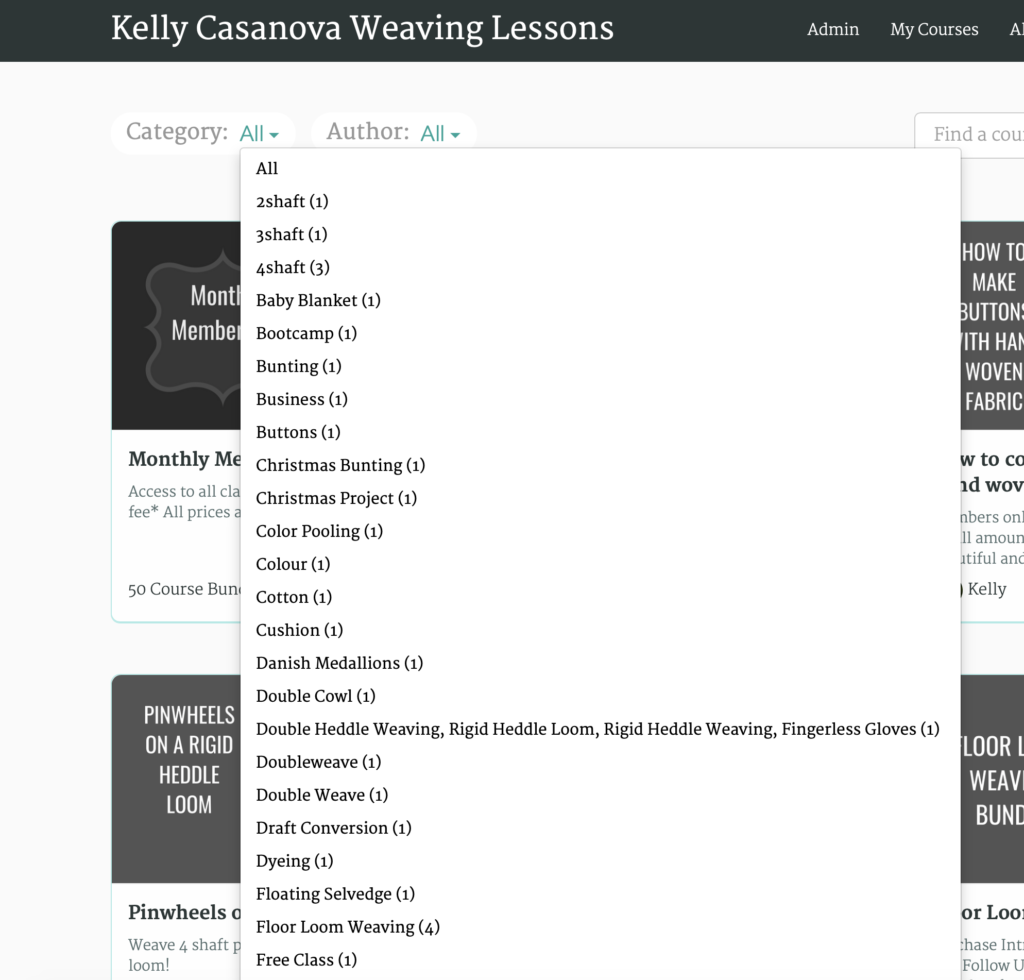
OK, on your homepage at the top left you will see “Category: All”, with a little green upside down triangle next to “All”.

Click on the upside down triangle and a drop down menu will appear.

There are lots of different categories apart from the three I already mentioned. These are in alphabetical order and just there to further help you find classes.

Scroll down until you reach categories beginning with “S”.

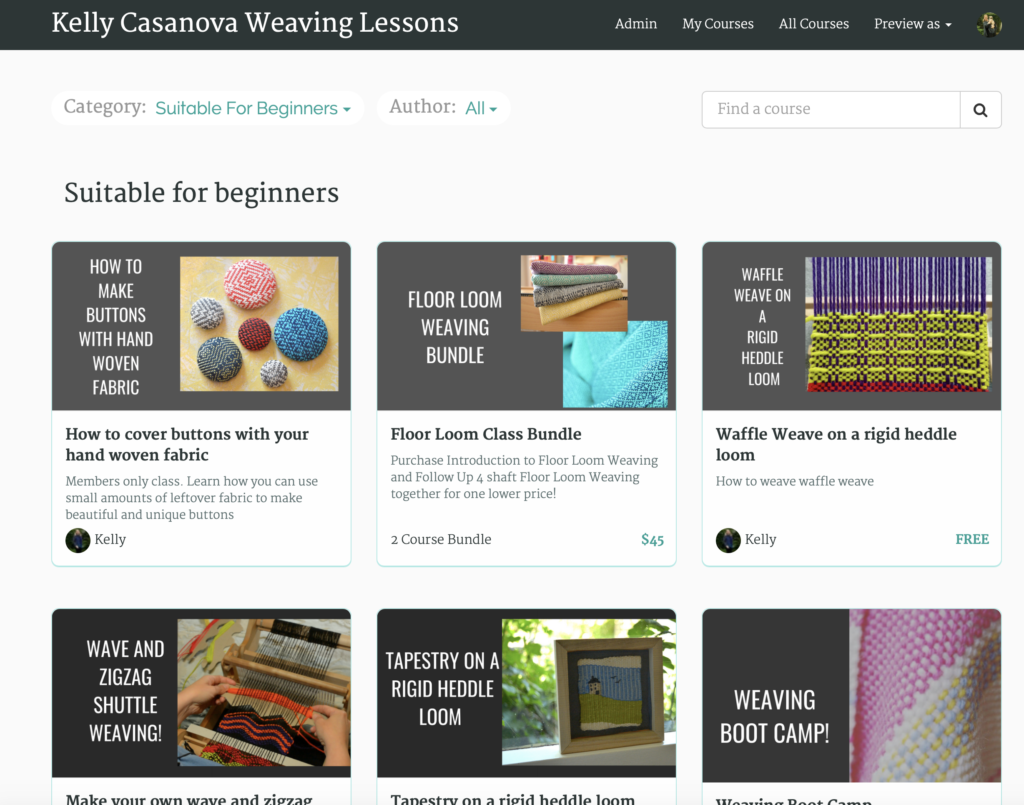
Select the option that you think would be the best fit for your level by clicking on it. I selected “Suitable for beginners”.

You will be taken to a new screen showing you all of the classes that come under the category you collected. From here, you can find out more about any of these classes by simply clicking on the thumbnail.

If you want to check out another category, you simply go back up to the top, click on the upside down triangle next to “Category: All” again and repeat the steps already described.

One of the reasons I chose Teachable as a hosting platform is that I felt it was very straightforward and easy to navigate. However, I have made an additional resource for you, to help make site navigation crystal clear – giving you the best learning experience. This free mini class covers these topics:

  • Sign in
  • Site overview/how to navigate
  • Your avatar
  • Managing your profile
  • Managing your subscriptions
  • How to access/purchase classes

You can access the Teachable Tutorial by clicking here.

I hope this helps you, if you have any questions, please don’t hesitate to comment under this post. I’m always open to suggestions for how I can improve my school, so I welcome your thoughts on this as well.

Until next time…

Happy Weaving!
Filed Under: Online Weaving School, Tutorials Tagged With: online weaving school, tutorial

June Weaving Boot Camp opens today!

by Kelly Leave a Comment

Hi Weavers!

Just a quick heads up to let you know that in just over 2 hours, I will open the doors of Weaving Boot Camp for a short time.

If you are a new weaver or you simply wish to get to know your loom and increase your confidence, this is the course for you!

To sign up, follow this link.

If you want to know more, follow this link.

If you have any questions, leave a comment under this post.

I hope to see you there, I can’t wait to get started!

Filed Under: Online Weaving School, Rigid heddle weaving, Weaving Boot Camp Tagged With: onlineweavingschool, rigid heddle weaving, weaving boot camp

Pinwheels on a rigid heddle loom!

by Kelly 15 Comments

Pinwheels are a bit of an ultimate goal for some of us rigid heddle weavers. I’ve often heard it said that it was a picture of another weaver’s pinwheel project that first excited the interest of some to the rigid heddle loom.

I’ve had many requests for a pinwheels class over the past couple of years, so I finally knuckled down, and as a result “Pinwheels for the Rigid Heddle Loom” is now available.

*This post contains an affiliate link. For further information, please view my disclosure policy.

I really enjoyed making this class, as it’s always a thrill to introduce my students to a project that I know just naturally has the “WOW!” factor in abundance.

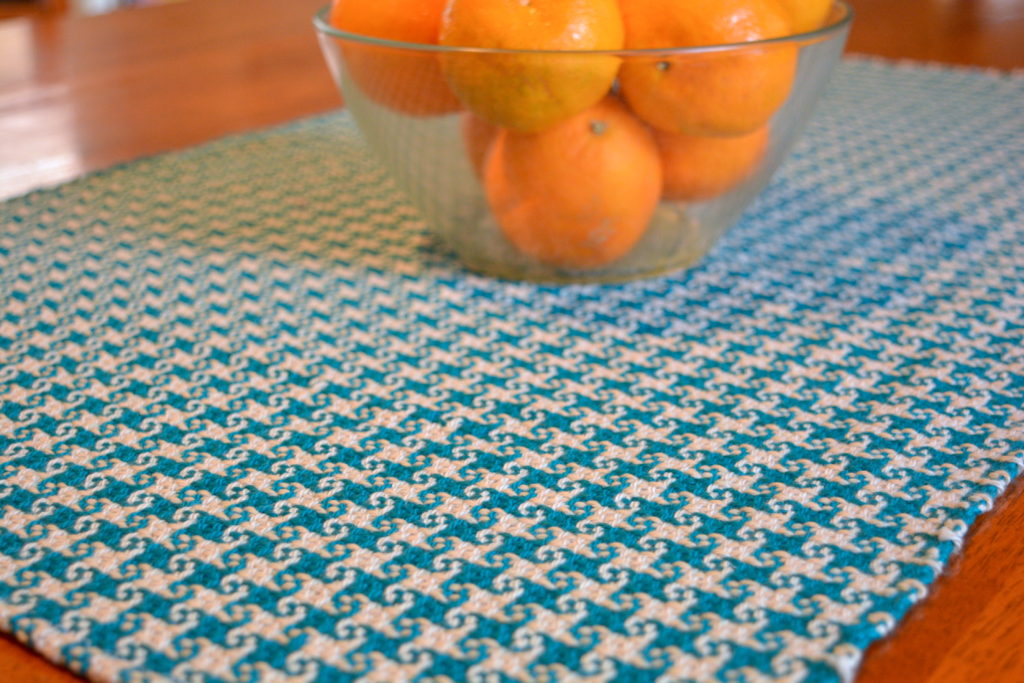
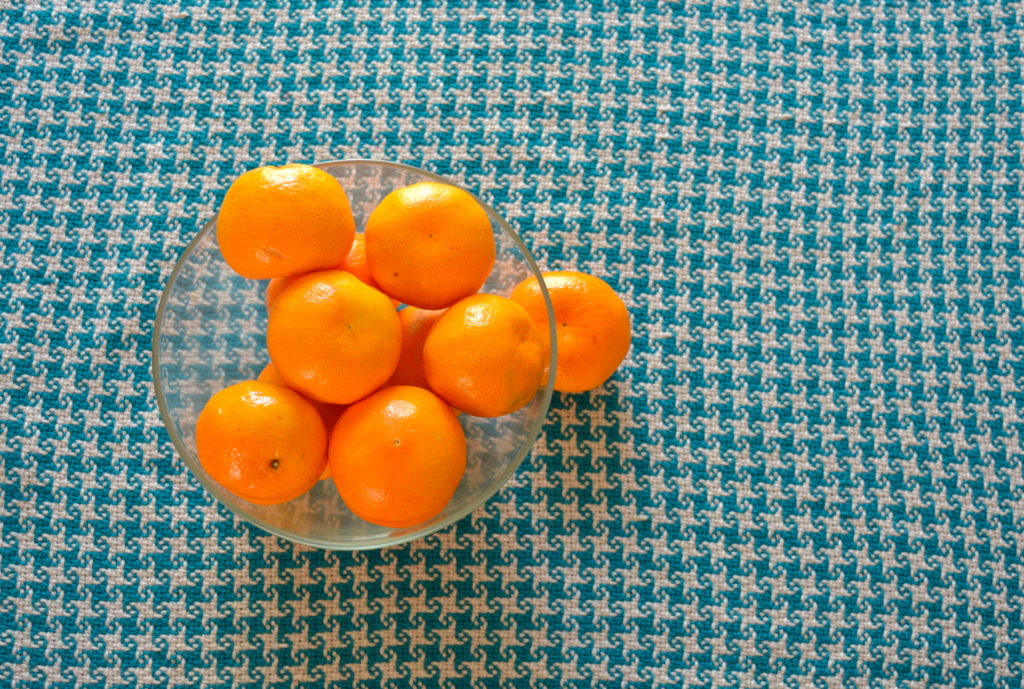
Pinwheels can be woven on either 8 or 4 shafts, and are essentially a twill draft combined with colour and weave to produce something really impressive, but not all that difficult. You have to love that!

For this class, I chose to weave on 4 shafts (for obvious reasons – 4 shafts is way more achievable on a rigid heddle loom than 8!) using a single heddle/reed and 3 heddle rods. The set up is a little time intensive, but very comparative to the time it would take to set up on a multi shaft loom. And once you start weaving, you are more than rewarded for your efforts.

The class demonstrates a Table Topper project (rather like a table centrepiece) but also provides all the calculations for a table runner, if that is your preference. I chose my colours (Latte and Peacock) to co-ordinate with my dining room curtains, which are a greyish coffee colour.

It is important with pinwheels to choose colours that are harmonious yet have enough contrast – you want those pinwheels to pop out at you!

Before undertaking this class, I highly suggest that you complete the “Converting Pattern Drafts to the Rigid Heddle Loom” to gain a good understanding of setting up your loom according to traditional pattern drafts. The Pinwheels class would then build on that knowledge and demonstrate that there are several ways to achieve the same result.

This class is available as a part of any membership to my Online Weaving School, or can be purchased as a single class.

Until next time….

Happy Pinwheel Weaving!

Filed Under: Online Weaving School, Pinwheels, Rigid heddle weaving, Weaving Tagged With: newclass, onlinelearning, pinwheels, rigidheddleweaving

Online Weaving School FAQ’s

by Kelly 88 Comments

Have you been wondering about my Online Weaving School? Maybe you have visited already but feel unsure about where to get started? Today I am going to address some of my most frequently asked questions!


What is your Online Weaving School?

It’s a place I’ve created online for weavers of all different levels and abilities to learn. Because the lessons are all online, the student can learn at their own pace, in their own time, and in the comfort of their own home.


How do I take a class?
You need to be registered and have an account to purchase classes. This is a simple process using your email and a password. Making an account does not cost you anything.
You can look through the classes available, read a little about them and view the curriculum. Many of my classes are available as single purchase classes and there are quite a few free classes you can take as well. 


What is a membership?
You can also purchase a membership. This gives you access to a library of classes and projects. Some of these classes are only available to members. Members are invited to join a private member’s group where we share photos, discussions and ideas. There are also occasional giveaways and live videos just for members.
Member’s also have access to Member’s Only Classes. There are currently 16 of these classes available that are not available to the public.
You have access to the library of classes while your membership is active. If your membership payments lapse or you cancel, you will no longer have access to the classes.


What is the difference between a monthly and yearly membership?

If you want to purchase a membership, you have several choices. Currently available are the Premium Membership, the 6 month membership and the monthly membership.


What classes are included in a membership?
Currently, all classes are included. 
Premium members also enjoy early access to all new classes as I make and upload them. This means that Premium members can access this new content weeks and sometimes months before it’s actual release.


Are memberships always open?
Yes, you can purchase a membership at anytime. 


What is Weaving Boot Camp?
This is a great opportunity for newer rigid heddle weavers, or those who have not yet gained the confidence they desire. The course runs over 4 weeks and is designed to get you going with your loom with step by step instructions and demonstrations. I have had many students tell me that this was the class that solidified weaving for them.


Is Weaving Boot Camp always open?
No. It opens once a year, for a limited time. The best way to keep updated on opening times is through joining my email list.


Are all of your classes for the rigid heddle loom?
Most are, as they are the most in demand.  I also have an introductory class for floor loom weaving plus a follow up to this class. There is the Weaving on a Table Loom course. I also have classes for inkle weaving, and plans for more floor/table loom classes and classes that incorporate other fibre art techniques.


Is there a time limit to watching a class?
No. Once you have purchased a class, you have lifetime access and can view at your leisure. You can go back and rewatch as many times as you wish.
Are your classes downloadable?
Unfortunately not. Due to the prevalence of online course theft, I do not allow downloads of classes. Instead, when you access your classes they are streamed.
How is your Online Weaving School different to your Youtube channel?
Good question! Youtube is where the idea for my weaving school began. Youtube is mostly a short tutorial format and is fairly basic. My Online Weaving School is not just a learning platform, it is also a community. Classes are usually lengthy, with lots of video content as well as printable PDF’s. The general rule is, if you like my Youtube channel, you will love my weaving school!
 
Any more questions I need to add to this list? Let me know if I’ve missed any and I’ll either answer in the comments or update to include them in this list.
 
Happy Weaving!


Filed Under: Online Weaving School Tagged With: FAQs, Kelly casanova weaving lessons, online weaving class, online weaving school, weaving

What is Clasped Weft? A step by step tutorial.

by Kelly 23 Comments

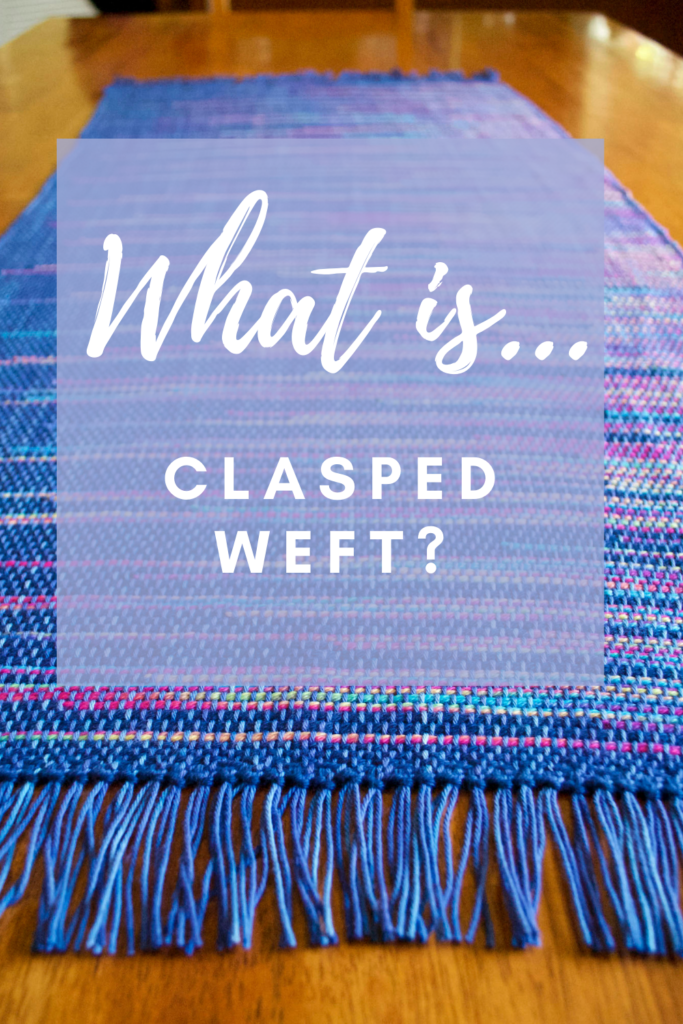
Just when you think you’ve tried everything in weaving, you come across something different, like Clasped Weft.
Clasped weft can be a great “next step” for newer weavers with a few plain weave projects completed and who are ready for something a bit more adventurous.
The cool thing about weaving clasped weft is that, similar to Colour and Weave, most of the work is in using colours to make your weaving look fancy, when in actual fact it is quite simple.
The clasped weft technique uses 2, 3 or 4 interlocking weft colours. Using 2 colours to begin with is the easiest and least complicated approach. If you have done any tapestry, you may already be familiar with the interlocking technique.
*This post contains affiliate links. for more information, see my disclosure policy.

We mainly use a plain weave structure (though clasped weft can actually be used in other structures, such as twill). It is a perfect technique for a rigid heddle loom, because, although it’s simple, it looks special and has big impact.


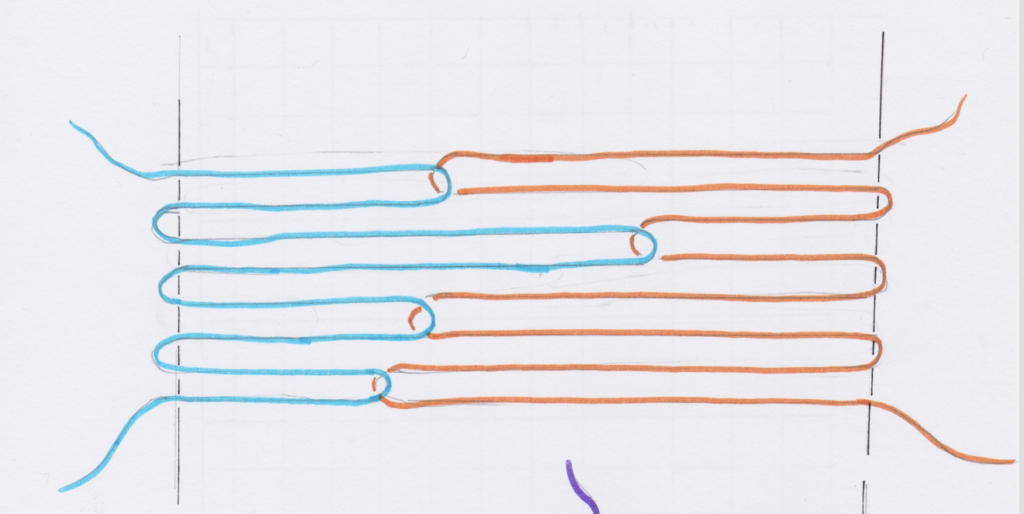
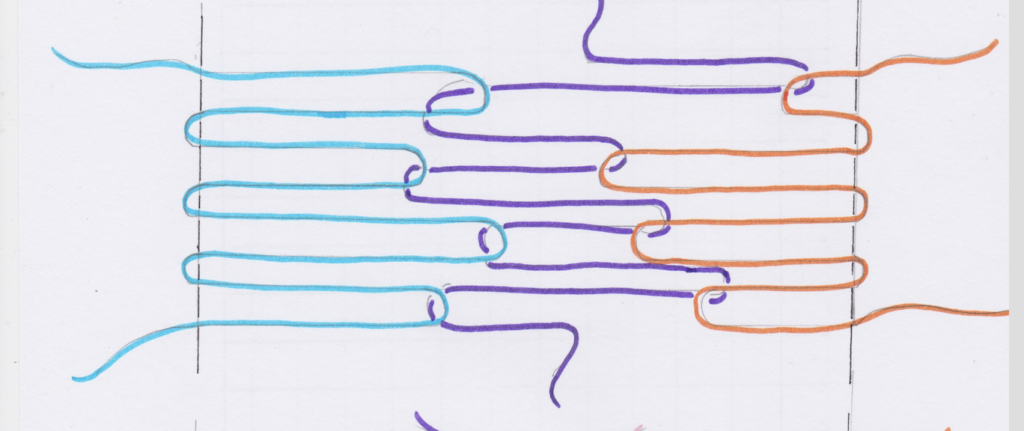
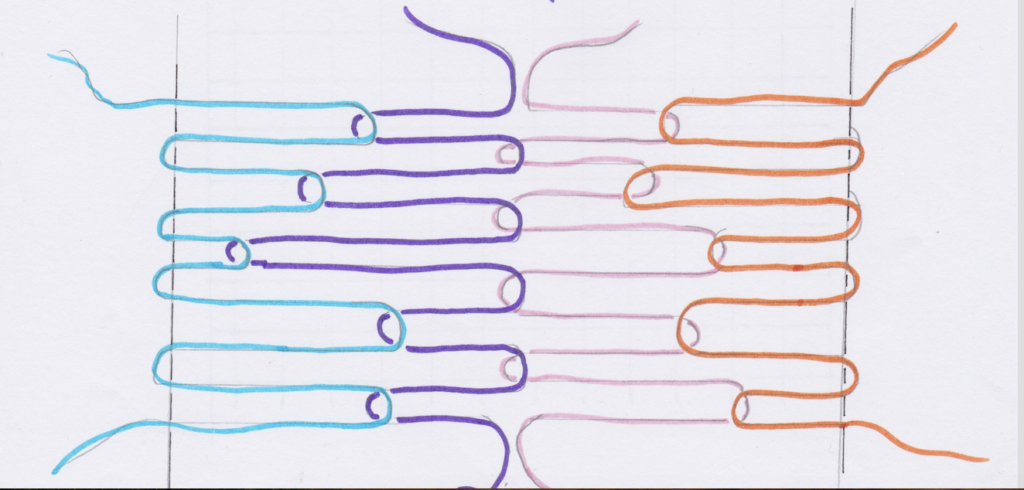
Before we go through the tutorial steps, let’s look at some (rather poorly drawn, sorry about that!) diagrams to get a clearer idea of how this works. The drawings are over simplified, as I haven’t drawn in the warp and weft interlacement, but I have drawn in the edge warp threads:

Clasped weft with 2 weft colours.

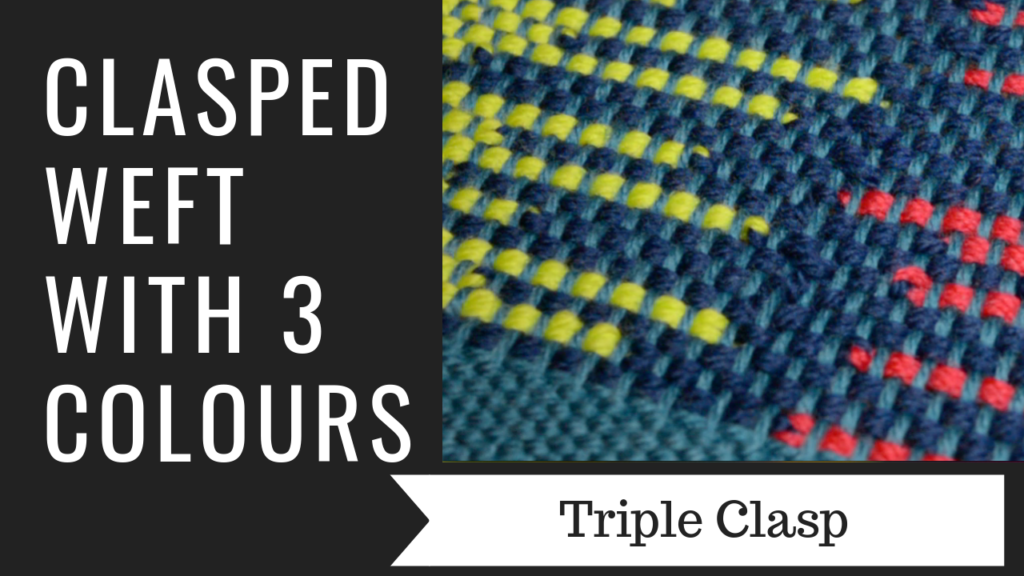
Clasped weft with 3 colours.

Clasped weft with 4 colours.

Now let’s go through the tutorial steps so that you can get clear on how clasped weft is actually woven. Today, we are just focusing on working the two weft colour technique, as I believe this is the best place to begin if you’re not familiar with clasped weft or haven’t attempted it before.
Begin with two contrasting weft yarns of the same weight. I have used one with a dark navy colour and another that is variegated with bright colours.
See the tips section below for more on why variegated works perfectly.
My warp and weft yarns were all light worsted/dk/ Australian 8 ply weight. Wool, acrylic or cotton are all fine.
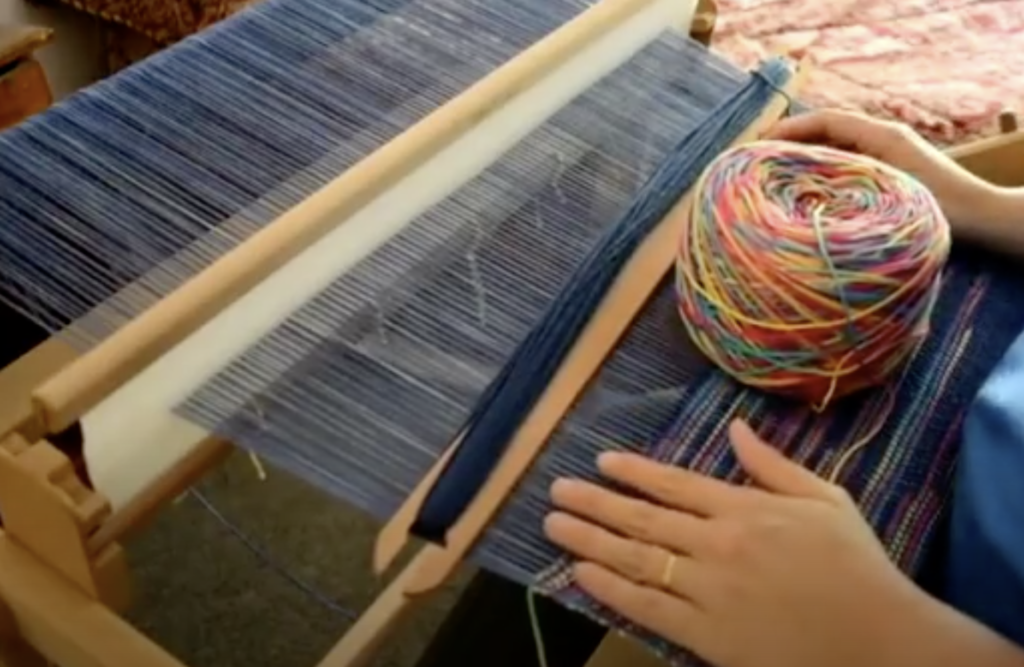
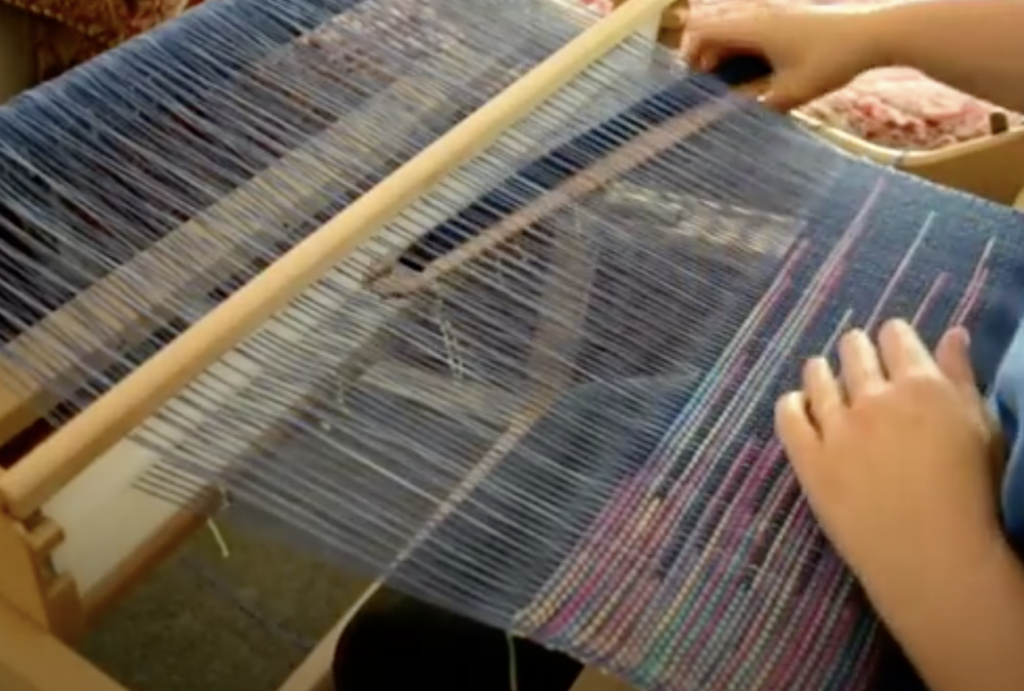
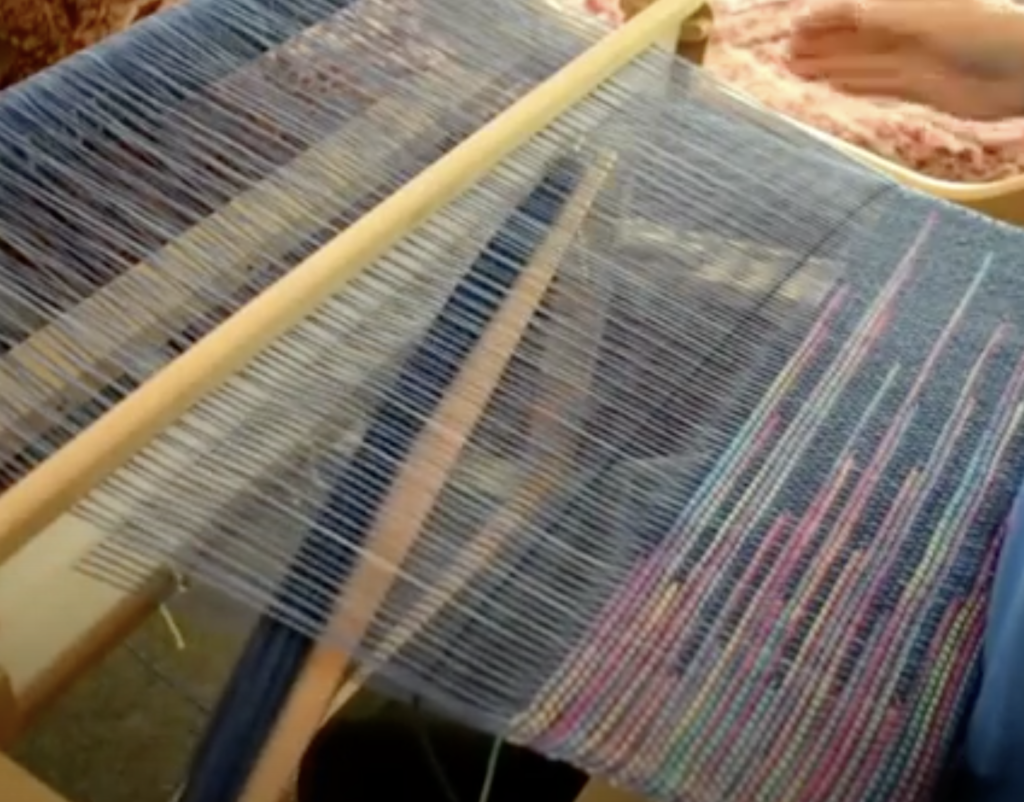
One weft yarn is loaded onto a stick shuttle, in my case this was the dark navy. The other colour is left in a ball or on the cone. My variegated colour was in a skein and so I wound it into a yarn cake with my ball winder.
A yarn cake (also known as a centre pull ball) is particularly good to work with for clasped weft, because it sits nice and flat on the floor and won’t roll away. The yarn also feeds off the yarn cake seamlessly, which makes the whole process that little bit easier. If you have a ball, you may want to sit it in a box or basket on the floor to contain it.
Place the ball of yarn on the floor at your left. It doesn’t matter if you place it on the right or left, but for the purpose of this tutorial it’s on the left.
Because the ball (let’s call it the contrast yarn) is on the left, we enter the shed with the stick shuttle on the right. Again, it doesn’t matter whether you are in the up or down shed, but I am beginning in the down shed.
Take your stick shuttle across from the right hand side to the left as though you’re going to weave a regular plain weave pick.
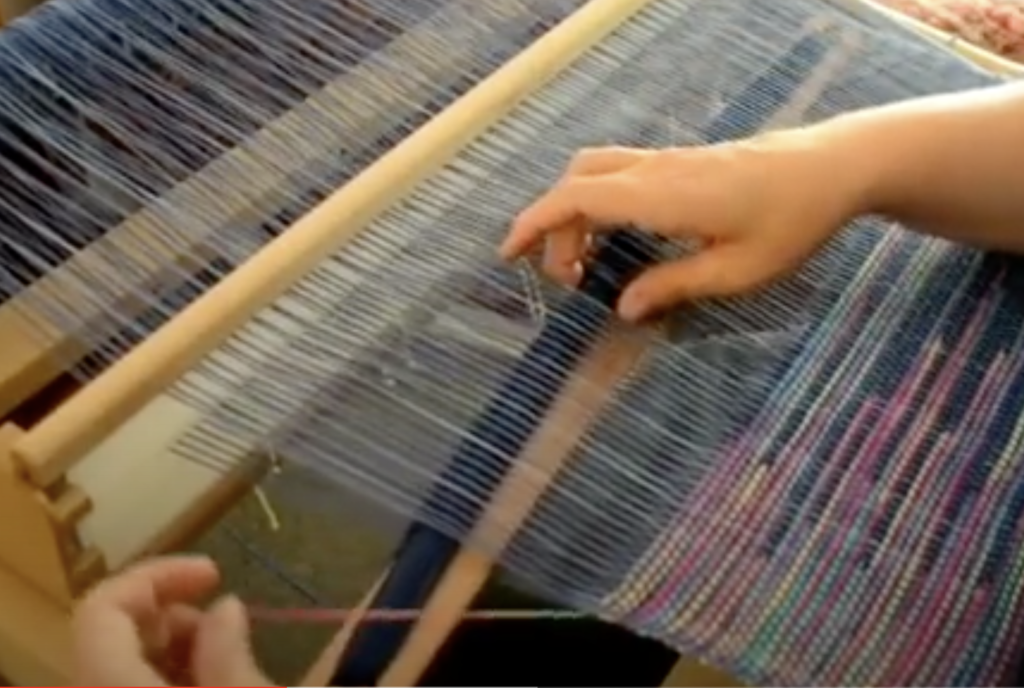
When your shuttle reaches the left hand side, pick up the contrast yarn and place it over the top of the stick shuttle.

Take the shuttle the rest of the way through the shed at the left – as you would for your normal plain weave pick.

On the right hand side (where your shuttle entered), tidy up and prepare your weft yarn as though you’re going to beat the pick in. If you’re not familiar with how to do this, watch my free video on How to Weave Neat Edges.  DON’T BEAT.

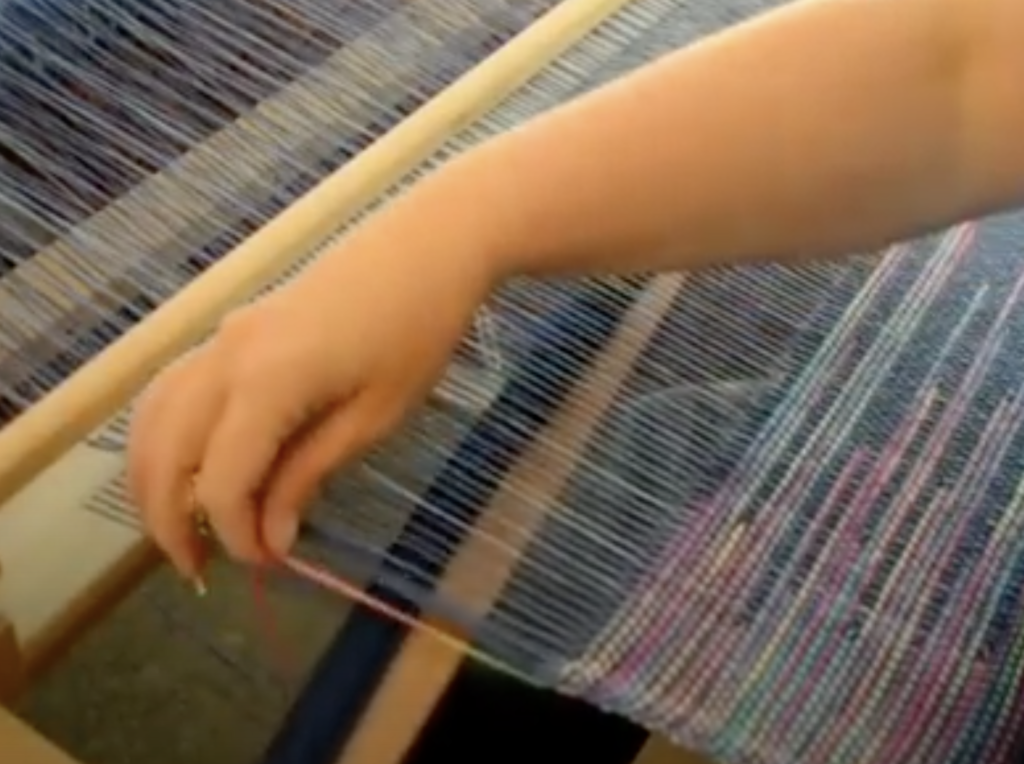
Take the shuttle straight back into the same shed. Don’t change sheds, and don’t beat! Take the shuttle through, back to the right where you first entered the shed.
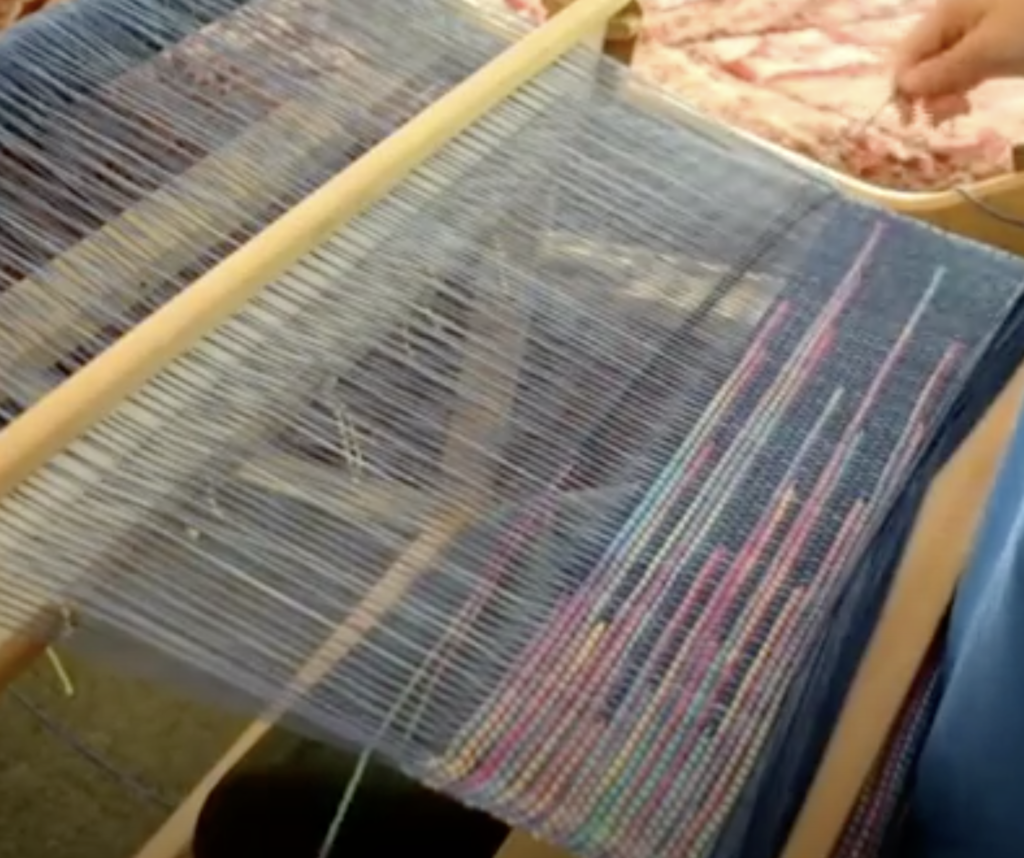
As you return the shuttle to the right, you will find that the navy yarn is linked or clasped with the contrast yarn. This means that the contrast yarn is pulled into the shed. Now you get to decide how far you will pull the contrast yarn into the shed. A little? A lot? Your choice, depending on the effect you want to achieve.
Hold both yarns under tension on either side to manipulate where you want the two yarns to go.
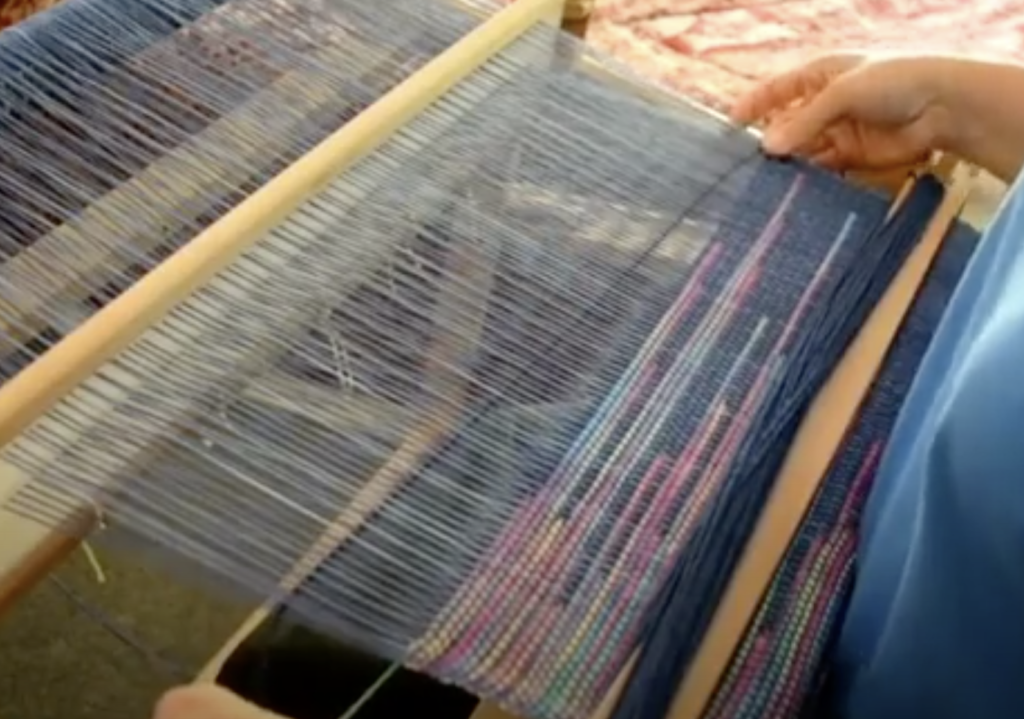
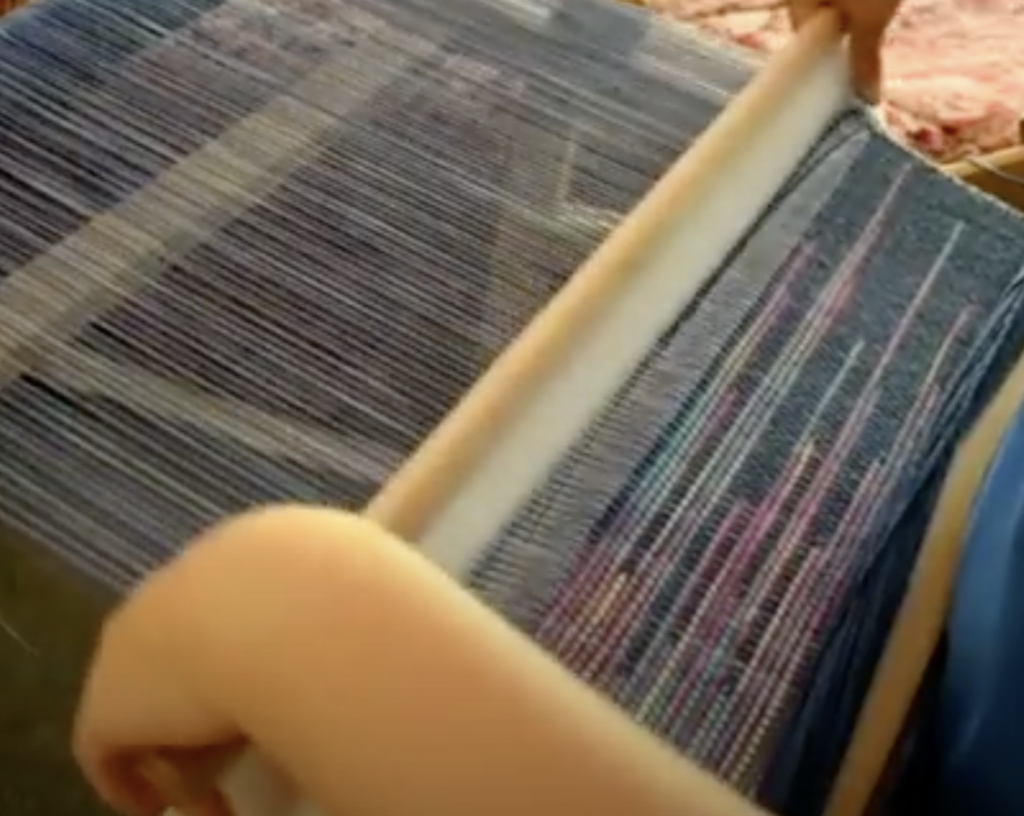
When you’re happy with the yarn positioning, beat the picks into place. You will notice that both yarns are now doubled in the shed.
Change to the next shed (in my case I had been working in the down shed, so I go on to change to the up shed).
Continue weaving in the exact same manner in the new shed and repeat until you’ve finished weaving.
Isn’t your head just swimming with all the possibilities of this wonderful technique?
Clasped weft can be extremely planned or extremely random. It looks wonderful both ways and is just so much fun to weave.
Here are a few recommendations for best results:
1. Use contrasting weft colours.
Light and dark will make the weaving pop. 
2. Use the same weight yarn for both warp and weft.
You will get better results and avoid the not so pretty lumps and bumps that can occur at interlocking points.
3. Variegated yarn is perfect for this.
For the 2 colour clasped weft technique, a variegated yarn with a contrasting yarn looks really cool! (See photos below and above).

              4. Using the same colour as the warp for one of your weft colours works great.

Too much colour can confuse the contrast of the clasped weft lines. In the tutorial, I used the same navy yarn for warp and weft no.1. I then used a contrast yarn for weft no.2.

If you like the look of clasped weft as much as I do, I have some great news for you! I have 3 free Youtube video tutorials that will teach you each of these techniques. Start with video 1 so that you can practice the technique, before moving on to the others. 

Clasped Weft with 2 colours
Clasped Weft with 3 colours
Clasped Weft with 4 colours
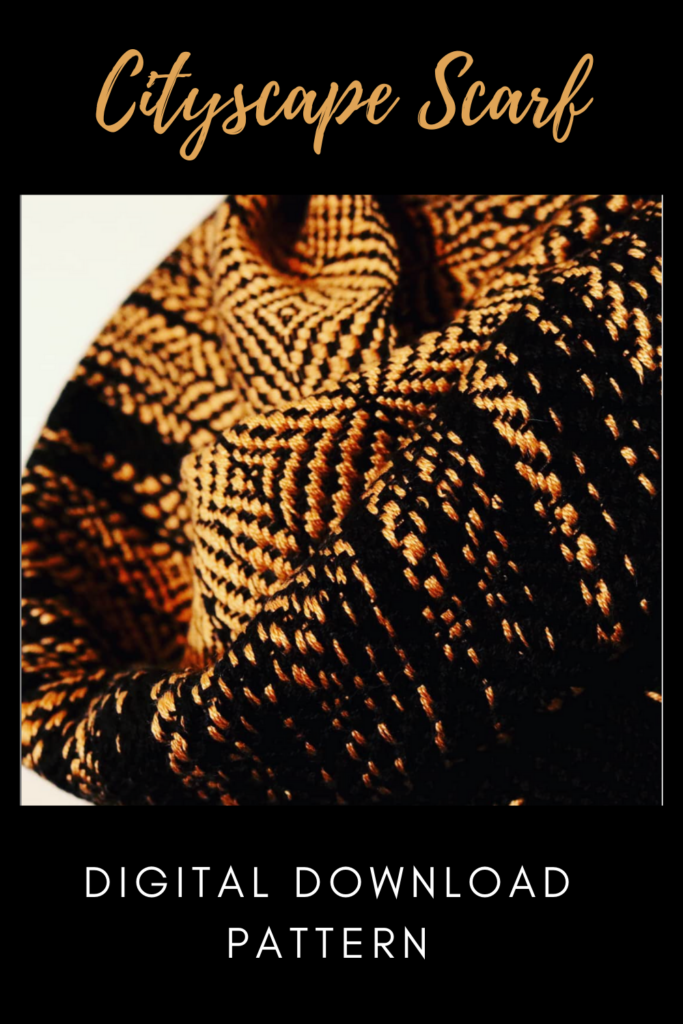
I mentioned that the clasped weft technique can also be used for other weave structures. This can create really interesting and impressive special effects. One of my Etsy patterns, The Cityscape Scarf is a perfect example of a clasped weft combined with a twill.
Try it out and let me know what you think. Leave me a comment here or under any of the Youtube videos, I love to hear from you!
Until next time…
Happy Weaving!
Filed Under: 4 shaft weaving, Free Pattern, Free tutorial, Inspiration, Online Weaving School, Rigid heddle weaving, Rigid Heddle Weaving Patterns, Tutorials, Weaving Tagged With: clasped weft, my youtube channel, rigid heddle weaving tutorial, weaving

  • « Go to Previous Page
  • Page 1
  • Page 2
  • Page 3
  • Page 4
  • Page 5
  • Go to Next Page »

Primary Sidebar

About Kelly Casanova

Hand crafted boat shuttles

Categories

Archives

Meta

  • Log in
  • Entries feed
  • Comments feed
  • WordPress.org

Copyright © 2026 Kelly Casanova Weaving Lessons on the Foodie Pro Theme