• Skip to main content
  • Skip to primary sidebar

Kelly Casanova Weaving Lessons

  • Hi! I’m Kelly!
    • Affiliates Disclosure
  • Online Weaving School Class Index
    • Common account issues
    • Common technical issues
    • What do I get with a membership?
  • New to rigid heddle weaving? Start here!
    • Never heard of the rigid heddle loom?
    • How to weave neat edges on the rigid heddle loom
    • Rigid heddle weaving
    • Rigid Heddle Weaving Patterns
  • Patterns
  • Subscribe

Weaving

5 Steps to Successful Weaving!

by Kelly 13 Comments

It is my belief that anyone can be successful in weaving if they really want to. It is important to break the learning process down into achievable steps. Remember that you can’t begin at someone else’s finish!
Here are my 5 steps to successful weaving!

This post contains an affiliate link. I only recommend products I use and love.


1. Basics first.
Start out simple. Acknowledge that, as a beginner, leaping into a difficult project straight away is probably not the best way for you to get started. If you do, you may end up feeling discouraged and that you’re “no good at weaving”. When learning something new, it is rare for anyone to jump into an advanced level, you need to take the baby steps, then walk, then run!


2. Patience.
You see the images from weavers on Pinterest and Instagram. They look so fabulous that they inspire you to try weaving for yourself. That is natural, that is how I started. But to get to the point of being able to weave anything like the beautiful images, it may take quite some time, and it may not be easy. Mistakes are an important part of the learning process. Know that you will improve, if you practice and give it time.


3. Persistence.
Would you believe me if I told you that I have almost given up on weaving a number of times? There were times that I was so frustrated and had no one to help, that I thought surely I must be just too stupid to learn this, or that I felt I was wasting my time. I’m so glad I never did give in though! Imagine where I would be now – a beginner level weaver with too much equipment gathering dust, and a feeling that I had failed. Keep going. Get stuck? Go back to the basics. Find help. Buy that new book you need, some online classes, or find people in your area with similar interests. There is a way. You can do it!


4. Resources.
I could say that I am a self taught weaver, but realistically that is not really true. I have learned this craft through reading many books, studying articles, drafts and discussions online, and by taking online classes. When I got my first loom, I had no idea where to start. I didn’t know any weavers. I was too busy caring for my family to be able to attend a guild. So, I found the right resources that helped me get going. As I improved, I found more resources to help me level up. Resources are out there – lots of them, you just need to find the right ones for you. 


5. Community.
Funny for an introvert like myself to have “community” as one of the keys to success. I’m the type who avoids social settings wherever possible and hates the idea of group meetings or activities. Like many other typical introverts, social occasions are physically draining and just mostly not enjoyable. However, that doesn’t mean that I hide in a hole and don’t see or speak to anyone! 
I never would have realised the importance of community until I started weaving. My community is online and I am so grateful for it. I have daily contact with hundreds, if not thousands of weavers across the globe and of all different levels of ability. We teach and learn through one another, share information and discoveries, and most importantly, we inspire one another. It’s a beautiful thing to have the support of others who are just as passionate about weaving as you are. 
So, whether you love real life interaction or virtual interaction, find the people who are going to help you succeed in weaving!


I hope this article was helpful to you! Perhaps you are looking for some new resources? Here are a few to get you started:


My Youtube Channel


My Online Weaving School


My Weaving Lessons Facebook Group


Filed Under: Inspiration, Weaving Tagged With: learn to weave, weaving, weaving success

What is Clasped Weft? A step by step tutorial.

by Kelly 23 Comments

Just when you think you’ve tried everything in weaving, you come across something different, like Clasped Weft.
Clasped weft can be a great “next step” for newer weavers with a few plain weave projects completed and who are ready for something a bit more adventurous.
The cool thing about weaving clasped weft is that, similar to Colour and Weave, most of the work is in using colours to make your weaving look fancy, when in actual fact it is quite simple.
The clasped weft technique uses 2, 3 or 4 interlocking weft colours. Using 2 colours to begin with is the easiest and least complicated approach. If you have done any tapestry, you may already be familiar with the interlocking technique.
*This post contains affiliate links. for more information, see my disclosure policy.

We mainly use a plain weave structure (though clasped weft can actually be used in other structures, such as twill). It is a perfect technique for a rigid heddle loom, because, although it’s simple, it looks special and has big impact.


Before we go through the tutorial steps, let’s look at some (rather poorly drawn, sorry about that!) diagrams to get a clearer idea of how this works. The drawings are over simplified, as I haven’t drawn in the warp and weft interlacement, but I have drawn in the edge warp threads:

Clasped weft with 2 weft colours.

Clasped weft with 3 colours.

Clasped weft with 4 colours.

Now let’s go through the tutorial steps so that you can get clear on how clasped weft is actually woven. Today, we are just focusing on working the two weft colour technique, as I believe this is the best place to begin if you’re not familiar with clasped weft or haven’t attempted it before.
Begin with two contrasting weft yarns of the same weight. I have used one with a dark navy colour and another that is variegated with bright colours.
See the tips section below for more on why variegated works perfectly.
My warp and weft yarns were all light worsted/dk/ Australian 8 ply weight. Wool, acrylic or cotton are all fine.
One weft yarn is loaded onto a stick shuttle, in my case this was the dark navy. The other colour is left in a ball or on the cone. My variegated colour was in a skein and so I wound it into a yarn cake with my ball winder.
A yarn cake (also known as a centre pull ball) is particularly good to work with for clasped weft, because it sits nice and flat on the floor and won’t roll away. The yarn also feeds off the yarn cake seamlessly, which makes the whole process that little bit easier. If you have a ball, you may want to sit it in a box or basket on the floor to contain it.
Place the ball of yarn on the floor at your left. It doesn’t matter if you place it on the right or left, but for the purpose of this tutorial it’s on the left.
Because the ball (let’s call it the contrast yarn) is on the left, we enter the shed with the stick shuttle on the right. Again, it doesn’t matter whether you are in the up or down shed, but I am beginning in the down shed.
Take your stick shuttle across from the right hand side to the left as though you’re going to weave a regular plain weave pick.
When your shuttle reaches the left hand side, pick up the contrast yarn and place it over the top of the stick shuttle.

Take the shuttle the rest of the way through the shed at the left – as you would for your normal plain weave pick.

On the right hand side (where your shuttle entered), tidy up and prepare your weft yarn as though you’re going to beat the pick in. If you’re not familiar with how to do this, watch my free video on How to Weave Neat Edges.  DON’T BEAT.

Take the shuttle straight back into the same shed. Don’t change sheds, and don’t beat! Take the shuttle through, back to the right where you first entered the shed.
As you return the shuttle to the right, you will find that the navy yarn is linked or clasped with the contrast yarn. This means that the contrast yarn is pulled into the shed. Now you get to decide how far you will pull the contrast yarn into the shed. A little? A lot? Your choice, depending on the effect you want to achieve.
Hold both yarns under tension on either side to manipulate where you want the two yarns to go.
When you’re happy with the yarn positioning, beat the picks into place. You will notice that both yarns are now doubled in the shed.
Change to the next shed (in my case I had been working in the down shed, so I go on to change to the up shed).
Continue weaving in the exact same manner in the new shed and repeat until you’ve finished weaving.
Isn’t your head just swimming with all the possibilities of this wonderful technique?
Clasped weft can be extremely planned or extremely random. It looks wonderful both ways and is just so much fun to weave.
Here are a few recommendations for best results:
1. Use contrasting weft colours.
Light and dark will make the weaving pop. 
2. Use the same weight yarn for both warp and weft.
You will get better results and avoid the not so pretty lumps and bumps that can occur at interlocking points.
3. Variegated yarn is perfect for this.
For the 2 colour clasped weft technique, a variegated yarn with a contrasting yarn looks really cool! (See photos below and above).

              4. Using the same colour as the warp for one of your weft colours works great.

Too much colour can confuse the contrast of the clasped weft lines. In the tutorial, I used the same navy yarn for warp and weft no.1. I then used a contrast yarn for weft no.2.

If you like the look of clasped weft as much as I do, I have some great news for you! I have 3 free Youtube video tutorials that will teach you each of these techniques. Start with video 1 so that you can practice the technique, before moving on to the others. 

Clasped Weft with 2 colours
Clasped Weft with 3 colours
Clasped Weft with 4 colours
I mentioned that the clasped weft technique can also be used for other weave structures. This can create really interesting and impressive special effects. One of my Etsy patterns, The Cityscape Scarf is a perfect example of a clasped weft combined with a twill.
Try it out and let me know what you think. Leave me a comment here or under any of the Youtube videos, I love to hear from you!
Until next time…
Happy Weaving!
Filed Under: 4 shaft weaving, Free Pattern, Free tutorial, Inspiration, Online Weaving School, Rigid heddle weaving, Rigid Heddle Weaving Patterns, Tutorials, Weaving Tagged With: clasped weft, my youtube channel, rigid heddle weaving tutorial, weaving

Weave Along Round Up

by Kelly 3 Comments

The Krokbragd Mug Rug Weave Along (try saying that with a mouthful of cake!) has been a great success! While many students are still working on their mug rugs and some have yet to start, I have been seeing so many wonderful photos of their work, that I couldn’t wait to share.


What I really love is the variety of mug rugs I’m seeing and the range of interpretations of my original design.


Charlotte, who has been with me a long time, and is a very prolific weaver, came up with several variations on the original design. She even figured out how to weave sheep and then shared the draft with the other students, several of whom were inspired to weave their own sheep!

Mary went with some darker colours and white highlights. So lovely!
This is one of Kelly’s (a different Kelly!) interpretations. I love that she included many different colours, but that they all work together so harmoniously.


And another, different rug from Kelly. You can see Charlotte’s sheep and my tulips (from this Youtube tutorial).

And finally, these beauties from Connie. So lovely!

Robyn decided on a bold and traditional design for this mug rug. Love the colours!

Perhaps you’re looking at all these gorgeous mug rugs and wishing you had joined in? No problem, you still can! 
All the details are here.

Thanks to everyone who joined in and threw themselves into the challenge with such gusto, it has been so exciting for me to see.

This weave along leads beautifully into the next class, which will be a krokbragd bag with two heddles. I’m working on that right now, it should be ready in a couple of weeks.

Until next time….

Happy Weaving!


Filed Under: Weaving Tagged With: Kelly casanova weaving lessons, krokbragd, rigid heddle weaving, weave along

Lacking inspiration? Do this!

by Kelly 6 Comments

We all have those days, usually when we’re overworked and overtired, when we want to do something but don’t know where to start. We don’t feel inspired and we wish an idea would just magically come.

Let me tell you my failsafe method for getting rid of the “no inspo blues”! 

My kids actually taught me this one. Every time I want them to do a big clean up of their bedroom or play area, they start to get busy but within a short amount of time I hear. “Mum, look what I found!”  “I actually forgot I had this!” And eventually, it becomes a battle to keep them focused on the task of cleaning up because they’re excited about rediscovering old games, toys and books.
Once the clean up is finally done (this whole process can be similar to having teeth pulled) they are much happier. Not only have they found things that they’re excited about, they now have a clean, uncluttered space to use those things in.

See where I’m going with this?

When I feel tired and uninspired I often find myself wandering into my studio, looking around, sighing, maybe working on a couple of unfinished things half heartedly.
But, once I get out the duster, pull everything off the shelves, clean and rearrange, then the change within my head starts to happen.
I’m reminded of all the beautiful yarns and threads just sitting there waiting to be used. I put these yarns into order so that they are better displayed and I can easily find what I want. I start to get ideas for new projects. I restack my reference books. Hey, I haven’t looked at that one for a while, let me just have a flick. Ooo, I love those colours, I wonder how I could incorporate that into my weaving! And once I’ve done the shelf, I notice how messy my big storage container has become, so I tackle that next. Oh, and what about the table? How can anyone get any work done on a table that is covered with stuff and getting dusty? 

It’s not too long before my messy place is clear and clean. In turn, my mind now feels clear and clean. I have mental plans for my next steps forward and I know it’s going to be all the more enjoyable because everything is in it’s proper place.


So, next time you’re lacking inspiration, get into your creative space and get organised! Then, get making!


Filed Under: Weaving Tagged With: my creative space, weaving

Kelly’s hand woven, perfectly hemmed technique.

by Kelly 23 Comments

*This post contains affiliate links
I won’t tell you how long these towels have been sitting on my creative table waiting to be hemmed. What is it with final techniques and me? I go to all that trouble to weave something beautiful and then let it sit there for who knows how long before I get around to hemming!  
Anyway, lets focus on the positives. The towels ARE hemmed now, and I’m going to share my simple but effective hemming techniques with you!
Firstly, always weave a little extra where you intend to hem, and don’t forget to factor in hemming allowances to your overall calculations. I like to make a little contrast weave at the beginning and end of a piece that I’m going to hem. Here I’ve woven plain weave borders at either end. There are 2 advantage to this – 
1. The contrast looks nice.
                                                                       2. The border is less bulky and therefore makes a more crisp and pleasing hem.
You can see that my raw edge is secured on a serger to prevent any unravelling during the wet finishing process. It is helpful to give the whole woven piece a good press before beginning, it’s always easier to work with pressed fabric.
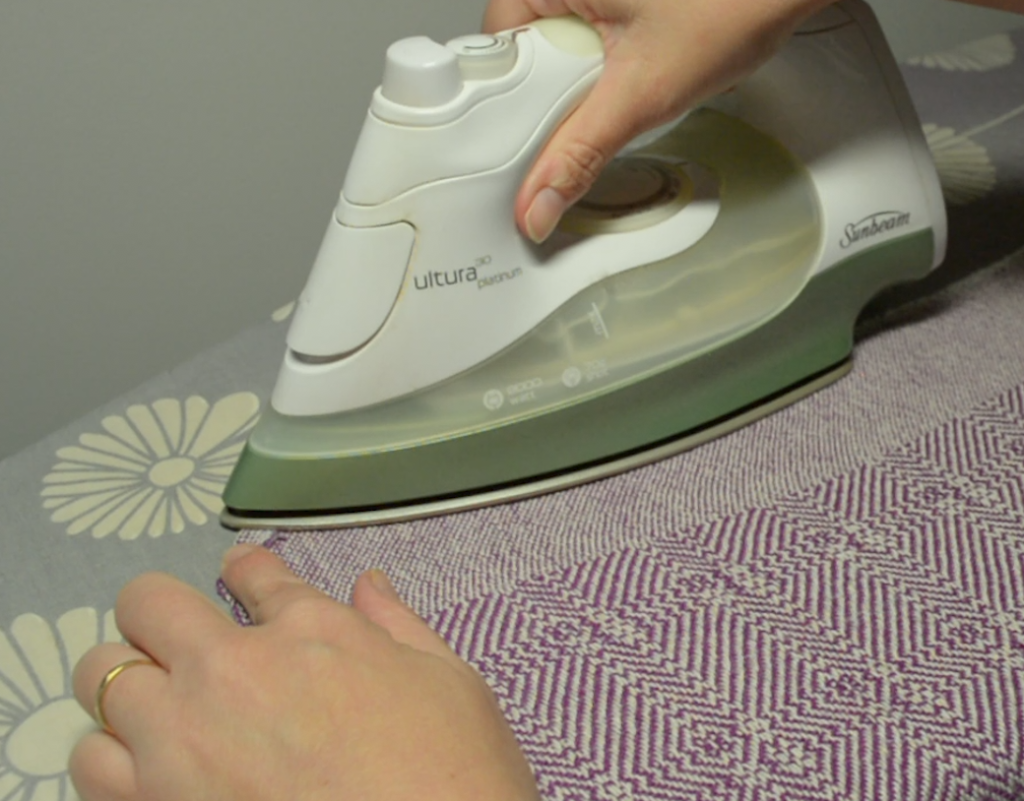
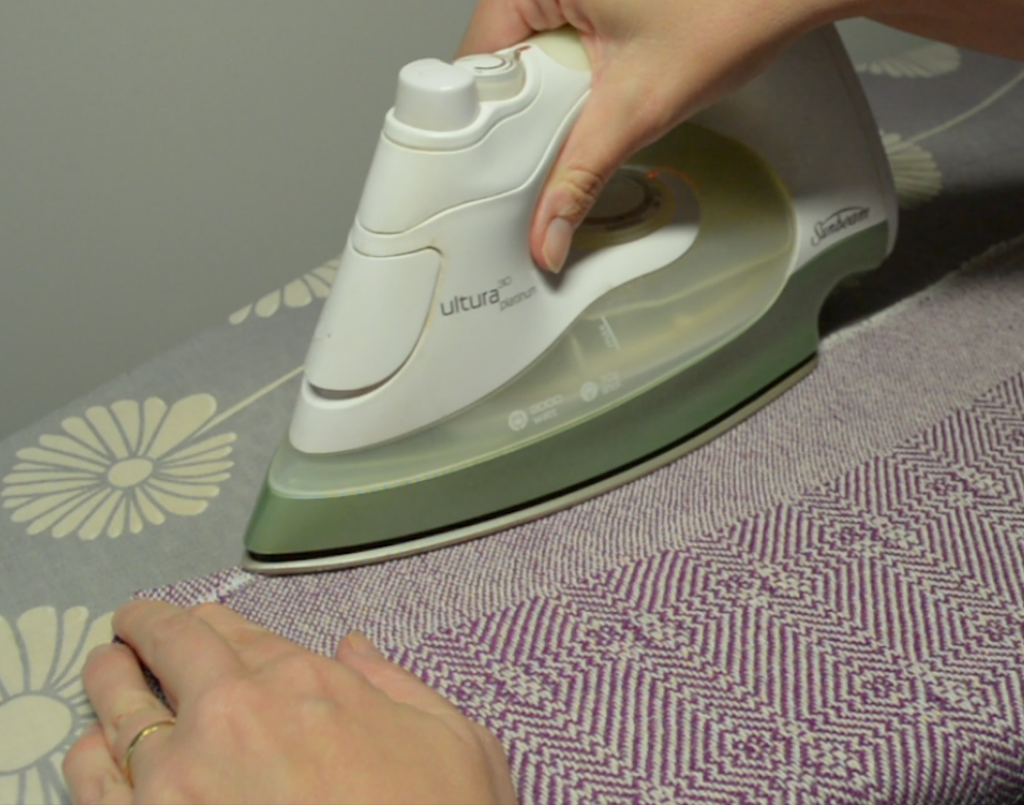
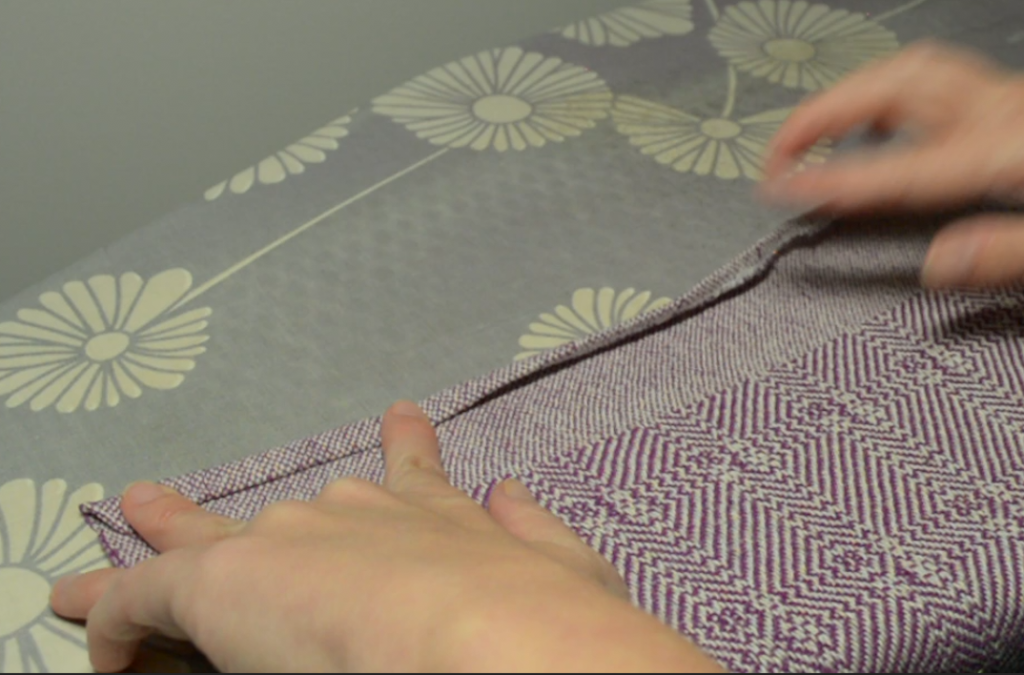
This is what I call my “dog ear” technique.  Fold in a corner on each side of the hem and press down with an iron. There are 2 reasons for this also – 
1. The corners can get ugly and a bit ragged in the washing process – I want to hide them!
             2. Towels have a tendency to be wider at each end. This reduces a little of that “flared out” look.
Once my dog ears are pressed down neatly, I take the raw edge and fold it over, usually around 1/4″ but more if it’s particularly raggy. Press with the iron.
Now I fold again, this time 1/2″ or more and press. Now all raw edges and corners should be completely encased and hidden. Once pressed, you can also place pins along to hold everything in place if you wish.
Take it to the sewing machine (different towel in this photo but the same process). I use Gutermann sewing thread. I learned early in my sewing journey that life is too short to sew with cheap threads that will break over and over! Sew with a straight, medium stitch close to the folded edge (roughly 1/4 – 1/8″).
You can use a different stitch if you want to, I just like the professional looking finish a medium straight stitch gives. Don’t forget to reverse stitch at the start and finish.
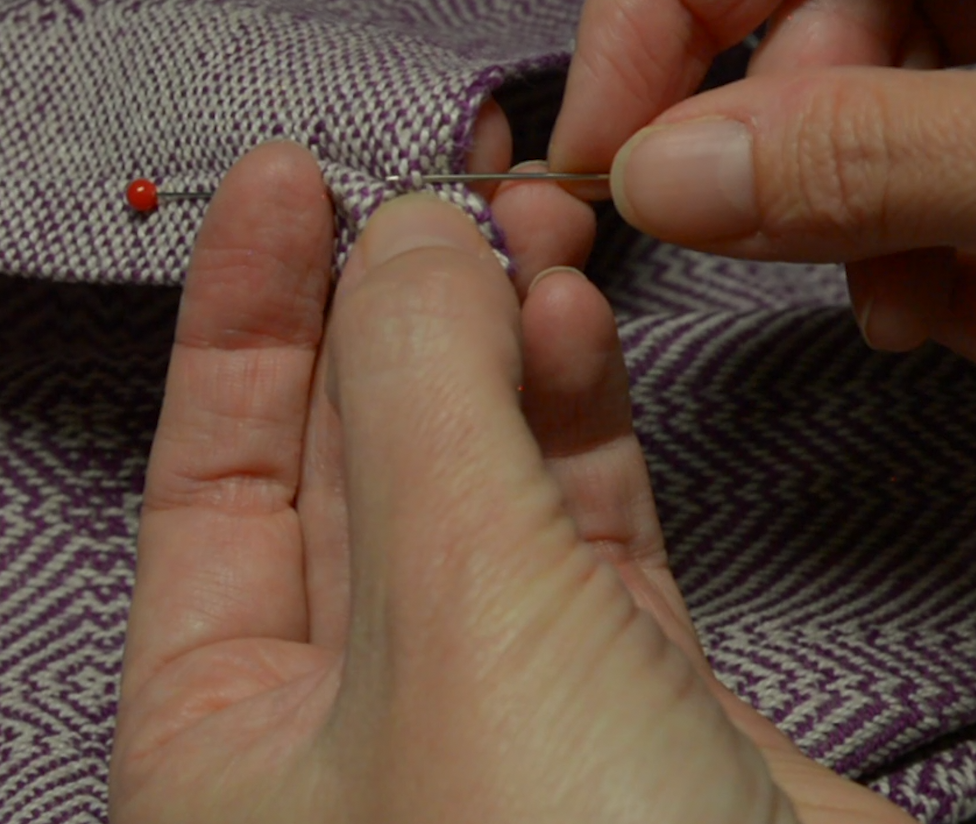
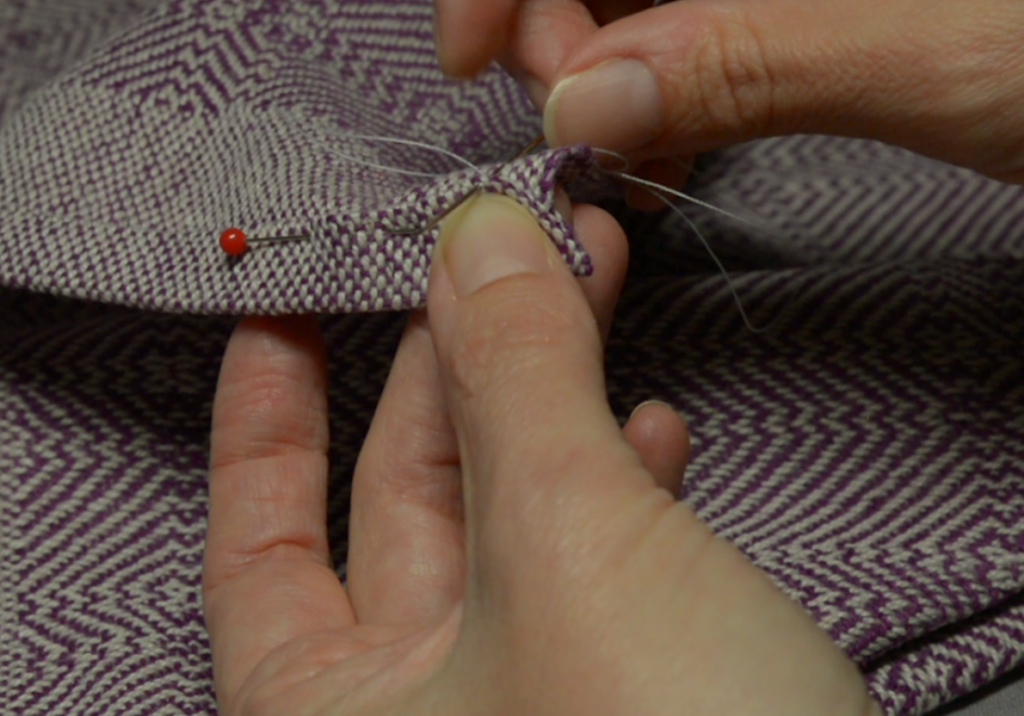
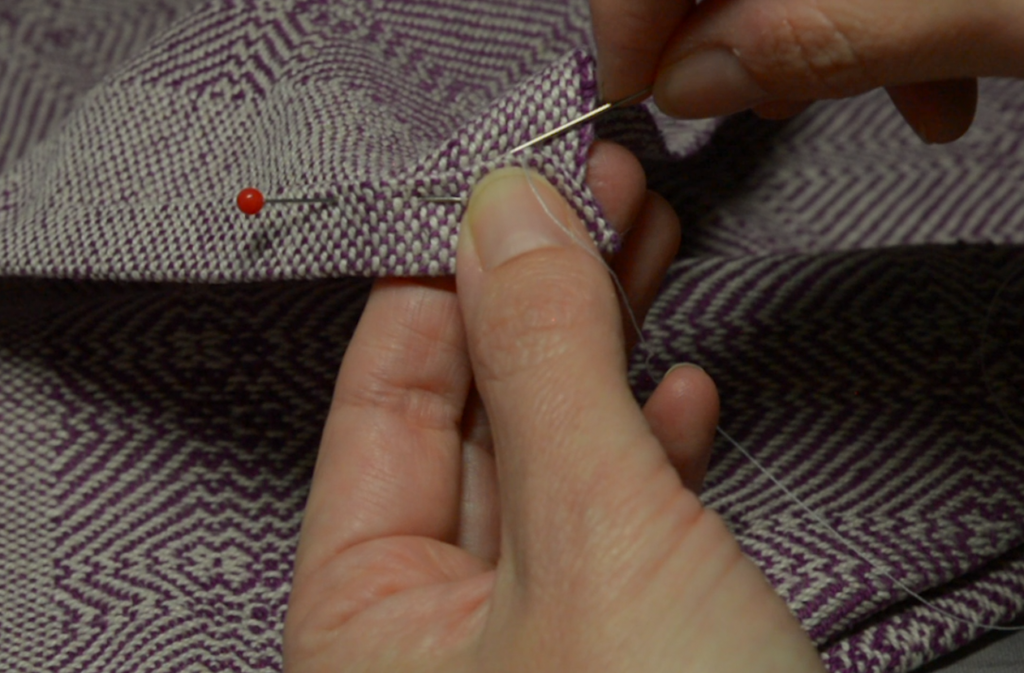
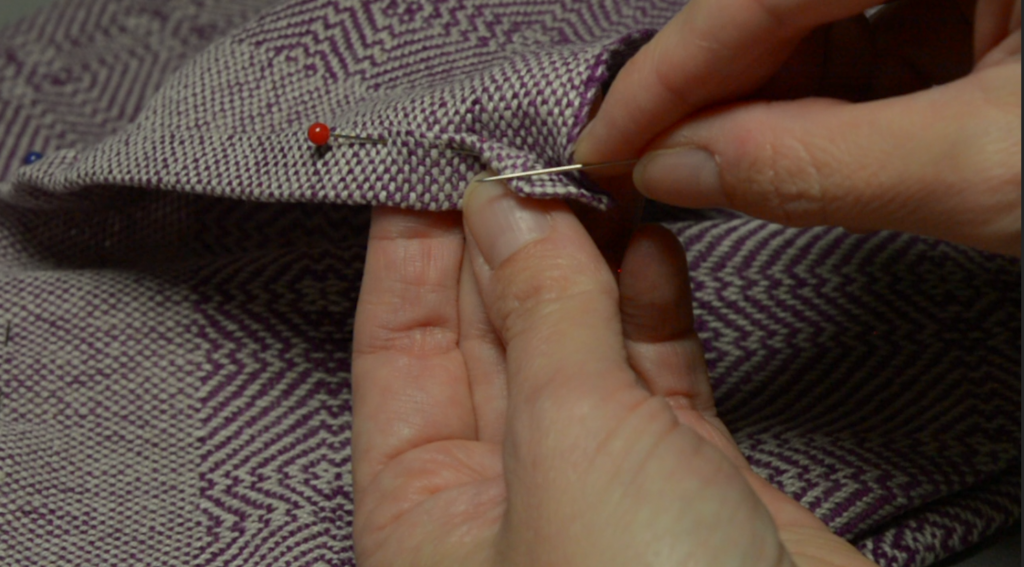
For an almost invisible finish, you can hand hem with a needle and thread, you can find that tutorial here.
Seeing as we’re on the subject of towels, if you’re on the hunt for your next towel project, you may want to try one of my classes or patterns.
Online class:
Happy Fibonnaci Towels
                                                                       Colour & Weave Towels
      Diamond Stripe Towel Weave Along (currently only open to members of the Online Weaving School)
PDF Patterns:
Lux Hand Towels
Happy Fibonnaci Towels
                                                                           Diamond Stripe Towels
                                                                        Bright & Beautiful Towels
Drop me a comment to let me know if this post has been helpful to you, I love feedback!
Until next time…
Happy Weaving!
Filed Under: Weaving Tagged With: floor loom weaving, hemming, kitchen towels, rigid heddle weaving, Sewing, weaving

I have a rigid heddle loom, why would I consider buying a floor loom?

by Kelly 2 Comments

I was asked this question in one of my Facebook groups. I started to type a response, then decided it would be better answered in a blog post as it’s not a simple question!


It is true that the Rigid Heddle Loom is capable of a lot (even an 8 shaft pattern if you really want to) but there are many reasons why I love to have both a RHL and a floor loom. 


I wrote a series recently that compared different types of looms that you may wish to review:


The Rigid Heddle Loom


The Table Loom


The Floor Loom


Now, I said the rigid heddle loom is capable of weaving 8 shafts, but does that mean that I would actually want to? To achieve that would mean multiple heddles, multiple pick up sticks and a pretty painstaking process that would have me leaping on to my floor loom in no time. Because the floor loom is made for this, it’s set up for more complex weaves, that is it’s job. So, while the RHL can be utilised for more complex weaves, that doesn’t mean that it’s the ideal choice.


Next, the RHL has yarn size limitations. The smallest dent heddle currently available is a 15 dent by Ashford. Yes, you can still double threads or use extra heddles to increase the available sett, but that is another difference to a floor loom and a consideration if you like to weave with fine threads.


Finally, the floor loom is a full body experience. That sounds a bit weird and new age doesn’t it?! But what I mean is that you are using your head (eyes to read the pattern as you weave, if you need to), your hands to throw and catch the shuttle (your body naturally sways slightly from side to side as you get into the rhythm) and your legs (as your feet move or “walk” the treadles to operate the shafts). It’s actually a bit of a workout!


Because of this “full body” approach on a floor loom, you are able to operate many actions at once. And that is the real beauty of floor loom weaving, the harmony of actions that allow you to work fast to achieve sometimes quite amazing results.


Don’t forget that there are pros and cons to all types of weaving and I try not to promote one over the other because I believe each weaver needs to find the right fit for their particular needs. If it seems that I am promoting the floor loom in this article, it is only within context of answering a question.


To recap, why would I buy a floor loom? 
1. Intricacy of pattern
2. Finer threads
3. Speed and efficiency


I hope this article helps you, thank you for reading!

Filed Under: Floor Loom Weaving, Rigid heddle weaving, Weaving Tagged With: floor loom, floor loom weaving, rigid heddle loom, rigid heddle weaving

Which loom to buy, part 3 – the Floor Loom

by Kelly 3 Comments

It’s hard to know where to start the discussion on floor looms for a few reasons. There are many, many types of floor looms available from many different loom companies. Out of the three types of looms I have discussed in this series, a floor loom is the one that requires the most research on the part of the buyer to ensure the right loom is purchased.
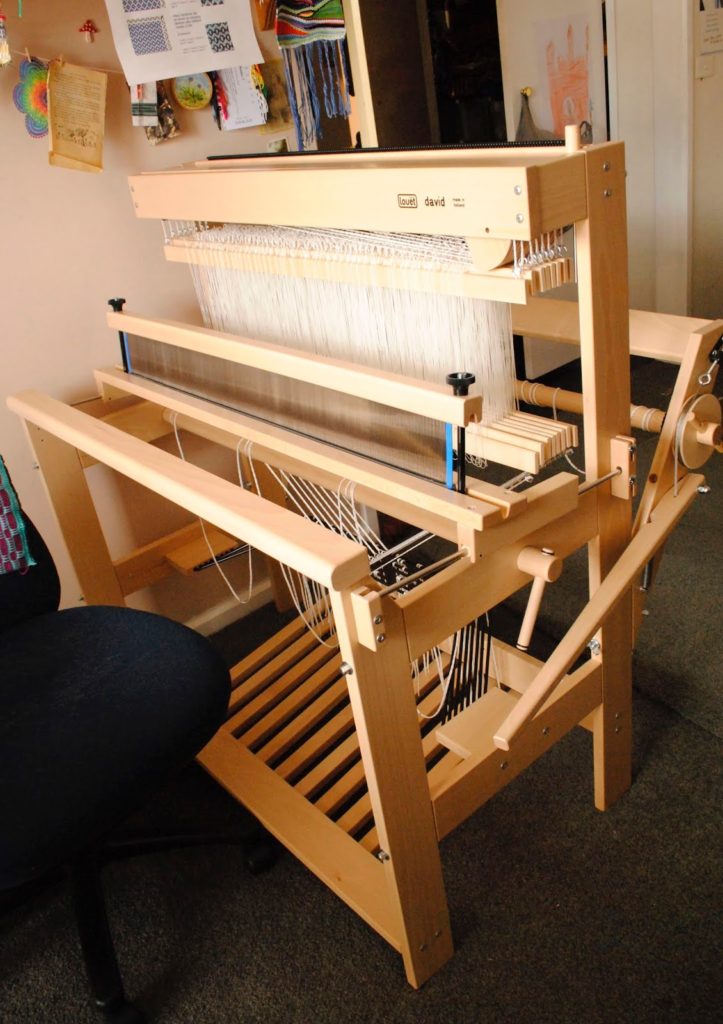
My floor loom is the David 2 by Louet
There are 3 main types of floor loom available –
* Countermarch
*Counterbalance
*Jack
 
I’m not going to go into the specifics of each loom here, (my Introduction to Floor Loom Weaving course does that) but there are obvious differences between each one that should affect your decision making. 
 
Lets have a look firstly at the benefits of a floor loom in general:
*Complex patterns can be achieved
*There are many choices for how many shafts, with many looms having upgrades to more shafts later.
*They are large and sturdy pieces of equipment
*They can take long warps and most looms have the ability to install a second warp beam for even longer warps.
*You can weave fast because your feet are operating the treadles, which in turn operate the shafts and there is no need to set the shuttle down in between picks.
*There are many resources available for floor loom weaving, in the form of books, online classes and face to face classes.
*Materials and parts and generally readily available.
*There are so many choices, from a basic 4 shaft to a computerised loom (depends on your budget!)


And, the negatives:
*Many floor looms are large and heavy, so not portable
*Depending on the loom, it can take up a lot of space – so you need to have room to house the loom as well as clearance space so that you can move around the loom for warping etc.
*A floor loom can be very expensive.
*The warping/threading process can be hard on your back.
*Warping is a long process, it takes a while to get used to this fact!


Would I recommend buying a secondhand floor loom? 
Yes and no! If you already have a working knowledge of floor looms so that you can make an educated decision, then absolutely look for a secondhand loom, which can literally save you thousands of dollars.
BUT…
If you are completely new to floor loom weaving, have never used one and are not familiar with the parts and what they do, I would be very cautious about buying secondhand. Many people sell looms from a deceased estate or similar and they really know nothing about weaving or looms – even whether it is in working order. This can actually work in your favour if you are educated because the vendor may sell cheaply, not understanding the value of what they are selling!
 
When looking at a second hand loom ask yourself – 
*Does it have all the necessary parts? If not, what is the make of the loom? Are these still made? Am I going to be able to get replacement parts? If the loom is in pieces – when was it last put together? Am I able to put it together? If the reed is rusty, am I confident that I can return it to it’s former glory? Am I going to regret this purchase because I have not researched enough? And, so on!
 
A great way to buy second hand can be through a weaving guild. The loom will generally have been well cared for and in use. The seller may be willing to give you a lesson on setting up. You can try it out before you buy in many cases. They will know the history of the loom. 
 
Try not to be impatient, wait for the right loom at the right price.
 
The best advice I can give to someone who is in the market for a new or used loom is DO YOUR RESEARCH! Talk to people, read articles, get advice.
 
I hope this series has helped you to understand more about different types of looms.
 
For more on floor loom weaving, check out my free Youtube videos:
 
Tools for floor loom weaving
David 2 by Louet Review
Just me weaving
 
How noisy is the David 2?
 
Or have a look at my Introduction to Floor Loom Weaving Course. 
 
Until next time, Happy Weaving!


Filed Under: Floor Loom Weaving, Weaving Tagged With: floor loom, floor loom weaving

Which loom to buy, part 2, The Table Loom

by Kelly 5 Comments

The table loom is often purchased by either rigid heddle weavers on brand new weavers who want to experience working with multi shafts but don’t wish to commit to a floor loom.


My second loom purchase was an Ashford 8 shaft table loom. (Affiliate link).My back issues at the time were very troublesome and I didn’t want to invest in a floor loom only to find I couldn’t use it. It was a great decision for me at that time.


The table loom is a perfect loom to progress into floor loom weaving – I am grateful for my time on the table loom for this reason, I picked up the floor loom very quickly because I gained a good understanding of multi shaft weaving first. 

Lets look first at the benefits of a table loom:
* Portability. A lot of teachers use them for teaching, as they can fold up the loom (with the weaving still on it!), pack it into a bag and pop it in the car.
*Versatility. Table looms are available from 4 shafts right up to 16 shafts (Ashford make a 16 shaft), making your pattern possibilities huge!
*The levers are easy to learn. You operate the levers (which operate the shafts), throw your pick, place the shuttle down, then beat. Your brain and body don’t have to cope with co-ordinating too much.
*My table loom had a swinging beater, which was really easy to use and I liked the action of it.
*The perfect learning tool. I already mentioned this, but it’s a stand out feature for me. If I had moved straight to a floor loom I may have found it overwhelming, but the table loom was an excellent preparation.
*They are affordable. Some may not agree with me on this point, but when you compare the price of a floor loom you will see what I mean. My table loom cost approximately a third of the price of my floor loom!
*They are upgradable. You can buy a stand and you can also add treadles, making it more like a floor loom. Many table looms can be bought as a 4 shaft with the ability to upgrade to 8 shafts later on.

Now for a few of the not so positives (just my opinion!):
*It can be difficult to get a good, tight tension for throwing the shuttle. My boat shuttle took a lot of dives through the warp when I had my table loom.
*Moving heddles around can be a bit of a pain. For my loom, I had to collapse the castle and take each individual shaft out to arrange or move heddles. I found this time consuming and a little annoying.
*A table loom doesn’t have the strength of a floor loom. It’s excellent for scarves, towels, blankets etc but maybe not the best for say, a floor rug.
*When warping, it can be a little tricky to get around. Because my loom didn’t have a stand, I had to warp at the kitchen table. The loom was quite big (it was an 80cm) and I found it challenging to find the right positions for both the loom and me so that my back wasn’t compromised.
*It can be hard to find information on getting started on a table loom – when I started there was very little help available so there was a lot of figuring out to do. However, a lot of floor loom weaving information is very helpful for a table loom as well.
*The weaving is slower. Because the levers are hand operated, you have to put the shuttle down in between beats.

I have a number of free videos relevant to the table loom, it sure is a popular topic! 

Ashford 8 shaft table loom overview

Table loom weaving demonstration

Rigid heddle/table loom comparison

Table loom/floor loom comparison

And if you have already taken the leap and own a table loom, my Introduction to Floor Loom Weaving Course is very relevant to you.

I hope this post has helped you. Next time, we will discuss the floor loom.

Filed Under: Weaving Tagged With: table loom, table loom weaving

Table loom, rigid heddle loom, floor loom?

by Kelly Leave a Comment

It is so hard to choose a loom when you are brand new to weaving! Without a doubt, the “which loom?” question is the one I get the most. And while I can’t tell you which loom is the perfect one for your individual circumstances, I can tell you a little about different types and their advantages/disadvantages.
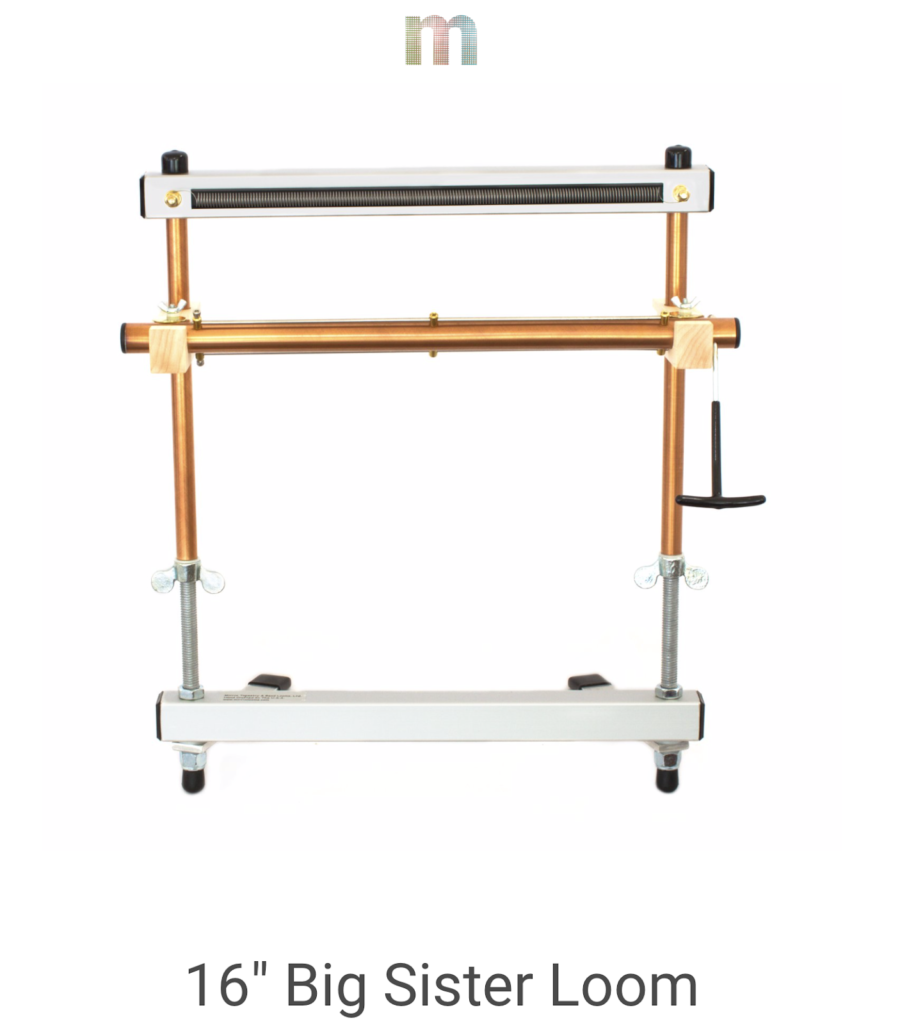

Lets start with the humble hero that I recommend most often for absolute beginners:

THE RIGID HEDDLE LOOM

The little champion of the weaving world! That is how I think of this humble loom anyway. I believe it’s thanks to this loom we have seen such an enthusiastic resurgence in weaving. You can view the rigid heddle looms I own (affiliate links):
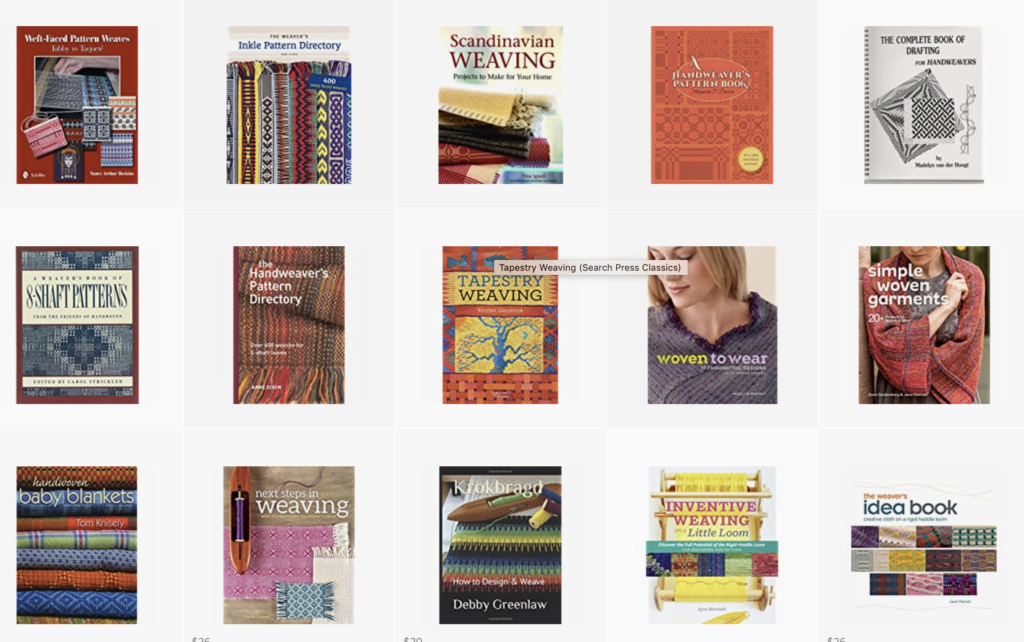
Ashford 24″
Ashford Sampleit 10″


They come in a variety of sizes, are lightweight and portable, are much more affordable than table or floor looms, are customisable by adding a stand and extra heddles, plus they are simple enough for beginners to get up and weaving quickly. The ability to direct warp means you don’t need a warping board to get started. Threading is straight forward and easy. There is very little yarn wastage. You can adapt the loom to weave tapestries.You can even weave 8 shaft patterns on this loom (I’ve seen it done, but I don’t intend to do it myself – waaay too much work for me!)


That all sounds great right? Surely there must be some drawbacks to this loom? 
Well, there are limitations to the rigid heddle loom. The tension, for example, is not like a floor or table loom. Weaving is slower, as you need to put your shuttle down after each pick in order to beat. I mentioned that you can weave up to 8 shafts, but it would take a lot of patience and mucking around that would have me personally reaching for my floor loom in a jiffy (though I realise that not everyone has that luxury!) 
I don’t really think of these things as negatives, the rigid heddle loom has too much going for it to warrant any real criticism. What I have listed above are more differences as opposed to negatives.


Want to know more about the rigid heddle loom? You may wish to watch my free Rigid Heddle Loom/Table Loom Comparison video. I also have a huge range of videos for rigid heddle weavers or those interested in starting out on my Youtube channel, so be sure to watch, like and subscribe to ensure you don’t miss new videos.


I also have a big range of rigid heddle weaving classes available on my Online Weaving School, I recommend you taking a look!


I hope this article has been helpful to you, next time I will discuss table looms!

Filed Under: Rigid heddle weaving, Weaving Tagged With: rigid heddle loom, rigid heddle weaving

Towels just for moi!

by Kelly 3 Comments

 I recently completed a project that I undertook just for me. Most of my weaving is for classes, patterns or customers, so to set aside the time to weave something for myself was pretty special!


As you may already know, I make bread for my family. I use kitchen towels to cover the rising dough and to cover the finished loaves as they cool. Perfect! Bread towels were what I needed!
I warped with 22/2 cottolin in natural with a red cotton stripe to accent.

Then I decided on M & W threading and some 2/2 twill variations.


I changed up the colour for each new towel so that some have bold patterns and others subtle.


For this one I changed both the colours and the treadling for a feature border.
To finish off, a little embroidery.


I am very happy with my new set of towels. Being hand woven with quality yarn, I know these will last many years in my kitchen.

How about you? Do you find that you’re always weaving or making for someone other than yourself? Perhaps you want to follow my lead and put aside some time to make something special just for you!

Filed Under: #weaveforme challenge, 4 shaft weaving, Floor Loom Weaving, Weaving Tagged With: 4 shaft weaving, floor loom weaving, weaving

  • « Go to Previous Page
  • Page 1
  • Interim pages omitted …
  • Page 25
  • Page 26
  • Page 27
  • Page 28
  • Page 29
  • Go to Next Page »

Primary Sidebar

About Kelly Casanova

Hand crafted boat shuttles

Categories

Archives

Meta

  • Log in
  • Entries feed
  • Comments feed
  • WordPress.org

Copyright © 2026 Kelly Casanova Weaving Lessons on the Foodie Pro Theme