• Skip to main content
  • Skip to primary sidebar

Kelly Casanova Weaving Lessons

  • Hi! I’m Kelly!
    • Affiliates Disclosure
  • Online Weaving School Class Index
    • Common account issues
    • Common technical issues
    • What do I get with a membership?
  • New to rigid heddle weaving? Start here!
    • Never heard of the rigid heddle loom?
    • How to weave neat edges on the rigid heddle loom
    • Rigid heddle weaving
    • Rigid Heddle Weaving Patterns
  • Patterns
  • Subscribe

Weaving

Hand Woven Tapestry Necklace

by Kelly 8 Comments

I completed 4 towels on my floor loom for the April #weaveforme challenge, but considering they were for a class as well, I did feel like I had cheated just a little.

*This post contains some affiliate links, which means that if you click and purchase, I receive a small commission at no extra cost to you.

So, I decided that I needed another project that was exclusively for me. I’ve been keen to start another project on my tapestry loom and thought it could be fun to weave a necklace or two. This is entirely different from my usual, often very practical projects.

I had a few hiccups to begin with. I wanted to use up some Appleton’s Crewel Embroidery Wool in a lovely range of colours that I had leftover from a crewel project long ago. This is a very thin and light wool.

I warped at 18epi with the same Ashford Tapestry Warp thread I have been using for all my tapestry work. Warping all went according to plan and I was ready to weave.

When I started weaving, however, I did not like what I saw! The wool is so thin that even though I beat down very hard, the warp thread still showed. It looked ugly! Now I had to put my thinking cap on and make some decisions. If I used a thicker weft, I was concerned that the 18epi would end up being too close. I wondered if I would be able to change the spring at the top of the loom that spaces the warp, in order to change the epi.

The Appleton wool. This was after beating really hard!

I loosened off the tension and went for it. I took off the 18epi spring and placed a 12epi spring on instead. Then I carefully rearranged all of those warp threads into their new spaces. This presented me with a new problem. My warp, now that the threads were space further apart was way too wide for the necklace project I wanted to weave!

Out came the thinking cap again (it received more use than normal on this particular day). I found that if I divided the warp in half, that would be just the right width for a necklace. Plus, that would allow me to weave 2 necklace panels simultaneously. Bingo!

The warp divided in half.

On one panel (left in the photo above) I used hatching with 2 contrasting wools – one solid black and the other a hand dyed variegated of similar weights.

The second panel used a worsted weight wool in dark purple and the same hand dyed as the other. The purple yarn was quite a bit heavier than the hand dyed, I dealt with that problem by doing extra rows on the middle panel to build it up at the same rate as the dark purple. These rectangular shapes are not joined, I used this technique because I wanted clean lines.

I was able to weave both panels at once, which worked out really well. My original intention was to continue to weave additional panels for extra necklaces, but I really wanted to complete the April challenge before too much of May had passed, plus I had other projects mounting up that needed to be started, so I decided to finish up and just do the two.

Finishing the fringes and making into a necklace.

I decided to use hemstitching and a tapestry braiding finish (I’ll have a video tutorial for that soon) to finish the fringes. At the bottom of the hemstitched hatched panel, I wove the fringe back into the work. I took the fringe at the top, placed my faux leather necklace on top, and began weaving the fringes individually back into the work, looping the fringe threads around and encasing the necklace band as I went.

I wasn’t sure if this would secure the panel onto the band with enough strength, but now that I’m finished it is surprisingly hardy and doesn’t move.

The fringe looped over the necklace and woven back in to the fabric.


Once all the fringes were woven in securely, I snipped them off close to the fabric. The back of the necklace doesn’t show, but if I was worried about it, I could have sewn on a piece of felt the same size as the panel to cover the back.

I have not yet finished the other panel, but I’m so glad to have completed another project for the April #weaveforme challenge. The challenge was so popular that I would love to run it again next year. What do you think?

If you would prefer to watch this post and see a bit of a demonstration of the actual weaving, here you go!

And, if you have an interest in learning more about tapestry weaving on a rigid heddle loom, I have a class that will teach you all the basics and get you on your way.

I hope you all enjoyed following along with this project and reading and watching about it.

Until next time…

Happy Weaving!
Filed Under: #weaveforme challenge, Tapestry Weaving, Tutorials, Weaving Tagged With: #weaveforme, mirrixlooms, tapestry necklace, tapestry weaving

How to Hem Woven Fabric by Hand – No Sewing Machine

by Kelly 4 Comments

Hand hemming. It just sounds good, doesn’t it? It takes you back to the days when time was spent stitching with a needle and thread. Quiet, meditative, and artfully skilled.

I’ll be the first to admit that most of my hand woven pieces are hemmed on my sewing machine, due to a lack of time and a love of convenience. But, I do enjoy stitching with a needle and thread at least occasionally, and it does provide a different finish to a machine stitch.

*This post contains some affiliate links, which means if you click on the link and purchase, I receive a very small commission at no extra cost to you.

If you are more interested in hemming your hand wovens on a sewing machine, this post has got you covered. The initial steps are the same, whether you are hemming by hand or machine.

Begin by laying out your washed or wet finished and dried piece. Fold in the corners (“dog ears”) and iron down on the cotton setting of your iron.

Next you begin to fold down the edge that was previously serged or zigzag stitched and press with the iron.

Now we make another fold, a little bigger than the last and press that down as well. Place pins along the fold to help hold it in place during the stitching process.

If you need more details on these steps, this post is more step by step.

Now we are ready to stitch. Use a needle (not a tapestry, you need a sharp point for this task) and a length of good quality sewing thread (I always use Gutermann Sew All Thread) and knot the end of the thread. Slightly lift the edge corner of one of your hems. In this space you will begin your thread and lodge your know to make it invisible.

Take your needle into the base cloth and pull through to lodge the knot. Fold the hem back in place so that the thread is wedged between the hem and the base cloth.

Take the needle into the fold of the hem, close to the corner and close to the edge of the fold. Pull the thread through.

Now, take the needle back to the base cloth, horizontal to the fold. Pick up one or two threads, very close to the fold of the hem, but not on it. This is the fabric underneath the hem. Pull through.

Now, take the thread vertically through the fold of the hem once again. Pull through, and return to the base cloth to repeat these steps.

Once you are proficient at this, you may want to eliminate one step of the process by combining the two stitches into one action. It is best if you watch the video to learn to do that, it is much easier to show and tell!

Finish up by knotting the thread and burying it into the cloth, using your needle. Cut off any loose ends. Give your hem/s a quick press and they’re good to go!

So, what is your preference? Hand hemming or machine? Let me know by leaving a comment!

Do you like the towel I’m hemming in the photos? It is one of 4 towels from my Floor Loom Weaving sequel class. It’s almost finished, won’t be long now! Make sure you’re on my email list to receive notification of when it goes live.

I hope you enjoyed today’s tutorial and until next time…

Happy Weaving!
Filed Under: Sewing, Tutorials, Weaving Tagged With: hand hem, hemming, how to hand hem, needle and thread, tutorial

Darn it! Mending hand woven towels.

by Kelly Leave a Comment


It’s bound to happen. That moment when you realise there is a little or large or even gaping hole in one of your hand wovens.

I love using my hand woven towels in the kitchen. I mean, if you’re spending a lot of time doing menial tasks ie. dishes, you might as well be doing it with something special and beautiful.

We don’t have a dishwasher, and with 6 family members we tend to wash and dry a lot of dishes every day.

The first time it happened, I may have gasped, my eyes may have goggled a little and my head may have drooped. Just for a moment. But, one thing you learn through being a parent is to not be too precious about your material possessions. It’s likely they will get broken or damaged at some point. I would still rather use things than have them sit in a drawer somewhere.

Towel 1 was the worst with one large hole and one small hole.

So, anyway, two of my not very old, fairly recently finished hand woven towels had, shall we diplomatically say, “person inflicted holes”? Likely pierced by a sharp knife in the act of drying it?

I began contemplating what could be done about the said holes and I thought of the wonderful old art of darning, something our Grandmother’s did all the time and my own mother avoided like the plague. Needless to say, this art was not passed on to me. But, since having children, I’ve done my fair share of mending clothes with usually passable results.

Towel 2 was in better shape with just one smaller hole.

The trick with handwovens is to try to trace the original path that the broken or snapped threads took. Easier to do if you have a good understanding of the weave structure you used, but you can still get on alright by observing the threads that are still intact.

Once you’ve observed the pattern of the threads and determined how many warp threads and how many weft threads are broken, you can start tracking where these threads should have been and try to follow their original path.

*This post contains affiliate links, meaning if you click on one of these links and purchase, I receive a small percentage of the sale at no extra cost to you.

Using a needle (I used a tapestry needle) and matching the original threads as closely as possible, (I wasn’t able to do this as I had run out of the original threads, but I found some pretty good matches amongst my stash) start your thread 1 -2 inches out from the hole. Doing this also usually allows you to follow the path of the original thread up until it reaches the hole where it is broken.

It doesn’t matter whether you start weaving in warp of weft threads first. After you have woven through and past the hole (hopefully in a pattern very similar to the one that was broken) you continue to follow the pattern with the needle for another inch or two out the other side. Leave tails hanging out from where you began and finished.

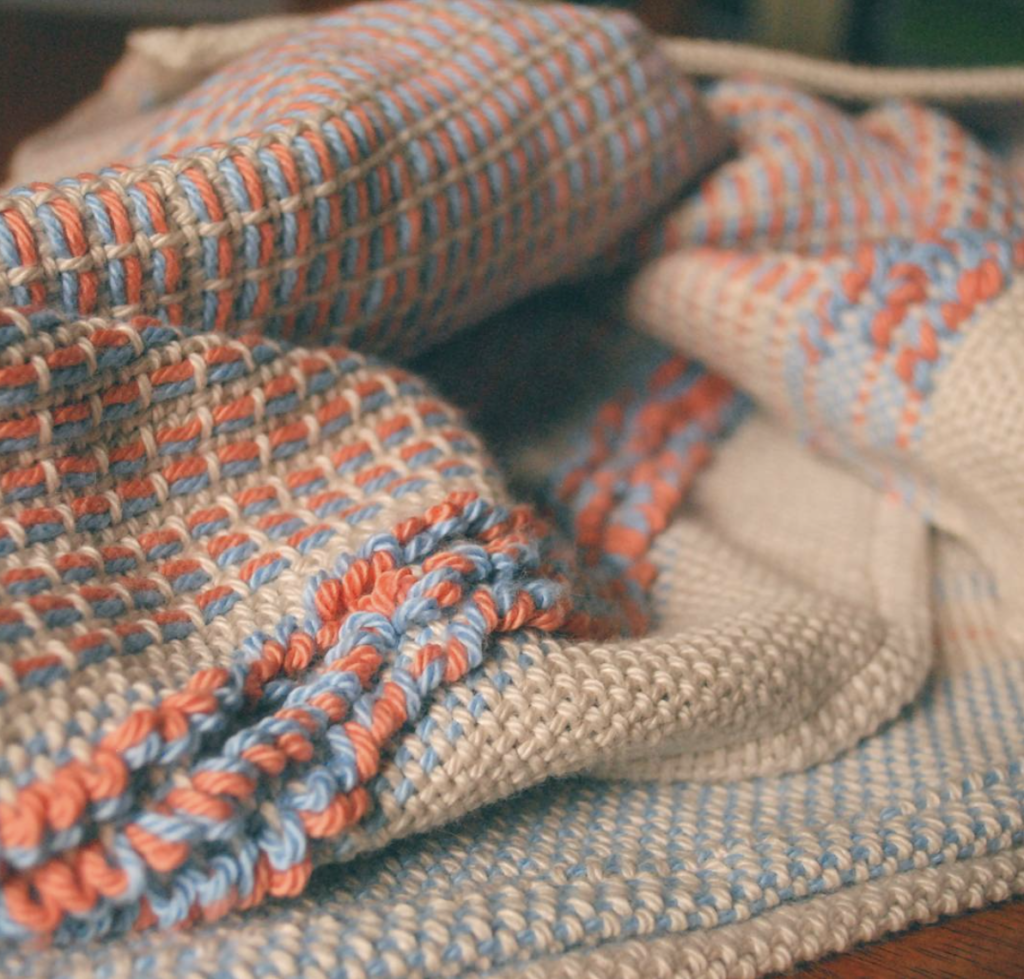
This technique worked really well for my smaller holes. Although I didn’t get an exact copy of the original pattern, I was able to replace the broken threads in a way that didn’t look terrible!

Not perfect, but not too shabby!

For the gaping hole I needed to try something else. Subtle mending was not going to suffice for this one, there were many severed warp and weft threads and the gap was wide. I tried. I really did. But it was ugly – perhaps uglier than before I started trying to replace the threads.

At this point I decided to embrace the “Visible Mending” movement. I didn’t have any matching fabric, having woven just this one towel with those particular threads and structure. I hunted in my scraps and samples pile and came out with a couple of pieces that were acceptable – at least they had the same colours!

I cut out the patch sizes I needed – one for each side of the hole and serged the borders of each piece. I used the wonderful sewer’s helper Heat n Bond to attach a patch to either side of the hole. When cool, I machine zigzagged around the edges. Not perfect, but at least I don’t have to look at my botched mending job anymore and the towel is functional in my kitchen once again!


Once I completed the surgeries, I put the towels through a hot (60 degrees celsius) machine wash, dried and ironed. I cut all the tails (including the original leftover broken threads) as close to the fabric as possible, without cutting the actual fabric. Don’t accidentally snip too close and undo all your hard work!

Oh, and in case you’re wondering, I’m very grateful to have children who wash and dry dishes for me, even if there are occasional accidents!

Until next time….

Happy Weaving!
Filed Under: 4 shaft weaving, Sewing, Weaving Tagged With: darning, floor loom weaving, kitchen towels, mending, towels

4 shaft weaving and sampling

by Kelly Leave a Comment

This week I’ve been working on the sequel to my Introduction to Floor Loom weaving class.


This class will focus on 4 shaft weaving and begins with an optional sampler. I always felt that a sampler was a waste of time and effort, but I have definitely changed my ways! I do a lot of sampling, particularly now that I use a lot of my own designs and need to see and feel how the fabric is going to be before I put it out there to my students. Since I realised what a fantastic learning tool sampling can be, I always recommend it to my students. It can pretty much make or break a project!


Plus, when you’re finished with a sample, you can either cut it up and use it for small project, or keep it to refer back to. Either way, it’s useful!

The next part of the class will move onto 4 shaft kitchen towels,  which I designed. Each towel is a little different but equally lovely. 
We will weave 4 towels all together.


Here is a sample of the first towel, isn’t it gorgeous? 
The towels tie in happily with my #weaveforme plans for April,  as I will be keeping them for my kitchen 😊

If you’re interested in the next floor loom weaving class, make sure you are signed up to my email list for announcements and special offers. Instagram is also a great place to keep up with what I’m doing.

Do you have plans for your #weaveforme project yet? I’d love to hear about it!


Filed Under: 4 shaft weaving, Weaving Tagged With: #weaveforme, floor loom weaving, Kelly casanova weaving lessons, sampling, weaving

#weaveforme April Challenge!

by Kelly Leave a Comment

April is challenge month!

We all know that weavers are generous and love to give hand woven gifts.  But, how often do you weave something just for you?

I’ll be the first to admit that I rarely weave anything as a gift to myself.  But, when I do, it’s so satisfying!

The challenge for next month is to weave something (anything you like!) just for you.

It could be something you need or just something you want,  as long as YOU are the one who gets to enjoy it!

If you need ideas,  there are a number of free projects on my Youtube channel and over at my Online Weaving School you are spoiled for choice with many,  many projects.  Don’t forget the patterns available in my Etsy shop too!

On Instagram,  share your project photos with the hashtag #weaveforme.  You can also share and follow along with what others are doing on the Kelly Casanova’s Weaving Lessons group on Facebook.

I hope you can join in the fun!

Alright,  thinking caps on!  😀

Filed Under: Weaving Tagged With: #weaveforme, challenge, weaving

I deleted my last post and wrote about krokbragd instead!

by Kelly 13 Comments

I had a long post, all ready to go. It was a little bit of weaving and a LOT of life. I’m glad I didn’t hit “publish” on that post right away. I’ll explain…


The post was written at the end of a really busy week. I had launched a new class for my Online Weaving School, I had made a Youtube video, I had promoted the new class everywhere I could think of to promote it, I had homeschooled the kids and cared for my family, we had been on educational outings, appointments and activities. Yeh, I was pretty tired at the end of that week. And then I sat down to write a blog post.


A little bit of advice to you all – don’t write blog posts when you’re over tired. And if you do write them, don’t publish them! That’s all I’ll say on the subject for now, except to add that I have now caught up on some much needed sleep and rest and am thankful that, not only did I get over my little self pity party, but also that I decided not to inflict my Whingefest upon your eyes and minds!


Now, let’s get to the fun stuff.


I had been wanting to warp up my inkle loom for quite some time, as it has been sadly neglected and I do so enjoy weaving on it, just for something a bit different. My loom is the Ashford Inkle, which is the larger version, they also make the Inklette, which is more petite for smaller and narrower bands.


I didn’t know what to warp up, so I took a flick through my go – to Inkle book, The Weaver’s Pattern Directory by Anne Dixon. I often recommend Anne’s Handweaver’s Pattern Directory  for 4 shafts, as it is so packed with drafts and quality information and her inkle book is no exception. 


I started by picking out some colours from my stash that I love (always a good way to start a project, even if you’re not that confident with colour choices). I ended up with a mixture of mercerised and unmercerised 8/2 cottons. If you’re unfamiliar with 8/2 cottons I often use Maurice Brassard as they are great quality and come in heaps of colours. Here is an example of MB 8/2 unmercerised. A comment from Gai has just reminded me of something I wanted to add about mercerised cotton. In general, I don’t like to use it on a larger loom, it twists up on itself and is a general pain in the neck. However, on the Inkle loom it’s different. Because you warp directly on to the pegs without having to do extra threading or moving of the warp, it behaves itself very well. It is constantly under high tension, so is easy to use and does add a lovely “gleam” to the project.

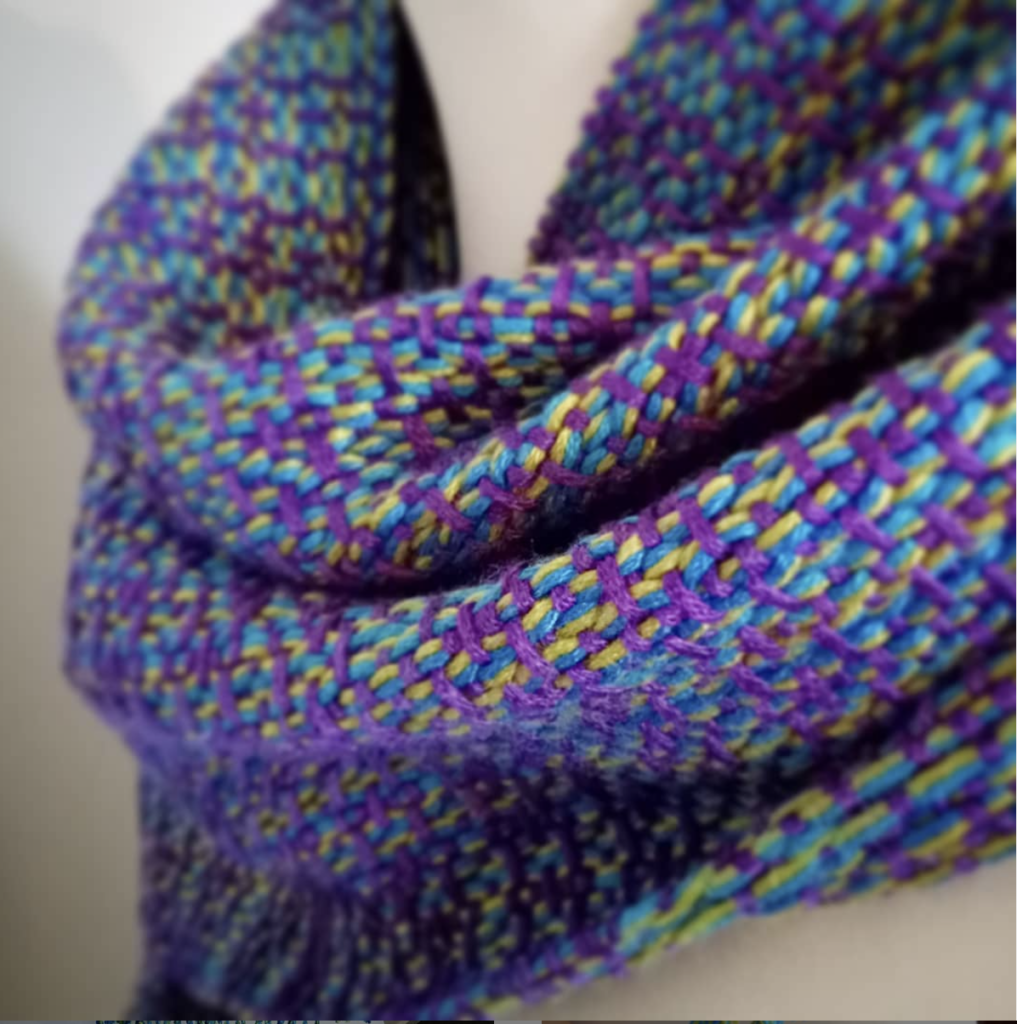
Being the lover of the weave structure Krokbragd that I am, it was a natural choice. Did you know you can weave krokbragd on an inkle loom? Yes, you totally can!


And, did you know that a krokbragd band is as equally gorgeous as a larger loom project? Yes, it totally is!  

So now I’m really excited about the design possibilities for this, though I admit that the design aspect is different to what I’m accustomed to –  it’s proving quite a challenge for me and is a bit to get my head around. I’ll keep plugging away at it though, and I’m sure I’ll get there.

I love that the reverse side is just as striking as the front.

As soon as I posted these on social media, people were asking me for a class, which I would love to do once I have some of my own designs up and running. In the meantime, if you have Anne’s book or are interested in purchasing (perhaps your library might have it?) this krokbragd design is from page 107.

And, if krokbragd band weaving is of interest to you, there will definitely be more to come!

Thanks for reading, until next time…

Happy Weaving!
*Please note – this post contains affiliate links, meaning that if you click and purchase, I will receive a small percentage of the sale. I only recommend products that I own and love.


Filed Under: Weaving Tagged With: inkle loom, krokbragd, weaving, weaving books

Which looms do you have and what is on your Wishlist?

by Kelly 24 Comments

This post contains affiliate links. I only recommend products that I own, use and love.
Ashford 60cm (24″) rigid heddle loom 

This is my most used loom at this point and most of the classes I teach are on this loom. Initially, I chose it because the price point fitted my budget at the time, and I had the right amount of space for it. I’ve never regretted the purchase. I think of it as my little workhorse! You can check out the same loom by following this link.


Ashford Sampleit


I bought this one for my girls, who often complained that they never got to weave because my loom was always full. I think I have used it more than they have though! It is so good for sampling new ideas and designs, enabling me to have a couple of rigid heddle projects going at once. It also takes up hardly any space at all.


Ashford Inkle

I love inkle weaving, but unfortunately have not had the time to indulge and explore as much as I would like. Once again, it’s not space hungry and allows me to weave a different kind of project while other larger projects are going on. This loom is for bands, but that doesn’t mean that only band projects are possible, you can sew bands together to make all kinds of cool things. I have a beginner series on Youtube for using an inkle.
 David 2 Louet
 

Aka the love of my life! Alright, that’s taking it a bit far but I do really love this loom. 8 shafts, 10 treadles, made in the Netherlands. Compact, easy to operate, beautiful to look at, and so much more. I review it here if you’re interested. I have the second instalment of my Floor Loom Series coming up soon, so watch out for that one!

Previously owned – Ashford 8 shaft 80cm (30″) table loom  (the loom available in this listing is a 24″)

I ran out of space when I bought my floor loom, so had to sell my table loom. You can see a demonstration of me using it here and an overview of the loom here. To be honest, I really do miss this loom and often recommend them to others. I can envision myself once again investing in a table loom “one day” but in a smaller format so that it is portable for teaching. The Katie, with it’s light weight and 8 shaft capability would be just the ticket.

Wishlist


Mirrix Little Guy or Big Sister

I have been doing a lot of tapestry work on my rigid heddle loom recently, which has highlighted a couple of things for me.
1. The rigid heddle loom is a good loom for playing around with tapestry, but not the best.
2. I love tapestry!
3. As tapestries are a time investment, it would be ideal for me to have a separate loom for this.
 
So, why would I choose a Mirrix?
Well, their looms are simple and compact but still a complete tapestry loom. It wouldn’t take up a lot of space that I no longer have the luxury of! I love their sturdy and attractive design, and the shedding devices that many of the loom have is a huge bonus. I have done quite a bit of research and I feel that these are really quality looms, made by weavers for weavers. 


There is a video version of this blog post on my Youtube channel if you’re a visual kinda person.


Until next time…


Happy Weaving!
Filed Under: Weaving Tagged With: floor loom, inkle loom, rigid heddle loom, table loom, weaving

Great rigid heddle weaving books!

by Kelly 10 Comments

My last post detailed some of my favourite books for 4 shafts or more, but today I’d like to talk about some great rigid heddle books.
I already have a video on this topic, but I know some people prefer to read rather than watch, plus I’ve added some extra books to the original list, so here we go!


*This post contains affiliate links. 

I’ll start with my favourite and most used book, in fact, this is the first rigid heddle weaving book I bought.

The Weaver’s Idea Book by Jane Patrick This book has so much content and is great for beginners. It allows you to start with the basics and build as you go. Just about everything you need to know initially is contained within these pages and I think of it a little like a training ground for new weavers. It is also hardcover with spiral binding, making it easy to lay flat and view while you’re weaving. Highly recommended!


Weaving made Easy by Liz Gipson. A lovely little book that includes information on loom set up. The projects are simple enough for beginners and interesting enough for all weavers.


Woven to Wear by Marilyn Murphy. I also read this book as a newer weaver and loved how it stirred my imagination. It contains simple garments with lots of plain weave, making it great for beginners, particularly those wanting to get a taste for sewing with your handwoven. The sewing projects are simple rather than finicky, with the use of large shapes instead of small pieces.


Inventive Weaving on a Little Loom by Syne Mitchell This book is awesome value for beginners to intermediate with lots of ideas. For the newer weaver, there is practical information and plenty of inspiration for once you have the basics down. I think of this book as one that you may not fully appreciate until you have some more weaving experience, perhaps a book that will grow with you through your weaving journey. Towards the middle and later part of the book are projects and ideas that may be too challenging for a new weaver, but that an enthusiastic and curious weaver will definitely want to make use of later on. There is a lot of information, it is attractively set out and a joy to flip through.


Weave, Knit, Wear by Judith Shangold  This book is responsible for opening my eyes and quickening my heart over the range of possibilities with a rigid heddle loom and garment making. Judith uses mostly plain weave, colour and design to make fabric look special. She includes design layouts and illustrations to help you wrap your head around how garments can be constructed. What I really love about this book is the fusion of weaving, knitting and crochet added in. It really has encouraged me to think outside the square and maximise my rigid heddle loom.


Simple Woven Garments by Sara Goldberg Another really great book on making simple garments with simple, colourful, hand woven cloth. There are more than 20 projects and they are all wearable! There are also details on adjusting garments to your own specifications.

I had to come back and edit this post to include Debby Greenlaw’s new book Krokbragd: How to Design and Weave. I actually like this book so much that I wrote a review for it here, so pop over and read that if it sounds like a book you would be interested in.

To see all my book recommendations is one easy to access place, visit my Amazon Shop.

If you would like to watch this post in video format please click on the video below.


I hope you enjoyed my list!

Until next time…

Happy Weaving!

 

Filed Under: Books, Rigid heddle weaving, Weaving Tagged With: books, rigid heddle weaving, weaving books

My Favourite Books for Multi Shaft Weaving

by Kelly 9 Comments

I love books, so it makes sense that I am a huge lover of good weaving books. It can be hard to know which books are worth buying, especially if you’re buying online and can’t view the book before purchase.


I have already made a video on my favourite rigid heddle weaving books, but haven’t talked about my floor loom or multi shaft books.


This is certainly not an exhaustive list, and I definitely plan on increasing my collection over the years, but these are a few that I have found particularly good.

*This post contains affiliate links


I will start with my absolute favourite. If, in some terrible circumstance, I had to choose just one of the following books to keep, this one would be it!

The Handweaver’s Pattern Directory by Anne Dixon only covers 4 shaft weaves, and yet, with the number of pattern drafts you could feasibly use this book for years before even considering buying an 8 shaft book. There is nothing I do not love about this book! Yes, it is a little expensive, but I consider  it my “go to” for any 4 shaft weaving. It’s a hardcover book with spiral binding. This is awesome because you can lay the book flat to follow a threading or treadling pattern, and the hard cover prevents any damage to the pages. I’ve had mine for many years and it still looks as good as new. The layout shows you exactly what you can expect from each draft by providing colour pictures and yarns used to achieve each one – great for those just starting out.

Once again, not a cheap book, but this one is an absolute classic!  Carol Strickler’s A Weaver’s Book of 8 Shaft Patterns has plenty of information on 8 shaft weaves, explanations of tie ups and treadlings, and black and white pictoral representations of each weave (there are almost 900 photos). Individual yarn suggestions are not given, but in each new chapter, suggestions are made for particular weave structures. Many of the drafts have historical information – where the draft came from (if known) or where it is adapted from, which provides the keen weaver the opportunity for further research if desired. 
Next Steps in Weaving by Patty Graver has been a great one to add to my library. Published in 2015, it has a more modern and fresh feel. The layout is uncluttered but still contains a lot of information. I admit that I read this book when it first came out and I was in the infancy of my multi shaft journey. I felt like some of it was a bit beyond me at the time. However, when I cam back to it later (after a lot of research and practice) I found that the language now made sense and it was in fact a very helpful book! 
The beginning of the book goes over understanding terminology and drafts (something that many new weavers struggle with!) She explains twills and twill orders and then launches straight into the projects. This is my style of learning and teaching – project based! To get stuck in and actually learn something as you do it, rather than be stuck at the starting line with a lot of theory and fear of how to put it into practice. Patty starts with some basic twill projects, then shows more advanced versions to expose the reader to what is possible with variations and colour. The threading charts for the projects are all colour coded, which I think is a really great visual learning cue for newer weavers, and even for more seasoned weavers who just want to follow a threading chart in a simple format.
There is a lot more I could say about this book, but then this post may turn into a book itself! So, I’ll finish up with this. It’s a great book, the projects and samples are beautiful and inspiring, and even if, like me, you find it a little overwhelming to begin with, it is a book you can keep going back to over and over.
A Handweaver’s Pattern Book by Marguerite P Davison is another well know weaver’s classic. It was first published in 1944 as a green book, the orange one being a more recent and publication. Thanks to the generosity of a student, I now own the green book as well. This book has 200 pattern drafts and has 4, 6 and 8 shaft weaves. The layout is a little more old fashioned (though there are black and white photo representations of most drafts) and some may find it difficult to decipher the way in which the drafts are drawn. That should not put off the adventurous weaver though, as it is very beneficial to be able to read all styles of drafts so that you can decipher them, no matter what country or time period they are from. 
This is one of those books that you read and just think, “that is a lovely little book”. Simple, lovely big photos, nice colour. Tom Knisely’s Handwoven Baby Blankets starts out with a useful section on the basics of baby blanket weaving, such as sizes, colours and materials. 
There are over 30 projects and it includes both 4 and 8 shaft. Every project has specific yarn and colour descriptions. If you’re interested in weaving baby blankets, I highly recommend this delightful book!
Probably my most asked question from multi shaft weavers is “how do I read a draft?” The next step on from understanding how to read and use a weaving draft is to begin drafting them yourself. This is something that is of huge interest to me, but something I have not devoted enough time to as yet and still have much to learn. If you are interested in drafting for yourself, Madelyn van der Hoogt’s The Complete Book of Drafting for Handweavers is going to help a lot! While I confess that I have not made my way through the entirety of the book yet (it is in a workbook style with drafting exercises for you to follow), I intend to do so as it contains such valuable information. This book is available from The Woolery.
If you’re as interested in coverlets as I am, these are my most loved coverlet books I own:
Carol Strickler’s American Woven Coverlets
Keep me Warm one Night, Burham and Burnham 
(This one is also in my possession thanks to the generosity of a student and it is now one of my most treasured books!)
A Book of Patterns for Hand-Weaving, Mary Meigs Atwater
Weaving a Traditional Coverlet, Helen Jarvis
My last recommendation is for those who are keen to branch out into double weave on your floor loom or table loom.
Doubleweave by Jennifer Moore. Whether you are wanting to explore weaving double cloth or double (even triple) width, this popular book will be a very valuable addition to your collection.
I do have more weaving books in my collection, but these books I’ve listed and described are the ones that I am most happy to recommend and really feel that they would benefit your weaving library too.
I hope you have found this post helpful, please let me know if you have any questions. Do you own any of these books? Which is your most used?
Until next time…
Happy Weaving!


Filed Under: 4 shaft weaving, 8 shaft weaving, Books, Floor Loom Weaving, Weaving Tagged With: books, recommended books, weaving, weaving books

Where it all started (long post!)

by Kelly 19 Comments

My 3 year Youtube channel anniversary came and went without my noticing back in August. I was looking through my list of 159 (!!) videos tonight and noted the date of my first video, way back in 2015.


While these years have flown so fast and so much has happened since I hesitatingly uploaded that first video, I thought it a good time to reflect and share a bit more of my journey with you, particularly if you have only found me recently.


Some of you have been with me almost since that first video, and I believe that I have most to thank you for. It is the first viewers who encouraged me to make more videos, who threw amazing compliments in my direction, and who have shown me so much love these past 3 years.


So, lets go way back to the beginning. Before weaving, I had many, many crafts under my belt.
One of them was knitting, which I used to indulge in a great deal until a painful shoulder Repetitive Strain Injury reared it’s ugly head and left me just a “sometimes knitter”. Anyway, I had learned an immense amount of helpful knitting techniques from kind people on Youtube.
When I had been weaving for some time and was really excited about what I was doing and learning (still am!) I had the idea of contributing to the Youtube craft community by sharing a little of what I knew. I borrowed my son’s little camcorder, and, with pretty poor visual and even worse audio, I recorded a Waffle Weave on a rigid heddle loom video. This is an updated version:

[embedyt] https://www.youtube.com/watch?v=FuhY5e1X4-k[/embedyt]

I didn’t expect that many people would watch it, and that was fine by me, I just wanted to share with anyone who may be interested. It wasn’t long before I started getting comments and very positive feedback. People were asking me to make more videos and I couldn’t believe it.

Me? Introverted, dull as dishwater housewife me? I was pretty astounded at the response!


I made some more videos and I discovered something about myself. I loved teaching! I had taught my kids at home for a long time (my oldest homeschooler is now 20!), but this was teaching adults something I was really passionate about and I wanted to keep doing that!


As I made the videos, the cost of materials started adding up and I had no job or real income at this time. Youtube had a “paid channels” feature and so, I started one. I charged roughly $2 per person, per month and this enabled me to keep going because people joined and paid. 


In my “spare time” I started putting together some weaving designs to sell in my Etsy shop. I now have many designs, and once again, I’ve been amazed at the response. I also love designing and look forward to continuing doing that. 


Back to Youtube, where it was abruptly announced that the paid channel platform was closing. This left me with a quandary – should I try to find another platform or is this a sign that I should close down. Well, my students came to my rescue and begged me to continue.

A short time later, I found a great hosting platform – Teachable and have been with them ever since. Youtube closing the paid channels was a HUGE blessing in so many ways and has allowed to go forward in ways I could not have imagined. If you haven’t seen my Online Weaving School, please check it out to see what I’m talking about! 


I now have 61 classes available, including my first floor loom course. Being on a professional platform has challenged me to do better and construct my classes to give students an optimal learning experience. I must be doing something right, because the school continues to grow and I continue to get awesome feedback. 


All of this has been made possible because people like you support me in so many ways. You support me with your enthusiasm for weaving and learning. You support me financially, which allows me to continue to grow this little business. You support me on a personal level with your kind messages and many prayers over the years. 


A topic that is often discussed in business circles is “success”. Success to many, seems to be when you reach 6 figures, as though there is some magic monetary value that means you have made it.

 I earn a living (maybe not a lavish one by the opinion of many, but it helps to feed and clothe my family!), I get to do what I absolutely love, and I’m surrounded by wonderful, supportive people. 
Am I successful? Heck, yeah!


I want to thank you all for making this happen. I had no idea that I was capable of running a business that began with a hobby and a passion. My hope is that I can continue to do this for the rest of my life, and with all the plans and ideas I have for my online school for the future, I shouldn’t have too much trouble achieving that goal!


God has blessed me abundantly through this venture, I pray He blesses you too!


Filed Under: Weaving Tagged With: Kelly casanova weaving lessons, my youtube channel

  • « Go to Previous Page
  • Page 1
  • Interim pages omitted …
  • Page 24
  • Page 25
  • Page 26
  • Page 27
  • Page 28
  • Page 29
  • Go to Next Page »

Primary Sidebar

About Kelly Casanova

Hand crafted boat shuttles

Categories

Archives

Meta

  • Log in
  • Entries feed
  • Comments feed
  • WordPress.org

Copyright © 2026 Kelly Casanova Weaving Lessons on the Foodie Pro Theme