• Skip to main content
  • Skip to primary sidebar

Kelly Casanova Weaving Lessons

  • Hi! I’m Kelly!
    • Affiliates Disclosure
  • Online Weaving School Class Index
    • Common account issues
    • Common technical issues
    • What do I get with a membership?
  • New to rigid heddle weaving? Start here!
    • Never heard of the rigid heddle loom?
    • How to weave neat edges on the rigid heddle loom
    • Rigid heddle weaving
    • Rigid Heddle Weaving Patterns
  • Patterns
  • Subscribe

Weaving

How to weave on an inkle loom

by Kelly 33 Comments

Have you ever wondered how to weave on an inkle loom—what it is, how it works, and what kinds of beautiful bands you can create with it? You’re in the right place!

An inkle loom is a simple, portable loom that’s perfect for beginners and experienced weavers alike. It’s designed for weaving strong, narrow bands that can be used for everything from belts and bag straps to decorative trims. In this post, I’ll walk you through what an inkle loom is, how to set it up, and what you can weave on it—so you can start your own inkle weaving journey with confidence!

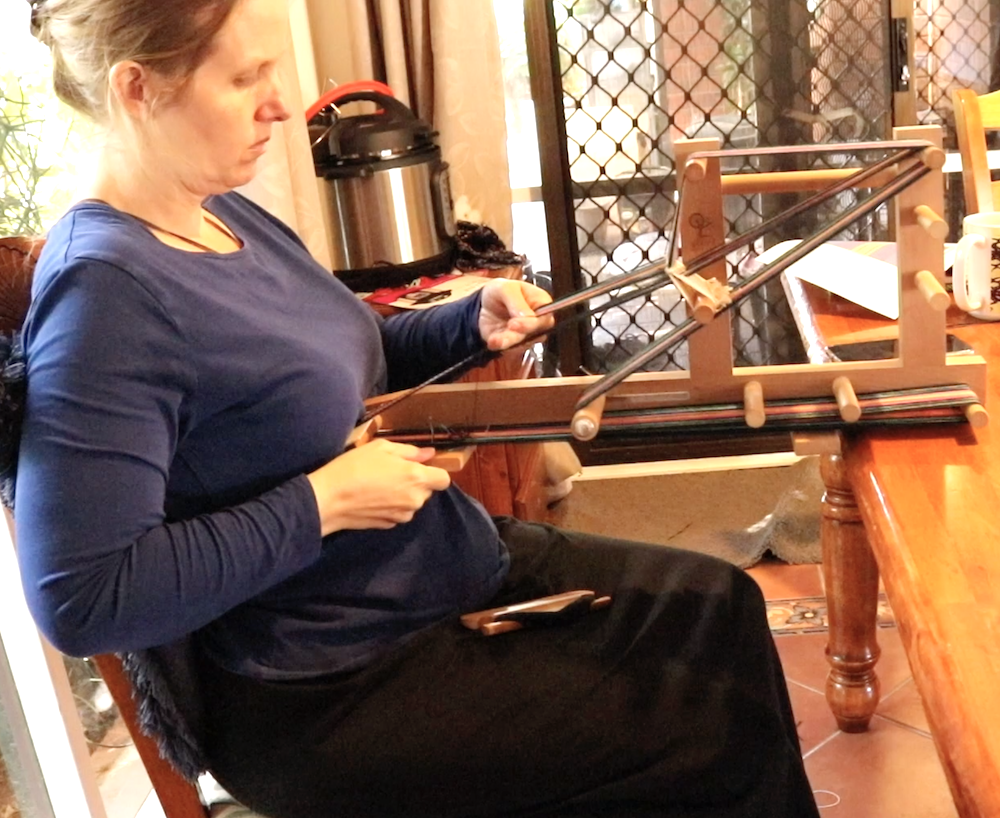
An inkle loom is basically a wooden frame with pegs for your warp to wind around and be tensioned on. There is also an adjustable tensioning peg to release or increase tension.

*This post contains affiliate links. For more information please see my disclosure policy.

Once you’ve wound on your warp, you create an extra shed for plain weave by using heddles to pick up threads. By the time you’re ready to weave, you will have shed 1 and shed 2 or heddled and unheddled threads. Pretty simple!

The weave structure that you use on an inkle loom is warp faced plain weave. This means that, although you are weaving plain weave, you place your warp under very tight tension and beat each pick down hard with a belt shuttle so that the warp colours remain visible but the weft threads do not. The warp threads become very condensed together, forming a thick, tight fabric, or band.

Now I’m going to address some commonly asked questions about inkle loom weaving:

What do I get when I purchase an inkle loom?

Whichever brand of inkle you choose, it should come standard with certain pieces. Firstly, the loom itself, commonly made of strong wood and usually requiring some basic assembly, comes with a built in tensioning peg.

You should also receive a belt shuttle, a clamp (this gives you the option of clamping the loom to a table or similar) and an instruction booklet.

You may or may not receive some string heddles, but you will need these, so check before purchasing if they are included. Of course, you an always make your own with some tapestry warping thread or seine twine.

What can I make on an inkle loom?

An inkle loom is for weaving bands. What you can then use the bands for is up to your own imagination!

Some ideas are: key fobs, dog leads, shoelaces, bag handles, decorative trim for other craft or sewing projects, tabs to sew onto your handwoven towels to hang them, stitched together to make a larger project like a bag or purse, bracelets, lanyards, belts, guitar straps… lots of possibilities!

What width and length can I weave on an inkle loom?

I will talk about Ashford inkle looms, as that is what I own and know best. There are 2 sizes available:

Ashford Inkle loom. (just over $100USD)

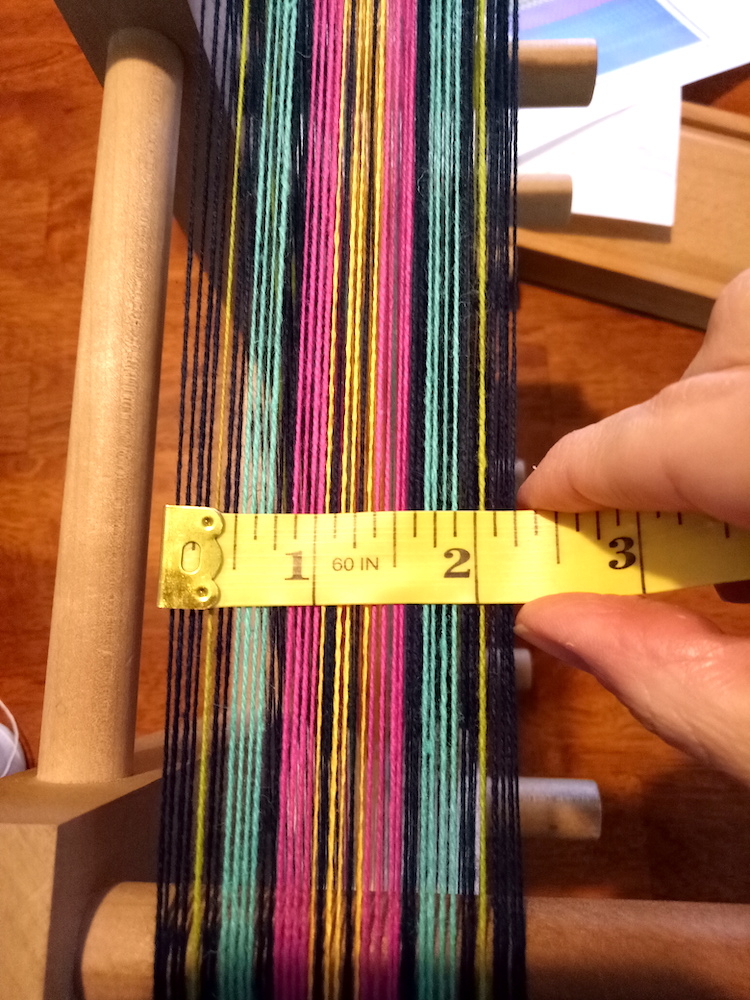
This is the inkle loom that I have. You can warp it to a length of 110″ and achieve a weaving width of up to 3″.

Ashford Inklette loom (under $100USD)

This is a smaller alternative. You can warp up to a length of 72″ and a weaving width of 2″.

Why is an inkle loom a good option?

You may find the thought of an inkle loom limiting because you can only weave bands on it. However, there are so many variations for the actual bands possible that inkle weaving can keep you very busy for a very long time.

I’ve had my inkle for a few years and feel like I’ve only just scratched the surface. For example, last year I experimented with krokbragd on my inkle. I hear you saying “but you said an inkle is a 2 shaft loom!”

Indeed, it is, just like a rigid heddle loom is, but by doing pick up and adding extra heddles, we can make those extra shafts we need for more intricate patterns.

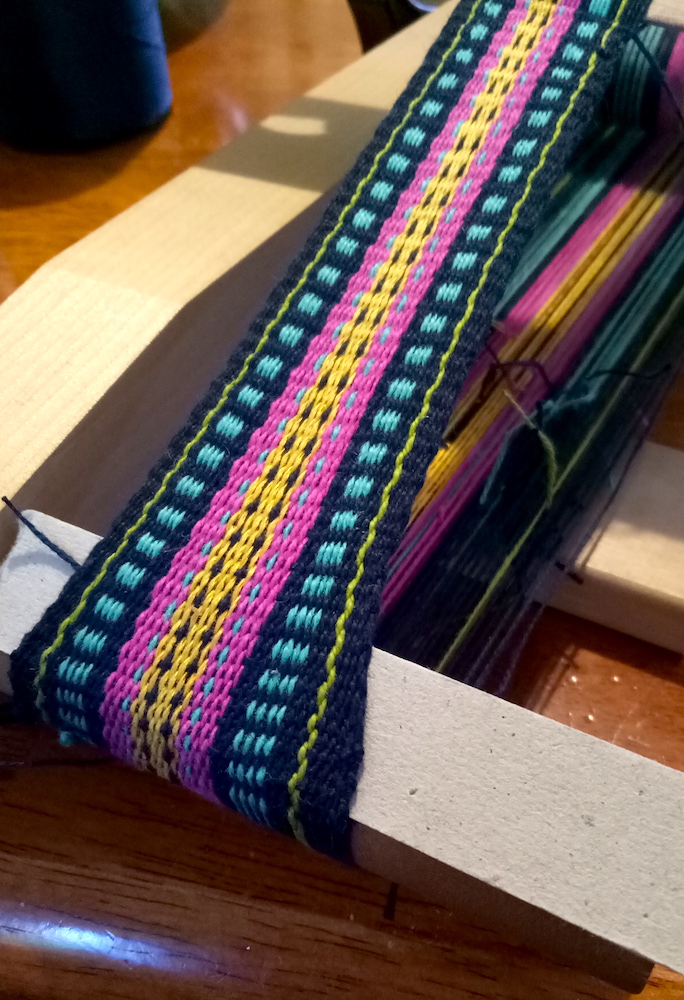
Weaving this krokbragd band was a fascinating exercise in taking a normally weft faced pattern draft and turning it to produce a warp faced pattern draft. And look at how gorgeous it is! If you want to know more about this project, I wrote a blog post about it here.

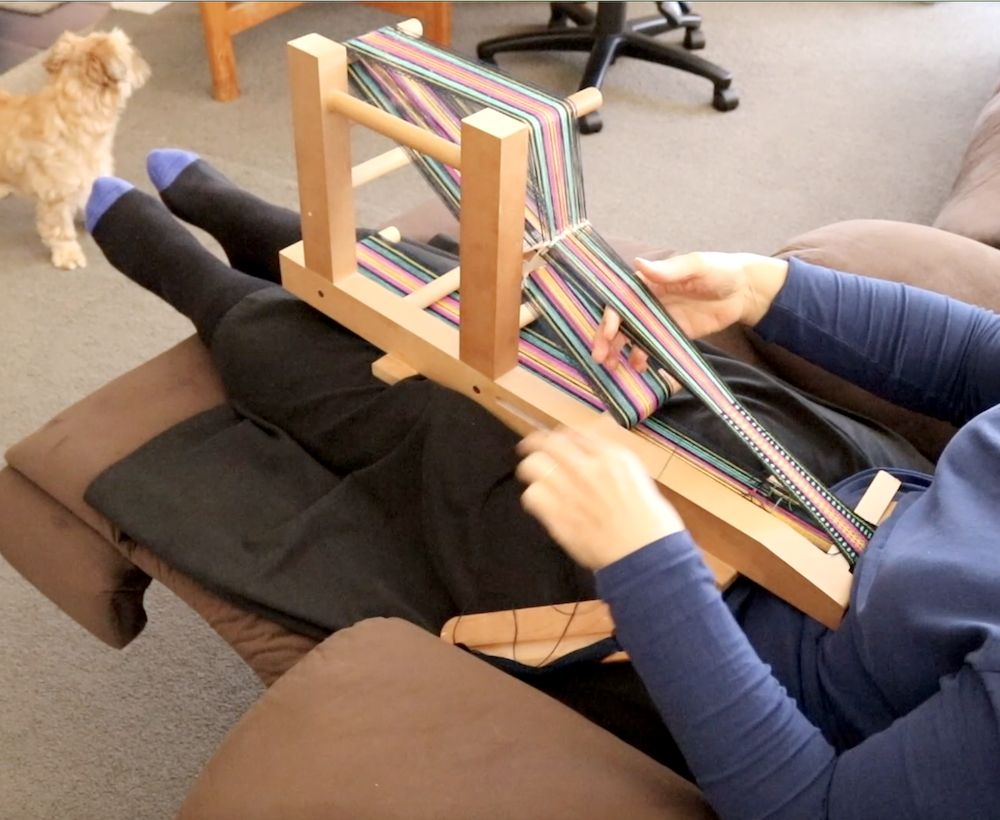
It is also such a light and portable loom. I like to sit in a recliner and weave on the inkle in the evenings while watching a movie with my family or chatting with someone. It’s small enough to take just about anywhere.

And of course, in the world of looms, this has to be one of the most affordable. Some weavers make their own, so make friends with google if that idea interests you.

Which yarns are best for inkle weaving?

I have mostly used 8/2 cotton. If you are familiar with me, you will know that I’m not a huge fan of mercerised cotton, aka Perle cotton, but for inkle weaving I have used it many times. It gives a lovely sheen to the bands.

I have also used unmercerised cotton a lot on my inkle. Both are perfect for the task. The colours of your band are all made in the warping process (remember, it’s a warp faced weave).

Here is a little tip – choose your weft colour according the colour of the edges of your warp, that way when you take the weft around the selvedges at the shed change, it will blend in nicely.

Where should I start?

The instruction booklet that comes with your inkle loom should help you a lot to get set up for your first project, however it won’t be long before you want to branch out and learn more. The best book that I have found on inkle weaving is Anne Dixon’s The Weaver’s Inkle Pattern Directory, which is extremely comprehensive and useful for both beginners and experienced levels.

Anne has over 400 patterns to try in all different styles and variations of difficulty. It’s quite an amazing book!

You will also find my Youtube series on weaving a floral inkle band invaluable, as it takes you right through from how to set up your loom to finishing your band after weaving. You will definitely want to check it out and be sure to watch all the videos so that you don’t miss any crucial steps:

You can download and print out this free floral pattern here:

Floral-band-inkle-patternDownload

Also, be sure to check out my article 7 Tips For Weaving on an Inkle Loom which includes yet another gorgeous and free downloadable pattern for you to weave on your inkle loom.

If you’re ready to get more serious about learning to weave on your inkle loom and also delve into tubular weaving, baltic pick up and all the tips and tricks, check out my online Inkle Weaving Course.

Product image

Inkle Weaving

Learn the fun and fascinating art of band weaving on your inkle loom!

4060 students enrolled

Last updated Dec 18th, 2025

Select a Pricing Plan
Buy now

I hope this article has peaked your interest in inkle weaving and helped you to see the many benefits of this little loom.

I love to weave on my Lojan Inkle Loom! I am a reseller for Lojan products in Australia, if you are interested in ordering please get in touch.

If you have any questions or comments, please leave them below, I love to hear from you (and it helps me to not feel like I’m talking to myself here 😆)

Until next time…

Happy Weaving!

Filed Under: Inkle Weaving, Tutorials, Weaving Tagged With: how to weave on an inkle loom, inkle loom, inkle weaving tutorial

Van Gogh inspired freestyle tapestry!

by Kelly 5 Comments

It’s hard to know what to say about the present world situation. Strange. Unprecedented. Uncertain. At times, scary.

Many people throughout the world are in isolation or quarantine – some self imposed, others enforced. Countries in lockdown.

My mind can’t help thinking that it all feels very much like a suspense movie or novel. But no, this is the reality of 2020 and coronavirus for all of us. Strange times indeed!

Beyond the feeling of bewilderment though, is one of hope and unique opportunity. We may be isolated in our homes, but we live in the age of the internet, where it easy to stay connected to others and share burdens. Many people have more time than they usually would, to explore interests and hobbies. My Youtube channel and Online Weaving School are great places to be right now!

With that in mind, I have a new Youtube project that is long, slow and relaxing. We could all use a bit of that right now!

The project is inspired by the wonderful Van Gogh painting, The Starry Night. I have long admired this art work for it’s colours, movement and mood. I thought it would translate really well to a tapestry, not as a replica but as inspiration.

I thought this would be a great, calming project because it is adaptable, doesn’t require much planning, is relaxing and free flowing. Oh, and the idea is to use stash yarns so you don’t need to go out to buy more!

All the materials plus the warp calculations are provided in this printable PDF-

Van-Gogh-inspired-tapestryDownload

Some of my stash yarns included wool, cotton, silk, acrylic and handspun, tencel and metallic. Weights included 8/2, lace weight, fingering, light worsted/dk and aran. My favourite weight ended up being the fingering.

The video/s are mostly in real time, something I have not done before. It means long videos, but I was figuring some people might appreciate sitting and weaving with me at this time – step by step and no hurry. And I know how some of you love to know all the details.

Begin with video one, which explains my aims for the tapestry and shows you the yarns I used:

Some additional resources that are relevant and helpful are:

My first freestyle tapestry series for Youtube –

You may be interested in my online course, Tapestry on a Rigid Heddle Loom to learn traditional tapestry techniques.

Then there is my review of the Mirrix Big Sister Tapestry Loom –

And my Tapestry Necklace project –

Filed Under: Free tutorial, Inspiration, Rigid heddle weaving, Tapestry Weaving, Tutorials, Weaving Tagged With: freestyle tapestry, tapestry weaving, tutorial, van gogh

How to Choose Yarn for Weaving: A Beginner’s Guide

by Kelly 44 Comments

Choosing the right yarn for your weaving project can feel overwhelming—especially when you’re just starting out on a rigid heddle loom. With so many options available, you’d think it would be easy. But when faced with dozens of yarn weights, fibers, and heddle sizes, even experienced crafters can feel unsure. Let me help you to choose yarn for weaving, regardless of your project!

One of the most common questions I hear is:
“How do I know which yarn to use with which heddle size—for which project?”
In other words… where do you even begin?

If you’ve ever felt confused by weaving yarn labels, sizing numbers, or what will actually work on your loom, you’re not alone. That’s exactly why I created my low priced online class, What Do All the Numbers Mean?—it’s a practical, beginner-friendly guide to demystifying yarn measurements and conversions, with helpful charts you can refer back to again and again.

In this article, I’ll walk you through how to choose yarn for weaving by looking at real weaving projects I’ve made. We’ll explore what worked, why it worked, and how you can apply the same approach to your own weaving.

*This post contains some affiliate links. For more information please see my disclosure policy.

Try the Snap Test First!

In all weaving, you begin with the warp, so it makes sense to start there. Doing a snap test will help determine whether the yarn you want to use for warp is going to be strong enough – you don’t want broken threads. Yes, they are fixable (this video shows you how) but not so ideal.

You should also be familiar with the drift test when choosing a yarn for your warp. This frequently occurs with an acrylic or wool yarn that is spun with low twist (here is an example). Although this creates a beautiful, soft and lofty yarn, it is better suited to the weft than the warp.

Knitting Yarn

To choose yarn for weaving your first projects, I highly recommend knitting wool. It’s economical, easy to use, accessible and thick. I use Bendigo Woollen Mills Luxury 8 ply a lot, it is a dk weight yarn and pairs perfectly with the 7.5 or 8 dent heddle that comes with most new rigid heddle looms. It is perfect for wearables, as it’s lovely and soft. Which brings me to the next point.

If you intend to wear your woven piece, give it the face brush test. Hold the yarn up against your cheek and lightly rub. If it feels too scratchy, you’re not going to like wearing it and it’s best saved for something else!

Cost effectiveness

Consider the cost of the yarn you intend to use. If you are a less experienced weaver, don’t go for that beautiful, expensive yarn – it will only put pressure on and stress you out. Use something affordable until you have more confidence. I have a handy weaving yarn cost estimator to take the guesswork out of it for you.

This scarf is a good example of a balanced plain weave piece using light worsted/ dk yarn with my 7.5 dent heddle. A piece like this is great for beginners and an excellent opportunity to practice neat edges.

The Right Sett

Before beginning a project, it’s really important to figure out the best sett for your chosen yarn. All you need is an inch ruler and your yarn. Once you have more experience, you may not need to do the test every time, but it’s a must for beginners. Here’s how:

The Weaver’s Toolkit is an invaluable resource for new and seasoned weavers. It includes useful charts that help you to match up the right sized heddle with your chosen yarn, yarn size conversion charts and so much more. Available as a digital download ebooklet, the Toolkit is a valuable asset to any weaver’s library.

I Love Wool!

A good example of a project using wool is my Garden Path Scarf pattern. This pattern is my best seller and I myself love to wear my assortment of GP scarves! I love that it looks a bit like lace knitting.

Woven with a lighter 4 ply Australian merino (fingering weight) it is light and airy but still warm to wear, thanks to the wool. I wouldn’t necessarily say that it’s an absolute beginners project, but it is actually not as difficult to weave as it looks!

Blended Yarns

I must give a caution at this point when it comes to blended yarns. Depending on what the blend is, it can make a nightmare out of your project.

For this “special” scarf I use a silk/ merino/ sparkle weft and a baby alpaca warp. All painstakingly hand dyed. I didn’t know until later that often, yarns with a silk blend will not always grip other yarns like, say a wool on wool will grip. So, I ended up with uneven weaving resulting in warp threads showing at the selvedges. It was an expensive mistake, but one that I’ve never forgotten (or repeated!)

Handspun Yarns

A lot of spinners also become weavers, and what a wonderful progression and integration of one art form into another. Handspun can definitely be used to weave with, and gives a very different look to commercial yarns. The main things to consider with handpsun:

*Does it hold up to the snap test?

*Which heddle is going to suit best?

Spun yarn can be inconsistent, depending on how it has been spun and what the spinner is wanting to achieve, but if you use your inch ruler to determine sett, you won’t have any problems choosing the right heddle.

Cotton Yarns

Cotton is also a great choice, but should be chosen a little more carefully for beginners. In fact, my Beginner Rigid Heddle Weaving course project uses the popular US cotton, Sugar n Cream. It is an aran weight yarn, thicker than light worsted, so it weaves up quickly. It’s pretty affordable to buy too! And, it’s just right for your 7.5 or 8 dent heddle. In Australia, Sugar n Cream is available from American Yarns.

I wouldn’t advise an inexperienced weaver to start out with a thinner cotton, there are too many extra things to consider. Your success is far more guaranteed with a thicker, more manageable cotton.

When you have gained that experience, you may want to explore weaving kitchen towels and other, finer pieces. This is where your 8/2 cotton comes in nicely. It is readily available, reasonably economical, strong and multi purpose. My personal favourite is Maurice Brassard 8/2 cotton because, out of all the cottons I’ve tried, it is the most consistent and reliable. It is unmercerised, which is my big preference over mercerised. In Australia you can purchase Maurice Brassard yarns at the Thread Collective.

My Happy Fibonnaci Towels project is available as a downloadable PDF and also as an online class.

Cottolin Yarn

I’ll give cottolin a quick mention, because it’s my favourite yarn for weaving kitchen towels. Linen on it’s own can be difficult to manage, but a blend of linen and cotton is a match made in heaven!

You can buy cottolin in dyed, undyed, bleached, unbleached and half bleached – lots of choices! I love the natural look of the half bleached. Once again, Maurice Brassard 22/2 is what I use. Don’t be confused by the numbers, linen is measured differently to cotton, so the 22/2 cottolin is very similar to 8/2 cotton size. Cottolin is so absorbent and after washing, so soft, I love it!

Bamboo Yarn

Now onto another personal favourite, bamboo. It’s available in a number of different sizes. One that I use very often is Bambu 7, which is available in Australia from BB Yarn Supply. A suitable alternative is Valley 5/2 bamboo and for a thinner weight, Maurice Brassard 8/2 bamboo.

I used Bambu 7 recently for the scarf project for my Table Loom Weaving course. The results speak for themselves!

Tencel Yarn

Another weaving yarn I love is tencel. This is an interesting fibre, manufactured from wood pulp. It is similar to bamboo in that it has a high sheen and is silky. It is very light and even though it comes in 8/2 size, it seems quite thin. I use Maurice Brassard 8/2 tencel. I’ve woven a number of pieces with tencel and have never been disappointed. It also takes dye beautifully. Once again, not a beginner’s yarn!

The Galaxy Scarf PDF pattern uses a combination of bamboo and tencel, with great effect! The two yarns together have a beautiful drape and work perfectly for light garments.

Silk Yarn

Last, but not least, we have silk. There is no denying the gorgeousness of silk, but it’s not the easiest yarn to weave with, especially if it’s very fine.

It is extremely light and almost “glows”, particularly if you use certain colour combinations. The project above was woven with 60/2 silk at 40 ends per inch on my floor loom. This yarn in definitely not cheap, so for special projects only.

In the following Youtube videos, I go through lots of my own projects and explain the yarns and heddles used and why. I hope you enjoy them!

Failing to plan is planning to fail

A guaranteed way to not waste yarn through avoidable accidents is to calculate for your project before you start. It’s not as confronting as it sounds!

If mathematics is not your favourite thing 🙋‍♀️ don’t worry. I have calculating resources that take all of the guess work out of it.

Are you a pen and paper kind of weaver? Then check out my free printable calculations sheet for rigid heddle weavers. It even comes with a free mini class that explains everything.

If you’re more of an online/techy weaver, you will love my free interactive warp and weft calculator.

When you’re new to weaving—especially on a rigid heddle loom—choosing weaving yarn can feel like one big guessing game. But as you’ve seen from the examples in this post, it becomes easier with time, experimentation, and a little guidance.

The more you weave, the more you’ll begin to understand how different yarns behave, which sett works best, and how to get the results you’re after. Don’t be afraid to sample, make mistakes, and learn along the way—that’s all part of the joy of weaving!

Need a gentle nudge in the right direction? Check out my Beginner Rigid Heddle Weaving Online Course for step by step instructions. Complete a lovely, practical project and get to know your rigid heddle loom while growing in confidence.

You can do it!

Until next time…

Happy Weaving!

Filed Under: Rigid heddle weaving, Weaving Tagged With: beginner rigid heddle weaving, choosing yarns, rigid heddle weaving, weaving yarns

Why would you weave with two heddles or more?

by Kelly 28 Comments

When you buy a rigid heddle loom, it comes equipped with one heddle – usually a 7.5 or 8 dent, depending on the company you purchase from. So, if there is only one heddle with the loom, why would you weave with two heddles or more?

Heddle or Reed?

Before I go any further, I just want to say that when talking about rigid heddle looms, the terms “heddle” and “reed” are usually interchangeable but mean the same thing. For the rest of this article, I will use the term “heddle”.

*This post contains affiliate links. For more information, please see my disclosure policy.

Image from Ashford website

What is a heddle?

The actual “rigid heddle” part of a rigid heddle loom is one of the features that makes it such a great loom for learning how to weave. The heddle is a multi purpose piece of equipment. It spaces your warp, allows you to achieve two different shafts and is also your beater. It’s pretty awesome!

One heddle equals two shafts. The holes are one shaft and the slots are another. So, a rigid heddle loom can be called a two shaft loom, though there are some hot debates about this (Facebook, I keep out of these arguments!) as some people argue that a rigid heddle produces sheds not shafts.

Not really worth arguing over in my opinion, as whatever the case, you can weave 2 shaft drafts (plain weave) with one heddle and a rigid heddle loom.

You may assume then, that when you add a second heddle, you can then weave a 4 shaft pattern, but that is not so.

“What? Didn’t you just say that one heddle equals two shafts? Now I’m confused!”

One heddle does equal two shafts when used on it’s own. BUT, adding an extra heddle does not add two extra shafts, because the slots can only be counted as one shaft.

Before you throw your hands up in frustration and storm away from this page, let me give you an example:

Two Heddle Example

I’m using two heddles. On heddle one, I’m using the holes as shaft 1. On heddle two, I’m using the holes as shaft 2. That leaves the slots for shaft 3.

Think of the threads in holes as dedicated – they’re on one set path that can’t be changed once they’re threaded in. If I lift heddle one, all the shaft 1 hole threads will go up and the slot threads stay down. If I lift heddle two, all the shaft 2 hole threads will go up and the slot threads will stay down.

The only way I can make the slot threads go up would be to put both heddles in the down position, forcing the hole threads down. So you see that the slot threads operate differently to the hole threads and can’t be manipulated in the same way.

The Desire for Exploration

It seems that the desire of weavers to explore and push the boundaries of their looms has been influential in loom production. Many commercially available rigid heddle looms now come with a built in double heddle block rather than just the single they used to be made with. This is a pretty good indicator that weavers want to weave with more than one heddle!

But what can you actually do with more than one heddle? Let’s take a look at the possibilities.

Possibilities

  1. Two heddles to increase your sett.

Say you want to weave a yarn at 20 ends per inch (epi). There is no heddle available that can do that for you, the closest sett available is a 15 (which will give you 15 epi), and that just won’t do when you want to weave at 20 epi! If you use 2 x 10 dent heddles, that will give you 20 epi.

2. Two heddles increase your pattern possibilities.

You can set up your loom with an extra heddle instead of a pick up stick to weave all kinds of patterns. You can consider an extra heddle as an extra shaft, so using two heddles will allow you to weave a three shaft pattern. And there are lots of three shaft patterns to choose from!

I really enjoy weaving with extra heddles in place of pick up sticks or heddle rods. The set up time is less and the weaving is more straightforward.

3. Two heddles allow you to weave double width cloth.

This is one of those eye opening weaving revelations that is just so exciting to discover. Your loom is not wide enough for the project you want to weave. With two heddles, you can weave double your loom’s available weaving width. It’s like magic!

Can I Use Pick Up Sticks or Heddle Rods Instead?

Of course! Extra heddles are definitely more of a financial outlay and the same results can be achieved by other means. This article discusses some pros and cons for each method.

Weaving with more than one heddle is such a popular topic that I have several resources available for weavers who wish to explore further:

Online classes-

Weaving with Two Heddles

Doubleweave Baby Blanket

Christmas Table Runner

Krokbragd Bag

PDF Patterns-

Diamond Stripe Towels

The Midnight Shawl

Double Width Blanket Ebooklet

And if you’re up for a challenge, this class will walk you through how to weave on three heddles!

Three Heddle Adventures

I hope this post was interesting and helpful to you, please leave me a comment to ask questions or let me know if you enjoyed this.

Until next time…

Happy Weaving!

Filed Under: Rigid heddle weaving, Weaving Tagged With: rigid heddle weaving, two heddles

Making pictures with your loom

by Kelly 10 Comments

Something that really captivated me before I even started weaving, was the idea of using artistic creativity in weaving.

When I was younger I loved to draw and paint. In my adult life, I have not made a lot of time to devote to making art, but I have been happy to discover that there is a huge crossover with art and weaving.

This post contains affiliate links.

One of the most obvious forms of weaving that this crossover takes place in is tapestry weaving. In tapestry, the weaver can have total artistic licence through the use of colours and shapes. The shapes can be basic or complex. Colours can be blended on the loom. And, tapestry can be woven on many different types of looms.

I purchased a Mirrix Big Sister last year, as I wanted to develop my tapestry techniques and also have a dedicated tapestry loom. It is an excellent loom for tapestry, as even though it’s small, I find the available weaving room quite spacious and the tension is awesome.

Before I bought the Mirrix, I wove tapestries on my rigid heddle loom.

I had a lot of fun using different yarns and styles. My most popular Youtube series details how to weave in a free and unplanned style with a variety of yarns and colours.

I’ve also explored more tradition tapestry techniques on the rigid heddle loom. I particularly enjoyed taking my Sampleit on vacation, which enabled me to sit on the beach, watch the kids enjoy the waves and weave. What bliss!

My adventures with tapestry on the rigid heddle loom gained so much interest on social media, that I developed a course to show others how to do it! The course includes all the basic tapestry techniques you need to know, plus how to use all of these techniques to weave a finished project. If that sounds interesting to you, the course is available here.

Another way to get started in tapestry without breaking the budget, is with a more affordable tapestry loom. Depending on your budget, you could opt for something like the Schacht Tapestry Loom, or even just an el cheapo like a Melissa and Doug simple frame loom. Some people choose to make their own by building a simple frame or repurposing a wooden picture frame or similar. Just be aware that the more tension the loom holds, the better it is for tapestry and if you go down the cheap route, well, you tend to get what you pay for.

A resource that I found to be great when starting out with tapestry, and still use for inspiration, is Kirsten Glasbrook’s book, The Art of Tapestry Weaving.

Aside from tapestry, are there other ways to make pictures with your loom. Oh, yes indeed!

If I haven’t already gushed about krokbragd on this blog enough times, here I go again! If you’re interested in going down my blog rabbit hole on this topic, start with this post. Krokbragd is a weft based, most of the time but not always 3 shaft, weft faced weave. You repeat the same order of treadling over and over, but can vary your yarn colour combinations to produce simple and complex shapes and images. It is seriously cool, and that is why I’m always gushing about it.

Many of the shapes are open to interpretation, as they can be slightly non specific, but there is really so much to explore. One of my goals for this year is to weave a striking krokbragd wall hanging using my floor loom. Can’t wait for that one! Debby Greenlaw has written a terrific book, Krokbragd: How to Design and Weave.

I have a number of Youtube lessons on krokbragd using my rigid heddle loom, but if it’s new to you, start with the above video.

Boundweave is another weft faced weave that is very adaptable and versatile. It can be woven on 4 or more shafts (so it’s possible on a rigid heddle loom). The picture possibilities are endless. I have been playing around with bound weave on rose path threading and 6 shafts recently on my floor loom.

I’m using Nancy Arthur Hoskins’ Weft Faced Pattern Weaves book for guidance. My goodness, what an extensive book – so much to learn! This was my first attempt and I’ve now branched out with some more random designs, which is all very interesting. Slow, but interesting.

There is a lot more to be said about making pictures on your loom, but I hope this post has inspired you with some of the possibilities. Have you tried any of these techniques? Which is your favourite? Let me know in the comments!

Until next time…

Happy Weaving!

Filed Under: 4 shaft weaving, 8 shaft weaving, Floor Loom Weaving, Krokbragd, Rigid heddle weaving, Tapestry Weaving, Weaving Tagged With: boundweave, pictures, tapestry

Which loom to begin with? Table loom and Rigid Heddle Loom Comparison.

by Kelly 10 Comments

When you’re starting out on your weaving journey, it can be confusing when you are faced with the variety of looms for purchase. How do you know before buying which one is going to suit your needs the best?

I get asked this question a lot, so I’ve put together a list of things to consider before purchasing. Specifically, I will compare the rigid heddle and the table loom, as these are the most common “beginner” looms available.

*This post contains affiliate links.

My first recommendation when considering the type of loom you might want to purchase is to try actually weaving on one. I know it’s not always possible, but if you have a friend who has a loom or you can get in touch with a guild that has looms for you to try, it can be a big bonus. Many shops that sell looms will be more than happy for you to come in store so that you can physically see and try a loom before buying too.

When I was looking for my first loom, a few factors contributed to my final decision.

  1. The price
  2. Simplicity of the loom
  3. Recommendations

My first loom purchase was the Ashford 24″ rigid heddle loom. I found that I could buy the loom and stand for a fraction of the price of a table loom. Having never woven anything in my life, I didn’t want to spend a heap of money up front, not knowing whether it was something I was definitely going to enjoy.

Being a complete newbie also helped me to decide on the RHL. I could see just by looking at it that it was a more simple loom, and I didn’t want something that was over complicated, as I was going to be weaving on my own.

I chatted with some craft friends online who already owned a rigid heddle loom, and their recommendations also helped me to decide that it was the right choice for me.

Now I’ll go over the pros and cons of the rigid heddle loom (in my opinion!):

Pros–

  • It’s very lightweight and portable, making it easy to travel with or carry from room to room.
  • Easy to learn. Like anything, becoming comfortable with a RHL takes time, but as long as you have good information, enthusiasm and practice, becoming a good weaver on a RHL is very achievable.
  • Time efficient. I guess this comes under easy to learn as well, but the RHL is really quick and simple to warp and get weaving.
  • Even though it’s a 2 shaft loom, it has more capabilities than meets the eye. By using pick up sticks, heddle rods and extra reeds, you can turn a RHL into a multi shaft loom. If this sounds interesting to you, I have an in depth class showing you how to convert 3 and 4 shaft pattern drafts to your RHL. You can find that class here. I also have a class that shows you how to achieve 4 shaft patterns by weaving with 3 heddles. You can find that class here.
  • Very little loom waste (you gotta love that!)
  • Very comfortable to sit at and use
  • Affordable to get started

Cons–

  • When I mentioned the possibilities in the “cons”, this means a little extra work and thought for the weaver. You may need some pretty good guidance to be able to set up your loom for more shafts or patterned weaving. A loom that is already set up for multi shafts is more efficient in this respect.
  • Limited reed sizes. The smallest dent reed currently available is a 15 dent from Ashford. This is due to most reeds being manufactured with heavy duty plastic in a wooden frame. It can only go so small.
  • It is hard to achieve good tension with finer yarns.
  • I tend to use my rigid heddle loom with thicker yarns as I feel it is better suited. Is that a con? It’s not really, it’s more of a consideration!

Some weavers ask: “So why would you bother buying a table loom if you can do so much on a rigid heddle loom?”

Well, for me, I was keen to level up my weaving without the full investment of a floor loom. I admit that after weaving on a RHL for a few years, I had loom envy! I felt like everywhere I turned I saw wonderful 8 shaft patterns tempting me, and convincing me that I just had to be able to weave them! If you are completely content with your RHL, I admire you, I really do. I wish I was more like you! 😄

But seriously, I did want the challenge of learning to weave on a multi shaft loom. And I wanted to achieve intricate patterns on a loom that was built for that very purpose.

My first table loom was the Ashford 8 shaft, 32″.

So let’s look at some pros on cons of a table loom.

Pros–

  • A more affordable way to set up for multi shaft weaving than a floor loom.
  • All the shafts are there, once you have “dressed” the loom (warped, threaded, sleyed and tied on) you can just enjoy the weaving without further set up necessary.
  • Boat shuttles work well.
  • Castle is collapsable, so even though it stands somewhat tall it can be compacted down.
  • Easy to use when it’s just sitting on a table.

Cons-

  • You need a sturdy table to place it on
  • Depending on the size of your loom, you may need help to move it.
  • Some table loom weavers stand while weaving – that is not going to appeal to everyone (me included!)
  • Not quite as comfortable to sit at as a RHL and it is best to have a good, height adjustable chair.
  • Heddles are not moveable once your project is threaded. You can make extra heddles if you need to, but cannot move the shafts during a project.
  • Dressing the loom is quite a time commitment!
  • Shed can be small
  • Depending on the size of the loom, you may not be able to advance the warp from a seated position.

It seems like there are quite a few cons for the table loom, but I try to give as much information as possible and don’t want to leave out any observations that I think are important.

I do think table looms are awesome, and for me, my table loom was a huge leap in my weaving knowledge and ability, especially towards my journey of owning and using a floor loom.

If you enjoyed this post, you may also want to watch the companion video:

If you want to learn more about table looms, please go to this post. Or, if you are interested in rigid heddle looms this post will help. Actually, I have a lot of rigid heddle posts here, so you can also use the search bar at the top of this page and type in “rigid heddle” and you will be spoiled for choice.

I hope this post was really useful to you, as always, you can speak to me in the comments or ask any burning questions you may have.

If learning to weave on a rigid heddle loom is interesting to you, my From Woe to Go! Beginner Rigid Heddle Weaving class is for you 😊

Or, if table loom weaving is your thing, my extensive Weaving on a Table Loom course is what you need.

I also have a comprehensive First Loom Buyers Guide that covers a range of looms to help you make an educated choice in purchasing.

Until next time…

Happy Weaving!

Filed Under: Rigid heddle weaving, Table loom weaving, Weaving Tagged With: rigid heddle loom

Table loom options

by Kelly 27 Comments

When it comes to selecting a table loom to purchase, we are not as spoiled for choice as we may be for rigid heddle looms.

This can actually be a positive rather than negative thing, as it can be easier to choose when the selection is more narrow.

In this post I’m going to provide details for table looms currently available commercially (if I miss any brands it would be because they are obscure and not easy to obtain.) I will also give the retail prices of each so that you can compare.

*This post contains affiliate links

As a little disclaimer, the only brand of table loom I have actually used and am really familiar with is Ashford. So, I’m not giving an opinion or appraisal on the other brands, but rather providing available information and pricing.

Most of the looms I mention here do not come with extras like stands, benches or raddles. These things are available as separate purchases.

Let’s dive in!

I’m going to start with Ashford table looms, for the reasons already given above. There are quite a few options with Ashford and pricing is quite reasonable by comparison. Please note that the photographs are all courtesy of the manufacturers and all prices do not include stands.

All prices are in US dollars.

The entry level table loom from Ashford is a 4 shaft and is available in weaving widths of 16, 24 (pictured) and 32 inches. Prices start at around $840USD for the 16″.

The cool thing about a 4 shaft is that there is room on the castle front to upgrade to 8 shafts later if you choose to, so if you’re not sure you can always start out on 4 and see how you go.

There are also stands available separately, and these come with the option of also purchasing a treadle kit for more of a floor loom experience.

Then we have the 8 shaft range, also available in 16 (pictured), 24 and 32“. 8 shaft prices start at $890USD.

There is even a 16 shaft table loom for those who love the idea of having lots of shafts to play around with.

All the Ashford table looms have a folding castle for compatibility, meaning they are a good travel or teaching loom. The beater is overhead and easy to use. Each loom comes standard with a stick shuttle, threading and reed hook, 10 dent beater and 640 texsolv heddles to get you started. All Silver Beech wooden pieces come lacquered and ready to assemble.

If you need help to assemble your new Ashford table loom, I have instructional videos:

Le Clerc has several table loom options. Their looms look to me to be made in a more traditional style with dark wood, straight lines and metal heddles plus a boat shuttle included.

The Dorothy table loom comes in 15.75 or 24″ weaving width and may have 4, 8 or 12 shafts. Starting price is $750USD. Le Clerc also make the Voyageur, which goes right up to 16 shafts. You have the option of buying a stand with these looms and I must say that I really like the way their stands are basically a sturdy little table with side shelves – shelves are a great thing to have with any loom in my opinion! There is also the option here to purchase a treadle stand.

Your options for table looms with Schacht are a little narrower, to be the best of my knowledge they just make one model of table loom, but in a variety of weaving widths and a choice of 4 or 8 shafts. These looms are constructed with maple wood and you actually get a choice of reed size, which is a nice bonus! Prices start at $742USD. A stand is available for separate purchase, as is a double back beam kit.

Glimakra makes the Victoria Table Loom. Once again, there is not a lot of variation as this is their only table loom and it is only available in 4 shafts with a 27″ weaving width. Something I find interesting about this loom is that it doesn’t fold and isn’t very portable, but just looking at it you can see that it’s a solid, sturdy loom. The starting price for this loom is $1,100USD and once again you have the option of purchasing a stand and treadle kit.

Toika makes a table loom in only one size (23.6″) but with a choice of 4 or 8 shafts. It comes with an 8 dent reed and 200 texsolv heddles. The levers for this loom look a little different as the ends that you grip on to for shaft manipulation are rounded pegs. At first glance, I wonder whether the shape of these pegs cause hand fatigue for the weaver, I do think that would be a possible problem for me. Prices start at $825USD. This loom can apparently be mounted on a stand, however I don’t think Toika actually make a stand specifically for this loom.

Lastly, Louet make a few different table looms. I have to mention the Klik Table Loom first, as it’s such a different concept to your regular table loom. The shafts are actually operated (raised) from the side based on a spring and click system. Then you beat with a swinging beater. The loom comes with 4 shafts, but up to 16 shafts can be added to the space. This loom looks very lightweight and portable, which would make it an ideal “take with you” loom. A couple of thoughts that spring to mind though. 1. You have to lean around to the side to operate the shafts, possibly not good for back or shoulder injuries? 2. The loom looks like it would sit flat on a table, but at the same time the shafts look lower than the bottom edge of the loom? And what about those handles, could you not do a full rotation if the loom was on a table? Therefore, would it possibly be necessary to purchase the stand to use this loom effectively? So, while the concept is very interesting, I would definitely want to try this loom before buying. Price for the Klik is $750USD.

Louet also make the Jane (pictured) and the Erica table looms. I have heard very good things about these two looms and they are definitely gaining popularity. The Erica starts at $555USD for the 4 shaft or you can start with the 2 shaft at $370USD and upgrade to 4 later. The Jane comes standard with 8 shafts in 2 different weaving widths, and a built in raddle (no separate purchase for that) starting at $1,195USD. These looms fold down and are light weight to transport.

The links I’ve provided in this post are from Amazon and The Woolery.

If you are in Australia and interested in purchasing an Ashford loom, I recommend Tracy from Knit Spin Weave.

If you are in Australia and it’s a Louet you’re after, I recommend Nicky from The Thread Collective.

Have I missed any table looms that should have been mentioned? If so, please tell me in the comments below.

If you are interested in table loom weaving or already own one but need help to get going, my Table Loom Weaving course would be perfect for you!

I hope this has been useful to you!

Until next time…

Happy Weaving!

Filed Under: 4 shaft weaving, 8 shaft weaving, Table loom weaving, Weaving Tagged With: table loom weaving

What is a table loom?

by Kelly 39 Comments

A table loom enables multi shaft weaving without the space or financial investment that a floor loom requires.

*This post contains affiliate links.

A table loom usually comes with four or more shafts. Four and eight shaft looms are the most common, but they can have more. Ashford, for example, manufacture a 16 shaft table loom!

Ashford 16 shaft table loom. Image from Ashford website.

Table looms are often favoured for their portability and affordability. They make a great loom to take along to workshops, or anywhere you want to take a multi shaft loom. Some will come with a handy carry bag and many will fold down to be even more space efficient. They are also often used for sampling, as you can test out your yarns or pattern before committing it to the floor loom.

Table looms come in a variety of sizes, meaning that if you only require one for sampling or you have a very small space to fit the loom, you could choose a 16 inch or lower weaving width. This size would also be suitable if you only wanted to weave narrower pieces like scarves.

The mode of operation for weaving on a table loom differs to other looms and makes it instantly recognisable. The shafts, rather than being operated by raising or lowering a heddle/reed (as in rigid heddle weaving) or being foot controlled (such as treadling on a floor loom) are raised by the manoeuvring of levers that sit at the front of the castle (the upright part of the loom) and are tied to the shafts underneath. These levers are very simple to operate and as lever 1 corresponds with shaft 1 and so on, it is visually simple – you are actually looking at the levers right in front of you, making it difficult to mix up and get the pattern wrong.

Table looms are also adaptable. In the last paragraph I explained that the levers are hand operated, however if you want more of a floor loom experience, you can purchase a stand along with treadles. The treadles are tied to the shafts in place of the levers, allowing you to lift the shafts by depressing treadles with your feet.

Some looms can be purchased as a four shaft and upgraded to an eight shaft later on. This is a terrific option for those who:

  1. Wish to start out on four shafts only OR
  2. Don’t wish to make the financial commitment of an eight shaft loom right away.

To weave on a table loom, you will need a few things apart from the tools that come standard with the loom:

*A table space to keep the loom on whilst weaving (unless you also purchase a stand, which is available separately). If weaving at a table, some weavers choose to stand. My back is no good for standing so I like to use an adjustable height office chair that I find comfortable.

*A warping board. A table loom is warped indirectly, so you make your warp on the board and transfer it to the loom.

*A raddle kit. This is necessary for spacing your warp before taking it to the loom. You can buy the raddle kit that fits your size of loom. Some weavers choose to make their own.

You can see a short overview of the Ashford 8 shaft, 32″ table loom here-

And you can see a demonstration of me using the loom here-

I have some exciting news regarding table looms too! I recently purchased the Ashford 16″ 8 shaft table loom to use for teaching. My husband and I made a two part video that shows you how to assemble it.

But that is not all! My primary purpose for buying this new loom is because I have had so many requests for a table loom class and I am happy to say that I’ve put together a very comprehensive class, Weaving on a Table Loom.

I hope this post has been useful to you, let me know in the comments if you have any questions or simply want to leave me a comment.

Until next time…

Happy Weaving!

Filed Under: 4 shaft weaving, 8 shaft weaving, Table loom weaving, Weaving Tagged With: table loom

Which weight of yarn do I choose?

by Kelly 11 Comments

For newer weavers, yarn choice has to be one of the biggest conundrums. We are totally spoilt for choice when it comes to variety of yarns available these days, but there are some important aspects to consider before you start shopping.

I often recommend that newer weavers start out by using knitting yarns. There are a couple of reasons for this.

  • Knitting yarn is readily available.
  • It is usually economical.
  • Many new weavers have a knitting background and therefore will often have a healthy stash of yarn!
  • Knitting yarn often has a nice amount of elasticity and are therefore quite forgiving to work with.
  • And finally, it’s usually thicker than weaving yarn, so for first projects it is an excellent choice – it will make your warping and weaving faster and easier.

*This post contains affiliate links. For more information, please see my disclosure policy.

When you purchase a weaving specific yarn online or in a shop, the recommended sett for that yarn will often be provided. Not so with knitting yarns, which tend to come with knitting needle or crochet hook recommendations instead. But, this is no problem to the savvy weaver who knows how to figure out the sett for her/himself! All you need is your chosen yarn and an inch ruler.

If you’re not familiar with the concept of sett in weaving, I explain it in this video:

And if you need an easy demonstration of how to figure out the sett for your chosen yarn, I recommend this video:

The demonstration in this video refers to balanced plain weave, the twill equation is a little different.

The next consideration after you have figured out the ideal sett is what you’re actually weaving. A scarf, for example may require a different approach to a table runner or placemat, even if you’re using the same yarn.

Let me give an example:

Say I have a light worsted weight (Australian 8 ply, DK) cotton that is lovely and soft. Say that I’ve done my wrap test to determine the sett and it showed me that my 7.5 heddle/reed is the best option. I go ahead with this sett because I want a soft and slightly flow-ey scarf.

I like the yarn so much that I decide to also use it for a table runner. But I want my table runner to have a firmer feel, so that it stays put on the table and is somewhat solid. Given my experience with weaving the scarf at a sett of 7.5, I decide that I’m going to use my 10 dent heddle/reed for the runner, as it will ensure that my warp and weft interlacement is closer than it was with the scarf, giving me a firmer fabric.

Here is a little tip when selecting a yarn for a woven piece you intend to wear eg. a scarf. Hold the yarn to your cheek and lightly rub back and forth. If the yarn feels scratchy or unpleasant to your skin, it will not be suitable to wear. If the shopkeeper and patrons are knitters, crocheters or weavers, they will understand what you’re doing. If not, you may get some odd stares!!

There is another, basic test you can perform if you’re unsure of yarn to heddle/reed suitability.

That is to grab your yarn and thread a single of it through a slot. If the yarn doesn’t fit through the slot, it is too thick. If it doesn’t fit, but you have to encourage it to get through, it is likely too thick. If you rub the yarn up and down in the heddle/reed and it seems a bit squashed, it is likely too thick.

Remember that your yarn has to deal with that friction for the entirety of your project, so if there is too much friction you increase the likelihood of broken warp threads and a less than comfortable weaving experience.

Likewise, if you thread your yarn through a slot and there is a heap of space leftover and your yarn seems very loose in the slot, it may not be the right heddle/reed for your project. Unless of course you are trying to achieve an open and airy fabric!

So, what if you don’t have a heddle/reed that is the equivalent sett for your yarn?

This can happen when using a finer yarn. The finest heddle/reed currently available for a rigid heddle loom is a 15 dent. But the recommended sett for my yarn is 30. Well, you can simply double your ends to achieve the right sett.

Then you have the choice for the weft, if using the same weight of yarn as warp, whether you double the weft as well or not. And this choice comes back once again to the purpose of the project and the type of fabric desired. Which brings me to sampling.

I used to think that sampling was a big waste of time. I’m not sure at what point I became a sampling convert, but it was probably somewhere in the throws of another project that did not turn out as anticipated.

Sampling is an absolutely failsafe method to guarantee the success of your project. It allows you to try the yarn at a particular sett, in particular colours, experiment with weft density, take the project off and wet finish. So, you get a mini glimpse of what your actual project will look like. It’s a very valuable education tool!

There is a lot to cover when it comes to the topic of yarns and this post really only scratches the surface.

If you found this post interesting and want to delve further into choosing yarns and understanding all the numbers, I have an online class that could be just the ticket. This is a short and sweet class that includes PDF charts for selecting the correct heddle/reed for your project and converting yarn terms for different countries.

You can purchase the class by following this link.

I have some other yarn related resources that will be helpful too.

The Weaver’s Toolkit is an ebooklet that includes all kinds of useful charts and information that are invaluable to the weaver.

I also have an “All about Yarn” playlist on Youtube, which includes 11 free videos:

I hope this post has been helpful to you, and as always, comments and questions are welcome.

Until next time…

Happy Weaving!

Filed Under: Rigid heddle weaving, Tutorials, Weaving Tagged With: choosing yarn, rigid heddle weaving, weaving yarn

Colour and Weave Basics for Beginners: Plain Weave Patterns That Pop

by Kelly 12 Comments

Recently I was talking about patterns for the rigid heddle beginner (you can read that post here if you missed it). I briefly mentioned Colour and Weave as an additional technique to jazz up your weaving, but decided that it would need to have it’s own discussion, as it is so versatile and varied.

Firstly, what is colour and weave?

Well, it’s very simple. It’s the introduction of colour, usually in a set sequence, first in the warp and then also in the weft. When you begin weaving, that is when the magic happens!

The prearranged colours cross paths and have a party on your loom 🥳

Plaid, which I discussed recently is a type of colour and weave, as you have set colours in set amounts in the warp and then cross with the same colours and amounts in the weft. Take a look at this post if you want to see some examples of plaids I made on my weaving software.

*This post contains some affiliate links. For further information please see my disclosure policy.

Candy Store Scarf

When the warp and weft colours cross over each other, they can produce some very interesting effects. You can use colour and weave in all kinds of weave structures, but it works great for plain weave and is perfect for the newer weaver. You are still weaving your familiar plain weave, but it can look very different! My Candy Store Scarf is the perfect example of this.

Colour and weave is wonderful for the rigid heddle weaver as it is such a simple “next step” once you have practiced plain weave and are looking for a new and interesting challenge.

Log Cabin

Some of the most famous and popular examples of colour and weave are Log Cabin and Houndstooth. These are often considered a “next step” for weavers venturing out from limited colour plain weave.

Although you can use multiple colours for both of these weaves, it can be a good idea to limit the colours to two that contrast well, otherwise the beauty of the crossing colours can become a bit lost.

Houndstooth colour arrangement is very simple, whereas log cabin is a little more complicated and warping can take quite some time. So, if you are a newer weaver, definitely have a go at houndstooth before attempting log cabin.

Houndstooth

Jane Patrick’s “The Weaver’s Idea Book” is a great resource for getting started with this technique. She has a section on weaving a colour and weave sampler and it includes many examples or suggestions for colour arrangements.

If you’re interested in exploring colour and weave, you have come to the right place! Here is a list of resources I have that can help.

Log Cabin Table Runner Class

Log Cabin Rable Runner PDF

Houndstooth Placemats Class

Candy Store Scarf PDF

The Town Bag PDF

The Weekend Scarf PDF

Pinwheels

Finally, I want to mention the applications of colour and weave beyond 2 shafts. Pinwheels are an easily recognisable example of this and can be woven on 4 or 8 shafts. Even though there are more shafts, the initial warp colour setup, then weaving colour sequence is still an essential aspect. My Pinwheels Table Topper class shows you how to set up your rigid heddle loom to weave this beautiful 4 shaft pattern.

When you get into 4 shafts and beyond, you can play around with your colour placement in the warp and weft in order to highlight certain areas of pattern. When I wove some bread towels for myself, I included a contrasting strip of red in the warp.

This is really not a colour and weave because I had already threaded the loom with the intended pattern – the pattern didn’t appear strictly because of my colour placement.

But I still think it’s worth mentioning to highlight how patterns can appear or at least become more prominent when selective colour arrangement is used. If I had planned this piece better, I would have ensured in the design process that the strip of red was going to be wide enough for one full repeat of the pattern – you can see part of the pattern has been cut off.

Another example from a 4 shaft project for the floor loom or table loom weavers is the Bright and Beautiful Towels.

This project uses a twill weave structure but strategically uses colour in the warp and weft so that they meed at specific points of the pattern AND so that they weave squares. This twill pattern is beautiful to begin with, but playing with the colour arrangement makes it truly unique and eye catching.

I think it’s a wonder that so many fascinating patterns can appear just by the meeting of colour!

I hope you enjoyed this post, and please leave any thoughts of questions you may have in the comments below – I would love to hear from you!

Until next time…

Happy Weaving!
Help Support My Free Content 😀

Filed Under: Colour and Weave, Pinwheels, Rigid heddle weaving, Rigid Heddle Weaving Patterns, Weaving Tagged With: colour and weave, weaving

  • « Go to Previous Page
  • Page 1
  • Interim pages omitted …
  • Page 20
  • Page 21
  • Page 22
  • Page 23
  • Page 24
  • Interim pages omitted …
  • Page 29
  • Go to Next Page »

Primary Sidebar

About Kelly Casanova

Hand crafted boat shuttles

Categories

Archives

Meta

  • Log in
  • Entries feed
  • Comments feed
  • WordPress.org

Copyright © 2026 Kelly Casanova Weaving Lessons on the Foodie Pro Theme